Happy Mother’s Day 2014!

mothers-day-spending

“My mother would be a falconress,

And I, her gay falcon treading her wrist,

would fly to bring back,

from the blue of the sky to her, bleeding, a prize,

where I dream in my little hood with many bells,

jangling when I’d turn my head.


My mother would be a falconress,

and she sends me as far as her will goes.

She lets me ride to the end of her curb,

where I fall back in anguish.

I dread that she will cast me away,

for I fall, I mis-take, I fail in her mission.


She would bring down the little birds.

And I would bring down the little birds.

When will she let me bring down the little birds,

pierced from their flight with their necks broken,

their heads like flowers limp from the stem?


I tread my mother’s wrist and would draw blood.

Behind the little hood my eyes are hooded.

I have gone back into my hooded silence,

talking to myself and dropping off to sleep.


For she has muffled my dreams in the hood she has made me,

sewn round with bells, jangling when I move.

She rides with her little falcon upon her wrist.

She uses a barb that brings me to cower.

She sends me abroad to try my wings,

and I come back to her.

I would bring down,

the little birds to her.

I may not tear into, I must bring back perfectly.


I tear at her wrist with my beak to draw blood,

and her eye holds me, anguish, terrifying.

She draws a limit to my flight.

Never beyond my sight, she says.

She trains me to fetch and to limit myself in fetching.

She rewards me with meat for my dinner.

But I must never eat what she sends me to bring her.


Yet it would have been beautiful, if she would have carried me,

always, in a little hood with the bells ringing,

at her wrist, and her riding,

to the great falcon hunt, and me,

flying up to the curb of my heart from her heart,

to bring down the skylark from the blue to her feet,

straining, and then released for the flight.


My mother would be a falconress,

and I her falcon raised at her will,

from her wrist sent flying, as if I were her own,

pride, as if her pride,

knew no limits, as if her mind,

sought in me flight beyond the horizon.


Ah, but high, high in the air I flew.

And far, far beyond the curb of her will,

were the blue hills where the falcons nest.

And then I saw west to the dying sun,

it seemed my human soul went down in flames.


I tore at her wrist, at the hold she had for me,

until the blood ran hot and I heard her cry out,

far, far beyond the curb of her will.


To horizons of stars beyond the ringing hills of the world where the falcons nest,

I saw, and I tore at her wrist with my savage beak.

I flew, as if sight flew from the anguish in her eye beyond her sight,

sent from my striking loose, from the cruel strike at her wrist,

striking out from the blood to be free of her.


My mother would be a falconress,

and even now, years after this,

when the wounds I left her had surely healed,

and the woman is dead,

her fierce eyes closed, and if her heart,

were broken, it is stilled.


I would be a falcon and go free.

I tread her wrist and wear the hood,

talking to myself, and would draw blood.”


Robert Duncan, “My Mother Would Be a Falconress.”
1 Comment

Filed under News

From Candlelight and Beyond!

Electricity-in-Industry

Those of us who make our living via computers can’t imagine going back in time even to word processors, much less manual typewriters. Even discs of linoleum byproducts known as records now seem ancient. But, less than a century ago there were plenty of people who hadn’t quite adapted to the concept of something we now take for granted: electricity.

Electricity has a lengthy and complicated history. You might as well ask who invented the wheel or the toothbrush. Sitting in my parents’ home are four relics of a seemingly bygone era – kerosene lamps. They belonged to my paternal grandparents; my father recalls the lamps being put to use during World War II “lights out” drills.

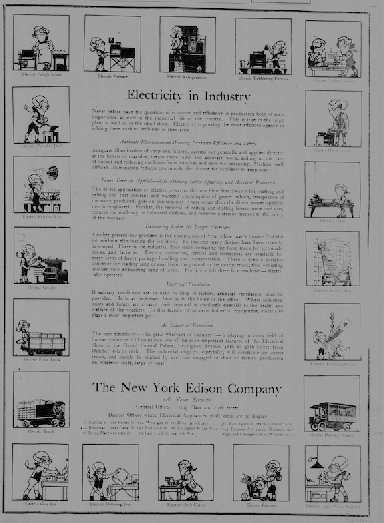
Yet, with the exception of some rural areas, electricity had become relatively commonplace by the 1940s. Just two decades earlier, however, electric companies began making concerted attempts to convince both businesses and individuals of electricity’s usefulness. Here’s an ad that ran in the October 5, 1920 issue of the “New York Tribune,” in which the New York Edison Company (now ConEdison) states its case:

“Never before have the questions of economy and efficiency in production been of such importance as now in the industrial life of the country. This is true in the large plant as all as in the small shop. Electricity is proving the most effective agency in solving these various problems as they arise.”

By 1900, 30 electricity companies existed in the New York City area. In 1920, New York Edison constructed a power generation facility that could generate up to 770,000 kilowatt-hours (kWh). Today New York City uses about 100,000 kWh per minute.

One unfortunate side invention? Utility bills!

3 Comments

Filed under Classics

One Is for You

430767_ruka_ladon_list_1680x1050_(www.GdeFon.ru)

All these lies you’ve thrown in my face? From the moment we first met, when you looked into my amber eyes and proclaimed your unrequited love for me, I now realize you’re nothing more ingenious than a charlatan. Stupid me, though! My battered soul stood open like an untreated gunshot wound; vulnerable to even the most inconspicuous of viral agents. Blind from years of isolation and self-pity, I relinquished the last vestiges of my trust and dignity to you.

Now, you do this to me? You turn on me like a rabid dog? I suppose you thought I could be yet another toy in your playroom. Telling me our age differences mattered not one bit to you; reassuring me that you could look beyond my sagging skin and gray hairs. Seduced by your gentle words, I felt I had no choice.
Oh, God, I just knew you were different from all the others who entered my life. You were so kind to me; your gentle words as sweet and irresistible as a flower’s nectar are to a bee. How did you know I floundered in such a fragile state? How could you tell my modesty was actually bitter self-loathing? I suppose that’s just one of your many attributes. You know how to find the vulnerable ones.

But, all of that stops now. You’ll never do that to me or anyone else ever again. Your games have ended. Oh, my God! What a beautiful sunrise! Look at it! Yes, turn your head and take a good, long look at it.

It’s the last one we’ll ever see together.

There are two bullets in this gun.

One is for you.

© 2014

2 Comments

Filed under Wolf Tales

Happy Cinco de Mayo 2014!

aztec eagle codex mendoza

“Oh, only for so short a while you have loaned us
to each other, because we take form in your act
of drawing us.
And we take life in your painting us,
And we breathe in your singing us.
But only for so short a while have you loaned us
to each other.”

– Aztec prayer

From “The Spirituality of Change” by Joyce Rupp.

Cinco de Mayo.

Image: The Aztec Eagle, from the “Codex Mendoza,” courtesy Colonial México.

2 Comments

Filed under News

My Time in a Locked Box

cubicles_15

Up until mid-March, I had a temporary position at a lock-box facility with a major financial institution. I won’t name the company or the staffing firm that found me the job, but I will emphasize that it was one of the worst places I’ve ever worked. I took the position as a filler job amidst my freelance writing gigs. In a way, I’m glad I did, though, because it gave me a clearer view of just how bad things are in the U.S. right now. If our elected officials could experience such drudgery, matters would change in no time.

A lock-box is an intermediary between a company and the bank that handles their accounts. You might notice a post office box listed as the mailing address on bills for telephone and water utilities. That box number simply steers the payments to a separate facility where they’re processed on behalf of the bank. It’s beneficial for the bank from a time efficiency standpoint. But, they’re also breeding grounds for fraud. The workers – many of them contract or temporary – handle countless personal checks and documents with sensitive information that can then be purloined or photocopied.

The place where I worked handles immigration applications on behalf of the U.S. Department of Homeland Security. My specific job was to analyze packets of applications and ensure they contained the proper documentation. Security procedures are tight. Every employee – even temporaries – must wear a slave tag, or what they call “badges.” The badge bears the individual’s picture; tiny image that make driver’s license photos look like glamour shots. The badges also have digital codes that would trigger doors to open. To enter the actual location where the documentation was handled, associates had to swipe their badges and then apply an index fingertip to a scanner beneath the electronic locks. For some reason, the lock always had trouble identifying my fingertip. No, I wasn’t using my middle finger – although seems more appropriate now. But, I’d often stand in front of that stupid lock pressing my finger down like a rogue political leader reaching for a nuke button.

The job was monotonous and dull. I get bored easily anyway, so it was difficult for me to stay interested. But, I noticed a number of things. Most of the associates were female and / or non-White. Yet, the bulk of the supervisors and managers were composed of the usual suspects: older White males. None of that really surprised me. Women, non-Whites, the disabled and immigrants now hold the bulk of temporary and part-time jobs in the U.S. These groups have always resided at the lower rungs of the American work force. But, the 2007 – 08 financial crisis intensified those numbers. But, gender and race only tell part of the story.

Between 2007 and 2009, the American labor force lost 8.4 million jobs, or 6.1% of all employment. Since then, most of the newly-created jobs have been temporary or contract. Last year the U.S. added 2.8 million temporary or contract employees to the national payroll. After the previous two recessions, American companies increased employment by adding temporary workers. In fact, an increase in temporary and contract work generally signifies overall economic improvement. But, this recession is something new; most of the good-paying jobs that delineated the American middle class have been replaced with low-wage positions. Temporary jobs aren’t a sign of better times ahead; they’re a sign of the new (pathetically, dismal) normal.

In early 1990, I had a temporary position at a lock-box facility in Dallas. Back then, as now, the bulk of the workforce was female and non-White, while most of the managers and supervisors were White males. My immediate supervisor, however, was a Panamanian-born woman who once made an employee remove 37 seconds from her time card because she said the latter had been late that much when returning from break. Her manager was an older White male who had a quirky Napoleonic complex, but whom I liked much better. He didn’t work well under pressure; something that made observing him the highlight of the day. But, that was almost a quarter-century ago. And, from a workforce standpoint, not much has changed.

When I told my parents the paltry pay rate I earned at this last job, they were shocked. It was the same amount my father had earned as a contract employee of a printing shop in the early 1990s. He had worked for the company for nearly 30 years before he got laid off in 1989; he was then, rehired as a contractor.

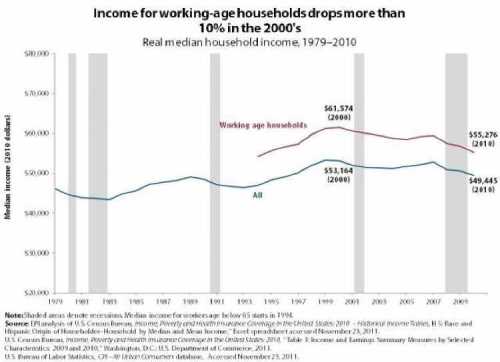
The issue of salaries and pay rates has been staring the slow economic recovery square in its ugly face. Mid-wage jobs – those averaging between $13 and $22 hourly –made up about 60% of the jobs lost during the recession. But, those same mid-wage jobs comprised about 27% of the jobs created since 2010. However, lower-paying jobs have dominated the job recovery – roughly 58%. Nearly 40%, or 1.7 million of the jobs gained during the recovery, are in three of the lowest-paying categories: food services, retail and employment services (e.g. office clerks, customer service representatives). All of this has not only decimated the American middle class, but has pushed the U.S. below Canada regarding middle class affluence.

stateofworkingamerica.org

Graph courtesy U.S. Bureau of Labor Statistics.

A few other things bothered me about the facility where I worked. Because of the number of documents that arrive on a daily basis, the amount of paper is overwhelming. Should a fire break out, I thought, it could be catastrophic – and mainly because of one simple device: cell phones. People aren’t allowed to bring cell phones into the main production area. The reason is obvious: most cell phones now have camera features, and it would be easy for someone to snap a picture of classified documents. Therefore, anyone who enters the production area has to leave their cell phone in their vehicle, in a designated locker in the same building, or with security. But, along with the odd juxtaposition of desks, I also noticed fire exits weren’t clearly marked. People would be safe in the building should a tornado descend upon the property. But, if a fire erupted, I’m certain many people would head towards their lockers to grab their cell phones. Such a scenario reminds me of the 1911 Triangle Shirtwaist Factory fire in which 146 people (mostly women and immigrants) perished.

I arrived home from work one Friday to find a voice mail message on my cell phone from the staffing agency, telling me to call them immediately. The lock-box firm had pulled the job from me. The unit manager had accused me of being consistently late. His idea of “late” apparently is one or two minutes past the hour. I pointed that out to the staffing agency; emphasizing, though, that I made up the one, two or three minutes I arrived late. Moreover, I said, I’d already attained a 100% accuracy rate on the job. None of that seemed to matter. The agency was in a bind; they couldn’t refute whatever chicken-shit opinion the manager had of me.

It’s no great personal loss. I won’t exactly be seeking therapy because of it. Some things just aren’t worth the trouble. As this May Day comes to a close, it’s important to remember that people usually work too damn hard for their money. As the wealth gap in the U.S. widens, I don’t know how much longer this, or any truly democratic society, can deem itself civilized.

Image courtesy Compare Business Products.

3 Comments

Filed under Essays

Happy May Day 2014!

mayday-green

“True individual freedom cannot exist without economic security and independence. People who are hungry and out of a job are the stuff of which dictatorships are made.”

Franklin D. Roosevelt


May Day.

Image courtesy Lucyria.

1 Comment

Filed under News

Happy Birthday Judy Collins!

CollinsJudy001

“It is true that I have had heartache and tragedy in my life. These are things none of us avoids. Suffering is the price of being alive.”

Judy Collins

“Amazing Grace”


“Both Sides Now”


“Send in the Clowns”


“Turn, Turn, Turn”

1 Comment

Filed under Birthdays

Happy Blueberry Pie Day 2014!

IMG_59151

Today is Blueberry Pie Day. Blueberries grow in many places around the globe. Native Americans called them “star berries” because of the 5-point blossom that grows at the end of each blueberry. According to legends among Lake Huron’s indigenous populations, a “Great Spirit” (who else?) sent the berries to feed children amidst a famine. Rich in antioxidants that benefit the central nervous system and can improve memory, blueberries are among the healthiest of fruits. They can also be frozen for long periods of time without any negative effects. There are few things worse than fruit with freezer burn.

So, it’s alright to indulge in some blueberry pie today. Remember, not only were children once saved by them, but blueberries can help you live a long, healthy life!

Blueberry_Bush-500x331

1 Comment

Filed under News

Happy Birthday Harper Lee!

1382129825000-AP-Harper-Lee-Museum

“Many receive advice; only the wise profit from it.”

Harper Lee

Born on this day in 1926 in Monroeville, Alabama, she is known for only two things: authoring “To Kill a Mockingbird” and being friends with fellow writer Truman Capote. Still, for (essentially) a one-hit wonder, she’s left an indelible mark on American literature.

1 Comment

Filed under Birthdays

God Save the Horses from the All-American Fat Ass!

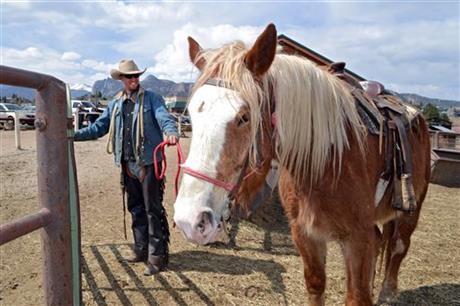
Joker, a Belgian draft horse, awaits a tour at Sombrero Ranches.  Please pray for him!

Joker, a Belgian draft horse, awaits a tour at Sombrero Ranches. Please pray for him!

First, plumbing companies started manufacturing toilets to support butt cheeks large enough to qualify as the mouths of orca whales. Then, ambulance firms began installing extra-wide stretchers for those extra-wide figures. There are even easy chairs with specially-designed hydraulic lifters to aid the large among us in getting back to an upright position.

Now, as if we haven’t done enough to accommodate the growing and relentless obesity epidemic in the United States, Sombrero Ranches, a conglomeration of horse-riding tour guide companies based in Colorado, is switching to sturdy draft horses to hold up those with extra pounds. In a twisted combination of animal safety and political correctness, want to make certain America’s biggest butts can enjoy the views of the treasured West from atop a horse, just the like the rest of us.

“Even though a person might be overweight, or, you know, heavier than the average American, it’s kind of nice we can provide a situation where they can ride with their family,” says Sombrero Ranches wrangler T. James “Doc” Humphrey.

Thanks, “Doc.”

Ranch operators note they’ve been adding draft horses to their ranks since the 1990s. But, the increased rate of obesity among both American adults and children has compelled various horse-riding entities to consider the welfare of their equestrian employees. Rockin’ HK Outfitters in Montana, for example, removed the 225-pound limit for riding guests last year.

“Little horses just aren’t sturdy enough to hold up in a dude operation in the Rocky Mountains,” Kipp Saile of Rockin’ HK said, noting that about 15 of their 60 horses are Percheron mixes. Their largest equine weighs 1,800 pounds.

Peggy Howell, a spokeswoman for the National Association to Advance Fat Acceptance, calls the ranch’s decision “wonderful,” adding that all businesses should become “size savvy.”

One drawback, though, is that larger horses cost more to maintain. Obviously, they eat and drink more, plus they require heavier doses of medication and larger horseshoes. It’s not surprising ranch owners would pass those costs off to consumers, including those of us who don’t cause the bathroom scale to scream, ‘Oh, Jesus Christ!’

I know some people have weight problems. But, obesity isn’t a weight problem. It’s more of a ‘can’t-wait-to-eat’ problem. If a person is so fat they could break the back of a 1,000-pound horse, then the problem isn’t with the horse; it’s with that lard-ass! Tour the Rocky Mountains on foot, instead, and lose some of those damn pounds. But, don’t torture a helpless animal just because you can’t keep your mouth away from the donuts!

4 Comments

Filed under Curiosities