Update: Ebola Hits Dallas

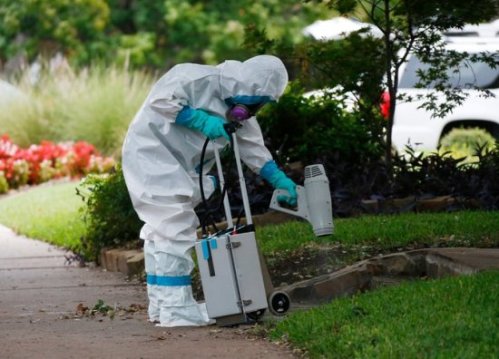
On October 5, a hazardous-materials crew cleaned outside the Dallas apartment building of a nurse who was infected with Ebola.

On October 5, a hazardous-materials crew cleaned outside the Dallas apartment building of a nurse who was infected with Ebola.

As some have feared and others predicted, the Ebola situation in Dallas has worsened. The man who became the first person diagnosed with Ebola in the United States was identified a couple of weeks ago as Thomas Eric Duncan, a 42-year-old Liberian native who arrived here on September 20. He died of the disease early on October 8. The facts surrounding Duncan’s case have changed almost as quickly as promises from the mouths of Texas politicians. But, then again, when the media hurries to publish a story, the truth almost always gets lost in the chaos.

Duncan had been accused of lying on a questionnaire he was given upon boarding a flight from Monrovia to Brussels on September 19; one that asks travelers if they’ve had recent contact with an Ebola patient or have recovered from the ailment. We learned almost as soon as news of Duncan’s dilemma became known that he had carried a pregnant 19-year-old woman to and from a taxi cab shortly before he departed Liberia. The woman died of Ebola not long after she’d been turned away from a local hospital because they were filled to capacity. Then, some of her other relatives got sick and died. By the time she passed away, Duncan was already in Dallas.

Now, news reports claim that neither Duncan nor any of the pregnant woman’s relatives were aware she had Ebola. Apparently, the latter didn’t realize it until after she died. Such is the case in Liberia and other developing nations of West Africa. The health care infrastructure is as pathetic as the road infrastructure. That’s why it doesn’t surprise me that the pregnant woman was turned away from a hospital.

“If he had known he had Ebola … he would not have put the love of his life in a situation like this,” family friend Saymendy Lloyd said of Duncan after he died.

But, officials at Texas Health Presbyterian Hospital of Dallas should have known better than anyone in a ramshackle hospital in Liberia. It’s bad enough that – when Duncan first arrived on September 25, complaining of fever and nausea – the hospital merely sent him home with a prescription for antibiotics. Now, we’ve learned he had a 103° temperature that night. I’m not a healthcare professional, but even I know someone with a 103° temperature needs to be hospitalized. Then, there’s the breakdown in information. The nurse who saw Duncan initially recorded his temperature in the hospital system. But somehow, that crucial bit of data got lost in the electronic shuffle. Hospital officials were quick to blame the software, which was designed and distributed by Epic, a Wisconsin-based firm that controls about 20% of the U.S. market in electronic hospital records. Another piece of lost information – Duncan revealed he’d recently traveled from Liberia.

Someone once told me that computers are only as smart as the people who operate them. No, I responded, they’re only as smart as the people who design them. Actually, it’s both. Presbyterian Dallas’ story keeps shifting, so hopefully they’ll settle on a final version before the book and TV-movie come out. Regardless, none of it leaves me with any sense of confidence in the U.S. health care system. The U.S. has spent more time and money building prisons and sports arenas than health care facilities. Our backward-thinking politicians have made sure oil companies got large tax breaks, while funding for education is always put up for a vote – and fails.

Yet, it’s gotten worse. A nurse who tended to Duncan while he was in isolation at Presbyterian has now tested positive for Ebola. The news just broke, so there aren’t too many details, except that she’s a 20-something native of Fort Worth. Supposedly, her apartment has already been cleaned out, although reports state her dog is still inside. Hopefully, the animal doesn’t suffer the same fate as the pet of a Spanish nurse last week. I mean, I’d rather sacrifice the entire Texas State Legislature instead.

And, the drama continues.

Leave a comment

Filed under News

Seattle Goes Native

Seal_of_Seattle

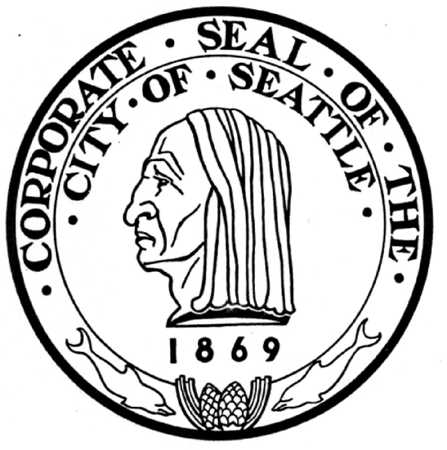
Seattle, Washington has become the latest city in the United States to rename Columbus Day “Indigenous Peoples Day.” On October 6, the Seattle City Council voted unanimously to celebrate the nation’s indigenous inhabitants instead of the Italian-born adventurer who didn’t know where he’d actually landed. Columbus Day has always been a point of contention for Native Americans. Saying that Christopher Columbus “discovered” America is akin to stating that Galileo “discovered” the moon. Many Americans of European extraction believe that Columbus technically opened the door for a new society. Most Indians feel it was the start of the world’s greatest and longest-lasting holocaust; the effects of which are still being felt today throughout the Western Hemisphere.

In 1992, celebrations for the 500th anniversary of Columbus’ voyage met with strong blowback from indigenous groups. A parade in Denver, for example, was canceled that year for fear that protests would turn violent. Some have, given the hostilities that exist; due, in no small part, to the racist ideologies of some White Americans, as well as the arrogance of some Italians. It’s odd because Columbus couldn’t get financial backing from his own people. In the 15th century, Italy was actually a collection of city-states that wouldn’t jell into a single nation until the 1860s. Even now, some people may refer to themselves as Sicilian, instead of Italian, which is like saying the sky is azure, not blue. Columbus turned to Spain and Queen Isabella I. He had wanted to find a western route to India to gain an advantage in the lucrative spice trade. It’s difficult to imagine now, but spices were as precious as gold and silver at the time.

I’ve always felt Native Americans should have their own holiday. I don’t see the point in revising Columbus Day; let the Italians have their holiday, if they want. All the renaming won’t change history. We simply can’t go back and make everything all better again. It’s happened, and we need to continue moving forward, while still acknowledging the past. We’re all part of the human race, so ethnic divisions serve no real purpose. Some day, I hope, everyone else will realize that.

3 Comments

Filed under News

Anatomically Correct and Socially Uptight

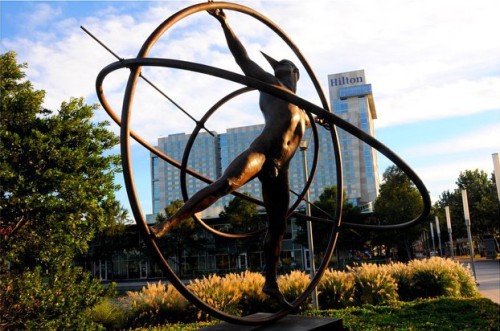
One of nine bronze sculptures by artist Jorge Marin in Houston.  Try not to look too hard.

One of nine bronze sculptures by artist Jorge Marin in Houston. Try not to look too hard.

In January of 2002, as the United States was still reeling from the calamity of the 9/11 terrorist attacks, then-U.S. Attorney General John Ashcroft became overwhelmed with a more pressing matter: two statutes of partially nude female figures in the Great Hall of the Department of Justice. Feeling undignified being photographed in front of them, he ordered one, “Spirit of Justice,” to be covered. At taxpayer expense, $8,000 worth of drapery shielded unsuspecting viewers from both of the art deco statues. These were the same statues that stood behind former U.S. Attorney General Edwin Meese in 1986, when he announced findings of a Department of Justice study on pornography.

In recent decades, social conservatives have associated nudity and human sexuality with pornography. The dysfunctional comparison has arisen again in Houston where Mexican artist Jorge Marin has – well – erected nine bronze sculptures of anatomically correct male forms in a park. Collectively entitled “Wings of the City,” the figures have taken up residence in the city’s downtown area. Houston is just the latest major metropolitan area to see Marin’s artwork; he’s exhibited his statutes over 200 times. They stood on México City’s heavily-traveled Paseo de la Reforma where millions of people viewed them.

But, to the easily-offended souls of America’s fourth largest city, the statutes don’t qualify as art; they’re pornography. Get real!

“It’s very inappropriate, seeing that they have a lot of kids here,” resident Trena Cole told the “Houston Chronicle” recently.

“I don’t know that it enhances the park,” another resident, Julie Griffis, who lives nearby, also told the Chronicle. “I don’t think it fits in with the theme.”

Other residents, such as Jim Thomas, don’t see any problem with the statues. “We see them as art,” he told the Chronicle, mentioning one of the most famous anatomically-correct nude male figures of all time: Michelangelo’s “David.”

College student Alan Lima pointed out, “It’s part of the body. What can you do? That’s the way you were born.”

Exactly! That’s how we’re born. There seems to be a growing sense of animosity towards the male physique in recent years. It’s gotten to the point where I often see young men wearing two and three shirts during winter and long pants during summer, while their overweight wives and girlfriends parade around in mini-shorts that make me want to call Green Peace about beached whales. Professional basketball players wear shorts so long and baggy they qualify as split skirts. I’ve heard stories of school boys who won’t shower in the locker rooms after physical education classes because someone might think they’re queer.

If the fools who think the statues are “pornography” could get proctologists to help find their brains, they might want to hop over to Houston’s rougher sides where people are dropping dead from drug use and gun violence. Visit a homeless shelter where children often stay and tell me again you think a nude male sculpture is “pornography.”

There’s nothing pornographic or offensive about the male body. I have plenty of pictures of my body. Videos, too! Oh, wait…that’s a different subject. Anyway, check out Marin’s work and try not to get too upset.

4 Comments

Filed under Art Working

Where Are They Now?

images

A couple of weeks ago I watched the latest documentary series by Ken Burns, “The Roosevelts: An Intimate History.” It focuses on the three most famous members of this legendary family: Theodore, Franklin and Eleanor. They are also three of the most fascinating individuals of the 20th century, and this series only solidifies, in my mind, a deep longing for similar people in public life today. The Roosevelts were much like the Kennedy family of Massachusetts. They were ambitious, assertive, intellectual and strong-willed. Their progressive ideals and bold honesty shoved the United States onto a (sometimes unwilling) forward track. Yes, they were wealthy and traveled in elitist circles. But, for the most part, they had overwhelming respect for their fellow citizens. They were committed to public service, not politics. And, as the United States stumbles from one crisis to the next in this strange, new world of the 21st century, I have to ask where are people like the Roosevelts and the Kennedys now?

The U.S. never has had a royal family. Our official founders technically escaped European feudalism because of the vice grips that small bands of inbred groups had on their ancestral homelands. But, I’d have to say the Roosevelts and the Kennedys come close to American royalty. The Roosevelts produced two extraordinary presidencies, and the Kennedys produced one; albeit a tragically short one. Yet, both families charted progressive courses for the U.S. that ultimately gave freedom to so many of their contemporaries and challenged future generations to keep America as a beacon of democracy.

I’ve always viewed Theodore Roosevelt as a personal hero. It’s odd, considering he had been a sickly child burdened with asthma. As an adult, he suffered from depression. Yet, he grabbed life by the throat and rung every ounce of energy from it. He was a ball of lightning; unafraid to take on the notorious bosses of Tammany Hall and the ruthless titans of industry. A nature lover, he established the national park system.

His fifth cousin, Franklin, and the latter’s wife, Eleanor, helped move the nation closer to racial equality than anyone had before. Franklin broke from family tradition when he accepted a post as Assistant Secretary of the Navy in 1913 in the administration of Woodrow Wilson. He ran for the vice-presidency as a Democrat in 1920. After losing that race, he returned to a simpler life, enjoying his family and earning a living as lawyer. But, in the summer of 1921, while vacationing in New Brunswick, Franklin experienced a life-altering event: he contracted polio; then called infantile paralysis, a frightening and debilitating scourge (usually afflicting children) with no cure or vaccine. Franklin never regained use of his legs and could only stand or walk with the help of someone or something. He persevered, however, and became determined to heal himself as best as possible with lengthy stays at a resort he eventually purchased in Warm Springs, Georgia. There he could languish in a pool for hours, which eased the agony of twisted muscles and constricted joints.

But, Franklin also remained committed to life as a public servant. In 1928, he ran for and won the governorship of New York state. Four years later he successfully ran for president. He ran three more times, holding the office for an unprecedented 12 years.

Like his familial predecessor, Franklin Roosevelt wasn’t afraid to make bold decisions and launch big projects. Whereas Theodore took on various industries, such as oil and timber; compelled the U.S. Congress to mandate safe working conditions; and commence the national parks system, Franklin forced the federal government to take control of the slew of banks still faltering during the Great Depression; created the Civilian Conservation Corps; and introduced Social Security. Franklin’s predecessor, Herbert Hoover, and Hoover’s Treasury secretary, Andrew Mellon, boasted typically conservative attitudes about business and the economy: government had no real role in managing corporations; if a company – or even a bank – got itself into financial trouble, it was incumbent upon that entity to get itself out of trouble. Franklin knew that was true, but he also understood the true scope of the economic calamity afflicting the nation in the early 1930s. People were losing their jobs, their money and sometimes their lives, as banks folded. The crisis was gigantic in scope, and the hands-off approach of the Hoover Administration only exacerbated matters. Roosevelt created the Federal Deposit Insurance Corporation (FDIC) during his first year in office; an entity that would safeguard consumer bank assets and – slowly – reinstill trust in the nation’s financial institutions.

After the U.S. became embroiled in World War II, Franklin’s health began to deteriorate. He hardly campaigned in 1944. But, he didn’t give up. He was determined to lead the nation out of the war. Sadly, he didn’t see the day when America’s enemies surrendered, yet he maintained a high degree of spiritual vigor. He didn’t stop until his body forced him to do so.

Eleanor Roosevelt triumphed as well on many levels, but not really until after Franklin died. Like most of her female contemporaries, Eleanor had few choices in life. She had to be someone’s wife or someone’s mother, but she could never be her own person. A niece to Theodore and a distant cousin to Franklin, she felt uncomfortable in the role of First Lady. But, once she realized how desperately poor much of the nation’s citizens were because of the Great Depression, she pushed her husband to enact the strident and controversial legislation for which he’d become famous; not being given even a smattering of credit for it, of course, until decades later. Almost accidentally, she also became a torch bearer for the burgeoning civil rights movement; knowing that all Americans – regardless of gender, race or ethnicity – deserved to be treated equally. Not long after Franklin’s death, Eleanor prodded his successor, Harry S. Truman, to proceed with establishment of the United Nations and, later, battled for the “The Universal Declaration of Human Rights.” Her tireless efforts towards gender and racial equality made her an enemy of the staid social right-wing (even to the point of receiving death threats), but they helped her carve out her own legacy in the gallery of extraordinary Americans. “No one can make you feel inferior about yourself,” she declared in her book “This Is My Story,” published in 1939.

John F. Kennedy is another personal hero of mine, but not because he was the nation’s 35th president, or an heir to a prominent and wealthy Irish Catholic family. Like his older brother, Joseph, Jr., John Kennedy joined the military during World War II. Joseph was killed in action in August of 1944, and John nearly lost his own life in the South Pacific a year earlier. John had joined the U.S. Navy shortly after graduating from Harvard University in 1940. While commanding a torpedo boat, a Japanese warship rammed the small vessel. Despite severe injuries, Kennedy led other surviving crew members to a nearby island. His back never fully healed, and he suffered with the pain for the remainder of his life.

Before his stint in the Navy, however, John Kennedy attained a modest level of intellectual notoriety. In 1939, his father was appointed U.S. Ambassador to Great Britain. During a visit to England that same year, the younger Kennedy researched why the nation was unprepared to fight Germany at the onset of WWII. It became his senior-year thesis; a detailed analysis so well-received that it was published as “Why England Slept.” Kennedy launched the space race by challenging the U.S. to “land a man on the moon” before the 1960s ended – which we did.

Other giants of the 20th century shouldn’t go unnoticed: Wilson and Truman, of course, but also Dwight D. Eisenhower and Lyndon B. Johnson. Wilson was reluctant to jump into World War I (then called “The Great War”) and envisioned the U.N., which he called “The League of Nations,” a multi-national entity that forced the United States onto the world stage. Truman integrated the U.S. armed forces. Eisenhower jumpstarted the interstate highway system. Johnson signed into law some of the most important pieces of legislation of the modern age.

They were not without their faults. Theodore Roosevelt was essentially a racist in that he believed Caucasians were biologically superior. But, one has to consider that he was a product of his time, so I think he can be forgiven for that. A lot of otherwise good people felt that way back then. Franklin Roosevelt, John F. Kennedy and Lyndon Johnson were adulterers. Johnson may have been a modernist in regards to civil rights, but he also led the U.S. into the quagmire of Vietnam.

The closest the U.S. has to a political dynasty is the Bush family, which isn’t saying much. The Bush clan has produced two of the most dismal presidencies within a quarter century. Therefore, I lament the fact I can’t point to many notable political leaders right now. I placed a great deal of faith Barack Obama, when he first ran for office. Now, I’m disappointed in him. I know it’s not completely his fault. He’s dealing with an arrogantly recalcitrant Congress; a hodgepodge of right-wing extremists who are more concerned with banning gay marriage and instituting creationism into America’s educational curriculum than more critical tasks, such as punishing those responsible for the 2008 economic collapse and rebuilding our crumbling infrastructure. I’m certainly disappointed in U.S. Attorney General Eric Holder who just announced his resignation. Our elected officials are wrapped up in petty battles with one another.

There seem to be no big dreamers anymore – and I don’t know why.

3 Comments

Filed under Essays

Ebola Hits Dallas

The Ebola virus.

The Ebola virus.

Okay, I’m being a bit dramatic. But, officials with the Centers for Disease Control and Prevention have confirmed, along with Texas Health Presbyterian Hospital of Dallas, that an unidentified man has tested positive for the Ebola virus. This is the first time that someone in the United States has been diagnosed with the deadly hemorrhagic fever. Since March of this year, Ebola has wreaked havoc across Western Africa; killing nearly 3,100 people and sickening thousands more. Before now, outbreaks had been limited to rural areas in Central Africa. This epidemic has been the deadliest and most widespread since medical aid workers accidentally discovered and identified it in September of 1976. With roughly a 90% fatality rate, Ebola quickly supplanted smallpox as the most lethal pathogen known to humanity. The current epidemic, however, has had a fatality rate of about 60%.

And, I just knew it would be a matter of time before it would reach a major metropolitan area outside of Africa’s largest cities. I’m actually surprised it hasn’t occurred sooner. I recently told a friend it was never if, but when it would hit. I even added that, with our luck, it would pop up right here in my home city of Dallas, Texas. Sometimes, I just think too damn much.

Confidentiality laws in the U.S. prevent the man’s identity from being released, but officials at first said he traveled directly from Liberia – the hardest hit of the countries in the Ebola outbreak – to Dallas on September 19 to visit relatives who live here. Now, we know that he traveled from Liberia to Brussels on the 19th, and, the next day, from Brussels to Washington, D.C., and then on to Dallas. He began getting sick with fever a few days later and sought medical treatment at Dallas Presbyterian on the 24th. Doctors there just thought he had a bad fever and sent him away with some antibiotics. The biggest health threats, as far as local officials are concerned, have been West Nile virus, HIV and bad driving. The man’s condition worsened, and he returned to the same hospital via ambulance on September 28 where he was immediately placed into isolation. But, here’s an interesting fact: a nurse who tended to him the first time asked the man if he’d been to West Africa, and he purportedly said yes. The nurse is believed to have recorded that information, but the doctors either didn’t catch that (no pun intended) or ignored it.

Now, the CDCP is trying to backtrack and find everyone who’s been in contact with the patient. Earlier today Texas Governor Rick Perry and Dallas Mayor Mike Rawlings took part in a press conference at the hospital where they and the facility’s officials emphasized that they have the matter under control; adding that everyone must remain calm. It’s important to note that Ebola is a blood-born pathogen and – while highly infectious – isn’t contagious. You have to come in contact with an infected individual’s bodily fluids to risk exposure.

I understand that. But, who’s to say hospital workers who first treated the man weren’t lax in cleaning up after him? Among the people he came in contact with are 5 children who attend four different schools in Dallas. Knowing the poor sanitary habits of children (and plenty of adults), it’s possible they could bleed, vomit and / or be careless about cuts and scrapes without realizing the severity of their actions. Anything is possible when dealing with people.

I’m not one to panic, but I am somewhat of a health freak. I’m always washing my hands. I take showers more than once a day. Even my dog is cleaner than most people. Technically, the U.S. has far more resources to combat any deadly epidemic, including media and community outreach avenues. But, I don’t have much confidence in the CDC’s ability to handle this Ebola situation. I certainly don’t have any confidence in the city of Dallas’s ability to do the same. Another troubling fact – a friend of the man contacted the CDCP to inform them about him. In other words, the CDCP didn’t learn of the individual’s possible Ebola infection from Dallas Presbyterian.

I only have to look back at the U.S. government’s response to AIDS, when it was identified in 1981. Because the first victims were gay men, drug users and prostitutes, the government didn’t take it seriously. They reacted with moral condemnations. And, any time people make medical decisions based on religious ideology, people die. If the government had taken AIDS seriously from the start, there might at least be a vaccine by now. Conversely, the U.S. government did respond quickly to swine flu and Legionnaires’ disease; both of which came to prominence in the fall of 1976. They even jumped into action during the 1982 Tylenol poisoning cases, despite that being an isolated incident.

In August, health officials in Liberia and Guinea quarantined entire neighborhoods in a futile effort to stem the Ebola outbreak. If other people in Dallas start getting sick with Ebola, I’d like to see authorities institute a lockdown in a city of roughly 4 million people, which is dissected by major highways and where most everyone has a vehicle. We’ll just have to wait and see what happens.

In the meantime, I’ll try to predict something more positive happening – like a mass die-off of politicians and rap singers.

Top 10 Deadliest Known Viruses.

2 Comments

Filed under News

Happy Birthday Jimmy Carter!

bigcar

“What are the things that you can’t see that are important? I would say justice, truth, humility, service, compassion, love. You can’t see any of those, but they’re the guiding lights of a life.”

– President Jimmy Carter


Habitat for Humanity International.

Leave a comment

Filed under Birthdays

A Jewel of Black Film History Appears

Bert Williams courts Odessa Warren Grey in this untitled 1913 film.

Bert Williams courts Odessa Warren Grey in this untitled 1913 film.

If anyone involved with film in its earliest days realized how important their work would become, they probably would’ve taken greater care to preserve the medium for future generations. But, at the time, few seemed to believe cinema would last beyond its initial novelty. So, when a silent film surfaces, it’s cause for celebration. Such is the case with the recent discovery of an untitled, unreleased film from 1913.

Comprised into 7 reels, the movie is unique for two reasons:

  • it’s an early concerted attempt at a feature-length project;
  • it stars a mostly-Black cast.

At the start of the 20th century, film was still expensive, and movie studios – really just a gathering of adventurous artists – put out “shorts” that would often last only a few minutes. In this particular film, refurbished by New York’s Museum of Modern Art, we see a rare depiction of a Black middle class. It features Bert Williams, the first Black star on Broadway, and already a veteran of music and stage. Williams competes with other men for the affections of a young woman played by Odessa Warren Grey. The film had three directors; one of whom was Black. With titles, it would have run for about 35 minutes. The movie was made in the midst of the Harlem Renaissance, an extraordinary period beginning in the 1890s when a variety of Black artists – writers, singers, dancers – expounded upon their creative intellects and showed the world that they and all Blacks were human, too.

The film is part of a collection of 900 unprinted negatives produced by the now-defunct Biograph Company of New York. In 1939, Iris Barry, MOMA’s founding film curator, acquired the cache in 1939. In 1976, a MOMA film curator began copying the film and realized its historical significance when he spotted Williams amidst the characters. But, not until 2004, did the museum begin both restoring the film and searching for its origins. The research team showed the material to film historians; looked through a number of old movie trade papers; and even hired a lip reader to extract potential clues from the movie scenes themselves.

Their efforts have paid off. Now, we know the names of just about everyone appearing in the film, as well as its producers. It’s been fully restored and is scheduled for a premier showing this October 24.

A strange fact is glaringly obvious: Williams, of all people, appears in black-face; the antiquitous cosmetic concoction often used by White performers on stage and in film at the time to portray Black characters. Why Williams did that is unknown. It may have been a mockery of the technique itself, or perhaps an attempt to make him more appealing to White audiences. Regardless, this is an important historical find and it should be treasured for the cinematic gem that it is.

1 Comment

Filed under Classics

Devon and Leah Sari Still: A True Father – Daughter Team of Hope

WCPO Devon Still and daughter Leah_1401905649321_5942107_ver1.0_640_480

With all the bad news surrounding professional athletes these days – as if there ever is any other kind of news surrounding professional athletes – I think it’s important to focus on Devon Still, a defensive tackle for the Cincinnati Bengals. This past June Still learned his daughter, Leah Sari, has Stage 4 neuroblastoma, a rare pediatric cancer, in her abdomen. The Bengals granted Still a leave of absence from team activities to tend to her. They cut him from the team earlier this month, however, but then, resigned him to the practice squad, which means he retains a paycheck and his health insurance. In order to raise awareness about pediatric cancer, Still coordinated a fund raising drive in which donations will be made on the number of sacks the Bengals make this season.

On September 8, the team announced it will donate all proceeds from the sales of Still’s jerseys to pediatric cancer research. Three days later they signed Still to their 53-man roster, since they had a spot available. As of now, they’ve raised in excess of $400,000. More importantly, Leah Sari has responded positively to an intense round of chemotherapy at Cincinnati Children’s Hospital and has a major surgical procedure looming ahead. But, it’s great news.

image002

It’s just as good that there’s a father who places so much emphasis on the health of his child than he does on his career. But then again, that’s what the overwhelming majority of fathers do anyway, including those in professional sports. It’s sad, though, the media doesn’t place the same degree of attention on Still as it does the miscreants they claim populate professional athletics.

Thanks to fellow blogger Jueseppi Baker for highlighting this story.

4 Comments

Filed under News

Banned Books Weeks 2014

ABFFE

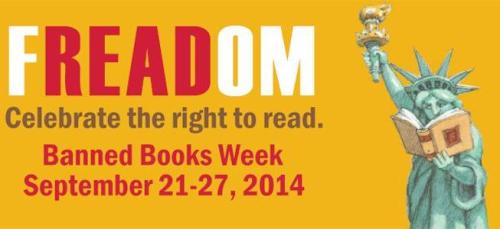
I should have mentioned this earlier, but it’s “Banned Books Week” in the United States – a time set aside every year to acknowledge the sanctimonious morons who have decided they are the ones who can choose what the rest of us can read and see. It’s the usual assault on free speech and freedom of expression moralists have been waging for centuries; a battle we writers and bloggers understand will never really be won. This is an annual event the American Library Association hosts every year. I personally feel it should be a year-long event and not relegated to a single week. The ALA maintains a list of frequently challenged books, but this year’s list features books that include the usual transgressions: sex, homosex, nudity and other various and miscellaneous adult-oriented themes that some think should be shielded from the eyes of America’s overweight, technologically-savvy youth.

Below is just a partial list of this year’s offensive tomes. For the complete list, check out the ALA web site.

Sherman Alexie, The Absolutely True Diary of a Part-time Indian, Thorndike Press; Little, Brown.
Removed as required reading in a Queens, NY Middle School because the book included excerpts on masturbation. Challenged on the tenth-grade required reading list at Skyview High School in Billings, MT because “[t]his book is, shockingly, written by a Native American who reinforces all the negative stereotypes of his people and does it from the crude, obscene, and unfiltered viewpoint of a ninth-grader growing up on the reservation. Pulled from Jefferson County, WV schools because a parent complained about the novels graphic nature. Challenged in a Sweet Home, Oregon, Junior High English class because of concerns about its content, particularly what some parents see as the objectification of women and young girls, and the way alternative lessons were developed and presented.

Isabel Allende, The House of the Spirits, Dial Press.
Challenged in the Watauga County, NC High School curriculum because of the book’s graphic nature. After a five-month process, the book was fully retained at a third and final appeal hearing.

Margaret Atwood, The Handmaid’s Tale, McClelland and Stewart.
Challenged, but retained as required reading for a Page High School International Baccalaureate class and as optional reading for Advanced Placement reading courses at Grimsley High school in Guilford County, North Carolina, because the book was “sexually explicit, violently graphic and morally corrupt.” Some parents thought the book is “detrimental to Christian values.”

Akram Aylisli, Stone Dreams, Novella published in Druzhba Narodov.
Burned in 2013 at various locations around Azerbaijan. The novella is sympathetic to Armenians and recounts Azeri atrocities in the war between Azerbaijan and Armenia twenty years ago. Azerbaijani President Ilham Aliyev stripped the author of his title of “People’s Writer,” and a pro-government political party announced it would pay $12,700 to anyone who cuts off the ear of the 75-year-old novelist for portraying Azerbaijanis as savages.

Elisabeth Gaynor Ellis and Anthony Esler, World History, Prentice-Hall.
Challenged, but retained in the Volusia County, Florida, high schools, despite a thirty two-page chapter on “Muslim Civilizations” that covers the rise of Islam and the building of a Muslim empire. Protestors believe the Volusia high schools are using the world history textbook to “indoctrinate” students into the Islamic religion and recommend student volunteers tear the chapter out of the 1,000-page book.

Anne Frank, Anne Frank: The Diary of a Young Girl, Doubleday.
Challenged, but retained in the Northville, Michigan, middle schools despite anatomical descriptions in the book.

Neil Gaiman, Neverwhere, HarperCollins.
Temporarily removed from the Alamogordo, New Mexico High School library and curriculum because of what one parents calls “inappropriate content.” The British author wrote in “The Guardian”: “Well-meaning adults can easily destroy a child’s love of reading. Stop them reading what they enjoy or give them worthy-but-dull books that you like – the twenty-first-century equivalents of Victorian ‘improving’ literature – you’ll wind up with a generation convinced that reading is uncool and, worse, unpleasant.”

Toni Morrison, The Bluest Eye, Knopf, Vintage International.
Challenged in Legacy High School’s Advanced Placement English classes in Adams County, Colorado, because it was a “bad book.” Challenge on a suggested reading list for Columbus, Ohio, high school students by the school board president because it is inappropriate for the school board to “even be associated with it.” A fellow board member described the book as having “an underlying socialist-communist agenda.”

Norani Othman, ed., Muslim Women and the Challenges of Islamic Extremism, Sisters in Islam.
Banned by the Malaysian Ministry of Home Affairs in 2008 on the ground that it was “prejudicial to public order” and that it could confuse Muslims, particularly Muslim women. The Malaysian High Court overturned the ban on January 25, 2010, and on March 14, 2013, the Federal Court threw out the government’s appeal to reinstate the ban.

Marjane Satrapi, Persepolis: The Story of a Childhood, Pantheon Books.
Removed, via a district directive, from all Chicago, Illinois, public schools due to “graphic illustrations and language” and concerns about “student readiness.” After students fought back via Facebook, twitter, protests and radio and television programs, the school board issued a letter telling high school principals to disregard the earlier order to pull the book.

4 Comments

Filed under News

Set Up

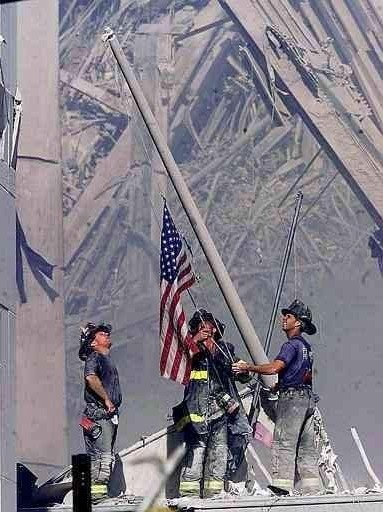
09-11-01_raising_the_flag

“They’ve bombed the World Trade Center in New York,” my mother said.

“Who?” I asked.

“I don’t know. We just heard about it.”

It was a few minutes before 9 A.M. on Tuesday, September 11, 2001, and her phone call had awoken me from a sound sleep. I had lost my job at the bank almost five months earlier and had taken to sleeping late throughout that summer. I had my alarm clock set for 11 A.M. My father had an appointment with his eye doctor at 1 P.M. Exactly one week earlier one of the doctor’s colleagues had implanted some radiation pellets into his left eye; another attempt to destroy a small tumor that had formed behind the eyeball. The doctor had made his first effort to eliminate it nearly seven months earlier by cauterizing the blood vessels around the tumor. But, it had regenerated. The pellets could only remain in his eye for a maximum of seven days.

After my mother had called me, I really couldn’t go back to sleep and finally got up around 10:00. Turning on the TV, I couldn’t believe what I was seeing: the South Tower of the World Trade Center collapsing. It had just occurred, and I was watching a replay. “What the hell happened?” I kept asking myself.

I thought back to Memorial Day weekend, when I visited New York with a close friend, Phillip*, who had lived there for five years. He had attended New York University, beginning in 1991, and after graduating, decided to stay and try to build a long-desired career in the film industry. When that didn’t go as planned, he returned to Dallas. Yet, Phillip kept his tiny one-bedroom apartment in the heart of Greenwich Village; subletting it college students. He hoped to move back there one day.

I had first visited New York with Phillip over Memorial Day weekend 1997. We stayed with some friends of his who lived across the Hudson in New Jersey. I had no desire to patronize the World Trade Center back then. Seeing the Statue of Liberty from a boat was enjoyable enough, but a cluster of office buildings wasn’t exactly akin to viewing the remains of Tenochtitlán.

But, before our 2001 visit, I told Phillip I’d visit the World Trade Center complex – just to say I’d been there. Then, as we made our way to Manhattan’s financial district, I stopped. Literally. In mid-stride.

“What’s wrong?” Phillip asked me.

I was silent for a moment. “Nothing,” I finally said. I don’t know what it was, but I had suddenly developed a sickening feeling as I looked at those two gargantuan structures just a few blocks away. I don’t remember exactly what I said afterwards, but I shifted my focus to an Indian restaurant Phillip had wanted me to try out. My appetite had evaporated, yet we made our way back up to the Greenwich Village area. I grew hungry, though, by the time we reached the restaurant. I couldn’t explain to Phillip why I’d abruptly changed my mind about the World Trade Center. I couldn’t explain it to myself.

As I sat alongside my father in the waiting room, we stared at the TV monitor snuggled high up into a corner. An older couple sat opposite us, and, of course, we all wondered aloud who had wreaked such havoc on us and why. None of us actually cared why. We just wanted retribution.

But, thirteen years on, I know why Al-Qaeda attacked the U.S. in so brutal a manner. It’s not like they all woke up one morning and decided to highjack those planes because they had nothing else better to do with their time and money.


Forgetting Afghanistan.

On December 27, 1979, the Soviet Union unexpectedly invaded Afghanistan. Back then, the average American probably couldn’t locate the landlocked nation on a map. It was the U.S.S.R.’s last concerted effort at a land grab. At the time, however, the United States was preoccupied with the Iran hostage crisis. Before then, most Americans probably couldn’t find Iran on a map either. In retrospect, though, the quandary was the U.S.’s first battle with radical Islam. President Jimmy Carter appeared thoroughly inept in his handling of it; a fact that cost him the 1980 presidential election. Ronald Reagan rode into the White House with a promise to help the mujahideen fighters drive out the Soviets. The Cold War was still very active; the U.S. and the U.S.S.R. locked in a never-ending battle of hearts and minds. In March of 1985, Reagan signed National Security Decision Directive 166, which allowed for much-needed financial and military support to the Afghan warriors. Within two years, the U.S. was shipping up to 65,000 tons of arm supplies and covertly spiriting a bevy of military operatives and specialists into Afghanistan via Pakistan. When the Soviets finally left Afghanistan in 1989, the Afghan people expected the U.S. to live up to its Reagan-born vow. We were supposed to stay and help the impoverished country move from its medieval environment into the 20th century. We never did. President George H.W. Bush simply didn’t see it as a priority. Neither did Bill Clinton. People don’t forget something like that.

Blindly supporting Israel.

The U.S. and Israel have one major thing in common: both were founded by White Europeans fleeing religious persecution who ended up displacing the indigenous peoples through violence and intimidation. As of 2013, the U.S. has been providing roughly $3.1 billion annually to support its only true ally in the Middle East. This small nation of 7.1 million was formally established in 1948 and now has the highest standard of living of any country in the region with a 95% literacy rate and an average life expectancy of 79. It’s not that its neighbors are bitterly envious of Israel’s global success. The harassment of non-Jews by Israeli police and government has always bordered on the criminal. But, any criticism of Israel’s actions is met with a harsh rebuke by its supporters. President Barack Obama is repeatedly accused of abandoning Israel; a declaration born more out of political partisanship and racism than fact. Yet, Israeli Prime Minister Benjamin Netanyahu has received scant criticism about his refusal to acknowledge a “Palestinian state,” or a “two-state solution.” The ongoing battle between Jews and Palestinians is a little like the English-French divide in Canada, but more pointless. Israel’s assault upon Lebanon in 2006 was met with silence, even as news of atrocities at the hands of the Israeli military seeped out, along with images of civilians fleeing to the island nation of Cyprus. The U.S. also remains mum on Israel’s constant push into the West Bank; forcing out entire families and destroying Palestinian property. Other democratic nations always seem to look away.


The United States should have seen 09/11 coming. There were plenty of signs: the 1993 bombing of the World Trade Center; the 1996 assault on the Khobar Towers in Saudi Arabia; the 1998 bombings of the U.S. embassies in Kenya and Tanzania; and the attack on the U.S.S. Cole in October of 2000. There’s also plenty of blame to go around. On September 12, 2001, people kept asking how something so horrifically grand could happen. Didn’t anyone suspect that planes could be used as missiles? Didn’t anyone believe it was imprudent to overlook the expired visas of foreign nationals? Didn’t someone think box cutters and pocket knives could be so deadly? Didn’t somebody alert authorities to the curious behavior of Middle Eastern men at flight schools? Well, yes to all of the above. Various people at various times had already expressed concern about those things. And, it goes far beyond just the infamous “August 6, 2001 Presidential Daily Briefing.”

There’s nothing that can take back the horror of that late summer day more than a decade ago. People launching themselves from the top floors of the World Trade Center towers is one of the most blood-curdling things I’ve ever seen. We’ll never just get over it. And, while I’m no security expert, I know the U.S. should never set itself up for catastrophe through an imaginary veil of isolation.

09/11 Memorial.

*Name changed.

2 Comments

Filed under Essays