Tag Archives: Iran

Words

Several years ago actress turned animal rights activist Brigitte Bardot found herself in legal trouble with French authorities.  The former screen siren openly condemned the Islamic practice of animal slaughter during the Aid al-Kabir holiday. She’d been in such a predicament before – several times.  French law doesn’t actually forbid disparaging religious ideology, but it looks down sharply upon it, as it can be considered slander or worse, a conduit to hate-obsessed violence.

It’s surprising, considering France fought hard against Nazi occupation during World War II.  One tenet of Nazism is that anyone who speaks out against the government is deemed a traitor.  But, short of slander or threats of violence, criticism of governing bodies and religion is free speech.  Imprisoning anyone, or even threatening to levy a monetary penalty for such views, runs counter to that.

All of it strikes hard for me – and other writers and artists – here in the U.S., as we witness ongoing assaults on various forms of free speech.  Book bans remain a primary source of concern.  And with Republicans in charge of the White House and both houses of Congress, the attacks continue.  Social extremists have always been opposed to any viewpoint that doesn’t conform to their standards – whether it’s coming from the left or the right.  The voices of moderates seem to get lost in the chaos.

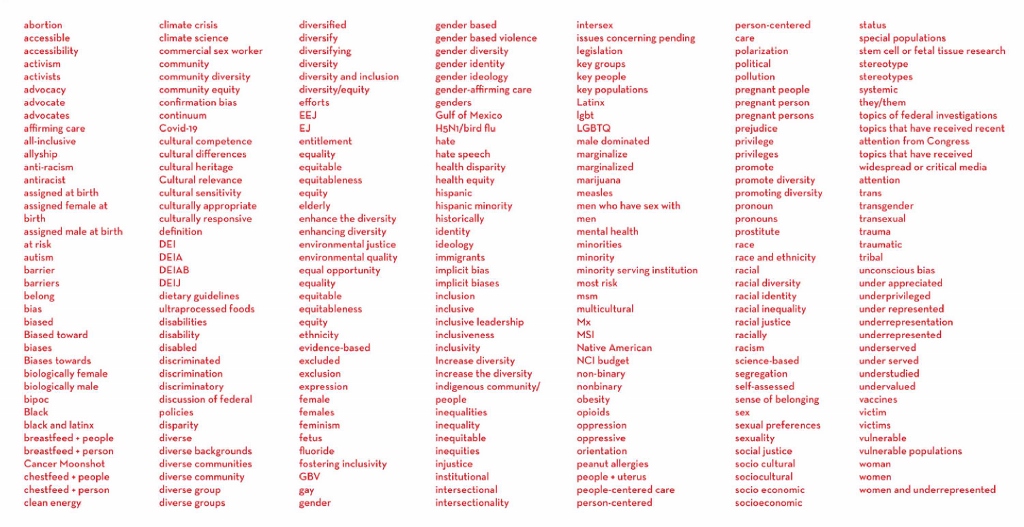
Recently the U.S. government – under pressure from the Trump administration – compiled and presented a list of words that are forbidden on federal web sites and other documentation.  They include such terms as “biologically male”, “clean energy”, “inequality”, and “woman”.  This is real!  I have a tendency towards creating outrageous stories, but I’m not intoxicated or deranged.  Well…not yet.

Regardless, the list definitely isn’t a manifestation of liberal outrage at the most right-wing president in decades.  It’s a result of years of conservative ideology designed to put people and institutions in categories and re-enshrine bigotry and hatred into the American conscience.  The leftward shift in culture and politics in the U.S. beginning in the late 1950s eventually met the hostility of Reaganesque antipathy towards anything viewed as different or the other.  The Trump era is the culmination of it all.

Those in formerly marginalized groups who also voted for Trump and his ilk shouldn’t be surprised – but they are.  For example, Cuban-Americans voted overwhelmingly for Trump, as they often have for the Republican Party.  As Cuba has been under communist rule since 1959, those fleeing the country have been given special protection from American law.  The same luxury hasn’t been granted to people fleeing war and violence in other Latin American nations, such as El Salvador and Guatemala.  However, the Trump Administration’s efforts to reform immigration law have started to impact thousands of Cuban immigrants.  Now, Cuban-Americans have the audacity to be horrified at the betrayal.  Remember the adage: be careful what you wish for; you might just get it.

We also need to recall the words of Martin Niemöller:

“First they came for the socialists, and I did not speak out – because I was not a socialist. Then they came for the trade unionists, and I did not speak out – because I was not a trade unionist. Then they came for the Jews, and I did not speak out – because I was not a Jew. Then they came for me – and there was no one left to speak for me.”

Trump and his cronies appear to be going after anyone who doesn’t fit the narrow definition of who he is.  His hypocrisy is glaring.  He never outwardly espoused any religious fervor until he first ran for president, but now says Christian ideology should be taught in schools.  If he believes in true biblical content, then consider the Christian Bible’s 7th commandment: “Thou shalt not commit adultery.” Exodus 20:14.

There are others.

“I am a stranger and an alien residing among you; give me property among you for a burying place, so that I may bury my dead out of my sight.” Genesis 23:4

“The sinless one among you, go first. Throw the stone.” John 8:6-11

“Love the Lord your God with all your heart and with all your soul and with all your mind and with all your strength. Love your neighbor as yourself. There is no commandment greater than these.” Mark 12:30-31

I’m sure this would be too much for him to handle.  It’s too much even for some devout Christians to handle!

Whatever words someone wants to use, they shouldn’t be frightened into compliance.  Russia, Iran and North Korea do that.  No truly democratic society wants to echo such autocratic leadership.

Leave a comment

Filed under Essays

Gallery of Nitwits

Well, just like the Earth didn’t self-obstruct when Barack Obama won his two elections, it hasn’t 75 7jpj56exploded now that Donald Trump has returned to the White House.  But at least there was never any (real) question that Obama actually won.  And I’m still feeling dismal.

It’s tough to remain faithful to the democratic process and the American vision of equality and happiness when someone like Trump keeps succeeding.  But this is life on planet Earth and it’s imperfect.  In fact, it’s downright screwy!

I don’t care what anyone says.  In my adult life, I’ve never seen anyone as incompetent or unqualified to claim the title of U.S. President than Donald Trump.  As I’ve stated before, I was embarrassed with George W. Bush in the White House.  But I’m incredibly disgusted with this former real estate magnate / pathetic reality TV star / tax cheat / draft dodger / womanizer in the same role.  U.S. politics has truly descended into madness.

Trump’s cabinet appointments have proven equally unfit for such prestigious and high-profile positions.   Former Congressman Matt Gaetz was the first of Trump’s appointments to come under intense scrutiny – and the first to withdraw his nomination.  Trump had wanted Gaetz to be his Attorney General, the nation’s top law enforcement official, despite not having any experience in the legal field – except as a litigant.

Trump’s second choice for the role, Pam Bondi, is Florida’s former attorney general and a corporate lobbyist.  Like the rest of Trump’s nominees, she’s a devout Trump supporter and apologist, but she actually made it through her confirmation hearing in one piece and is now overseeing the U.S. Justice Department.

For Defense Secretary, Trump picked Pete Hegseth, a former military veteran and FOX New TV host.  He also made it through his confirmation hearing – despite tales of his excessive alcohol consumption and sexual harassment allegations.  In this latter respect, he’s Trump “Light”.

Three other Trump nominees – Robert F. Kennedy, Jr., for Health and Human Services Secretary, Kash Patel for FBI Director, and Tulsi Gabbard for Director of National Intelligence – are facing tougher paths.  Kennedy, son of the late and legendary former U.S. Attorney General, ran as an independent candidate in last year’s presidential race.  But his past comments questioning the efficacy of vaccines, including COVID-19, have come back to haunt worse than one of Trump’s ex-wives.  He’d once declared that AIDS in Africa “is an entirely different disease from Western AIDS” and claimed that work done by the U.S. Centers for Disease Control and Prevention is akin to that of Nazi death camps.  He also propagated a popular conspiracy theory that vaccines cause autism in children.

Patel said recently that, if chosen as FBI Director, he’d terminate as many of the agency’s employees as possible and shut down its headquarters building, before reopening it as a museum to the “deep state”.  That “deep state” reference is common among right-wing conspiracy theorists, especially after FBI investigations into Trump’s antics during his first term in office.

Gabbard, a former Democratic congresswoman from Hawaii and a military veteran, may have the toughest road of all of them.  She has insinuated that Russia had some justification for invading Ukraine three years ago; denouncing the administration of Ukrainian president Volodymyr Zelensky as a “corrupt autocracy”.  She backed Russia’s unfounded claims that the U.S. and Ukraine have collaborated to engage in clandestine biological warfare.

One of my closest friends, Preston*, is a Trump voter who had told me last year that he was concerned – if Vice-President Kamala Harris won the presidency – she’d send U.S. troops into Ukraine.  He has two young adult sons who could face military conscription, if a military draft was enacted – which hasn’t occurred since the early 1970s.  I can identify with that sentiment.  In 1991, I feared something similar would happen with the Persian Gulf War, when I was in my mid-20s.  Preston believes wholeheartedly in Trump (which I don’t hold against him), but I’m worried now that Trump could send U.S. troops into the Middle East to help Israel fight against Iran.  Both those countries have nuclear weapons.

Another disquieting possibility is that Trump will enact the classic Republican tax cuts – that bullshit “trickle-down” economics regimen every GOP official has pushed onto the American people for over a century; the kind that has always shoved the U.S. into financial despair.  It happened with the Great Depression of the 1930s, the savings and loan crisis of the early 1990s, and the Great Recession less than two decades ago.  Trump’s round of tax cuts and deregulation measures during his first term only exacerbated the trauma of the COVID-19 pandemic.  I fear it’s going to happen again, and the U.S. will find itself in more economic distress.

But don’t blame people like me.  I didn’t vote for either Trump or Harris, but – as with Hillary Clinton in 2016 – I have to concede Harris would have been the lesser of two evils.  That’s never a pleasant position in which voters should find themselves, but it’s how I view politics in the U.S.

Now we’ll just have to see what shenanigans occur with Trump 2.0.  Fasten your seatbelts.

*Name changed

3 Comments

Filed under Essays

Curtain

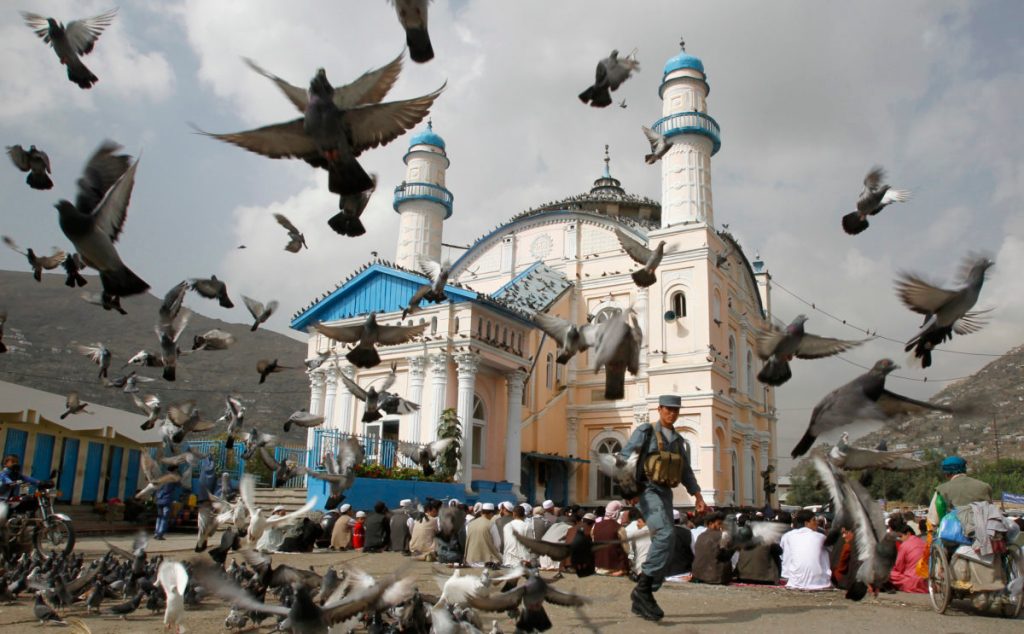
Pigeons fly as a policeman guards residents praying outside the Shah-e Doh Shamshira mosque during the first day of the Muslim holiday of Eid-al-Fitr in Kabul on Aug. 30, 2011. Photo by Erik de Castro/Reuters

Hyenas are one of the oldest species of canine on Earth.  Indigenous to Africa and more closely related to felines, they exist in four subspecies: spotted, brown, striped and aardwolf.  Despite these slight differences, hyenas are carnivorous creatures.  They’re also basically scavengers; waiting until a larger animal dies or is severely incapacitated before ripping it to pieces.  And – depending on the victim – they leave little behind, except horns, hooves and tails.  All subgroups of hyena boast another attribute – they can’t be tamed.  They’re not like domesticated dogs, which have become one of humanity’s truest non-human companions.  The hyena mindset is too rudimentary to allow it to sit and stay.  They’re just too savage and wild to conform to human-induced pleasantries and commands.  You really don’t want one as a pet.  Hyenas just need to be left alone.

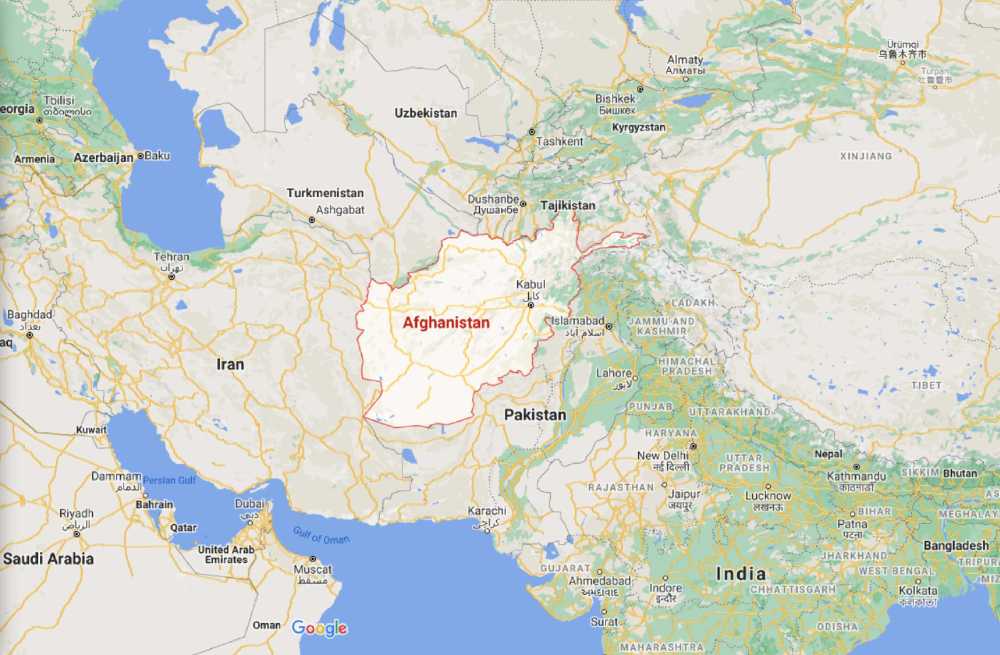
Afghanistan is a hyena.  It’s savage and wild.  We really don’t need it as an ally.  Unlike a domesticated dog, it doesn’t return the love.  We just need to leave it alone.

This landlocked pocket of mountains sits at the crossroads of Asia and the Middle East; languishing in another realm, a universe unto itself.  Its current borders were established in the 19th century, but Afghanistan bears an ancient history.  Its geographic location made it a principal feature of the storied Silk Road, which carried travelers and traders between Southern Europe and China.  Excavations throughout Afghanistan prove that humans populated the region as far back as 52,000 years ago; when Neanderthals were the dominant bipedals.  Archaeologists have shown that more stable, urbanized societies began developing by 3000 BCE.  With its history closely tied to neighboring countries, such as Iran and Pakistan, the Afghanistan of millennia ago was part of two of the earliest and largest civilizations on Earth – Indus Valley and Mesopotamia.  Mesopotamia is notable for evolution of one of the first writing systems in the world.

For almost as long as its relatively modern existence, Afghanistan has been subjected to one barbarous onslaught after another.  It fell to the Achamenid Empire, after Darius I conquered it around 515 BCE.  Alexander the Great stormed into the region around 330 BCE and defeated Darius III.  The Maurya Empire took control of most of the region where it further entrenched Hinduism and introduced Buddhism.  A variety of successive conquerors and empires descended upon Afghanistan and surrounding areas.  Islam arrived in the 7th century CE via Rashidun Arabs coming from the Byzantine Empire.  In 1221 CE, Mongols invaded Afghanistan under their founder Genghis Khan who oversaw unbridled destruction of towns and villages.

All of these invaders had to battle a common enemy: Afghan tribesmen, gangs of nomadic and uncultured warriors who had little more than determination and grit as guiding forces.  Even when the British first arrived in the 1830s – hoping to annex Afghanistan and protect the latter’s position as a vital trade route from the Russian Empire – they were confronted with bands of ruthless fighters.  Great Britain tried three more times to conquer Afghanistan, resulting in a 1921 treaty to…well, leave them alone!

The most recent invasion attempt came with the former Soviet Union in 1979.  While the Soviets had been able to swallow up much of Eastern Europe throughout the 20th century, the seeming backwater of Afghanistan proved to be more formidable than others.  The Soviets may have easily overrun such nations as Hungary, but Afghanistan tribesmen fought harder than even the great Russian bear anticipated.  The United States likes to claim it helped Afghans defeat the Soviets and drive them out before they could mark a full decade of their presence.  But one thing remained certain.  Afghanistan just couldn’t be tamed; that is, it couldn’t be conquered.

Afghanistan’s remote location has made it as difficult to study as it has been to conquer.

U.S. involvement in Afghanistan is only recent; dating to the 1980s.  Before then, most Americans couldn’t point it out on a globe of the world.  Many probably still can’t.

But in the modern schemes of geopolitical events, the fact the U.S. promised to help Afghanistan rebuild after defeating the Soviets and then failed to do it gets lost in translation.  It’s this failure that led to the rise of the Taliban in the 1990s.  The Taliban rejuvenated antiquated views of how the world should function, including a more brutal version of Islam – which is akin to evangelical Christianity: narrow-minded and filled with more hate than love.  What infrastructure remained in Afghanistan collapsed, and women became relegated to a status one step above cattle, driven from schools and forced to walk around dressed like beekeepers.  It was this bloodthirsty atmosphere that spawned the 9/11 terrorist attacks, which in turn, culminated in a 20-year occupation of this ragged bunch of mountains and its disoriented tribal factions by the U.S.

And, as of August 31, we’re gone.  The U.S. has left the region; exiting as a construction company forgoes building a skyscraper in quicksand.  It’s not that America is wimping out and giving up.  We’re tired of this place.  Just as some people can’t pinpoint Afghanistan on a map, some Americans were surprised to know we were still there.

And now, we’re gone.  Good riddance!

I have no qualms about leaving.  Afghanistan wasn’t worth the trouble.  The U.S. couldn’t maintain its place over there.  We can’t always be the ones to protect people from themselves.  We’ve spent trillions of U.S. dollars (taxpayer dollars) and have nothing much to show for it.  The Afghan Army, for example, surrendered to the reborn Taliban as soon as the Americans started leaving.  All that time, effort and money spent to train the locals to fight against the more brutal elements of their own society evaporated.  It’s like training nurses to work in the emergency room and then watch them pass out at the first sight of blood.

So what now?  Nothing!  Once we beat back the Taliban and helped move Afghanistan into the 21st century, the Afghan people should have been able to take control at that point.  Instead tribalism and that vehement version of Islam swarmed over the country.

Afghanistan donned the hyena mentality once again.  But that seems to be its true nature.  It’s wild and can’t be tamed.

Leave a comment

Filed under Essays

Iraq Again! Oh, Hell No!

Zombie hand

“It’s alive! It’s alive! It’s alive! It’s alive! It’s alive!”

Colin Clive in “Frankenstein


As the United States slowly recuperates from the wars in Afghanistan and Iraq, Americans are suddenly beset with a very real horror show: the rise of militants in Iraq, as well as the collapse of the Iraqi government. Most of us keep smacking ourselves across the face; trying to wake up from what can only be deemed a nightmare. No – a night terror. This can’t be happening. There must be some kind of misunderstanding. The media has it all wrong.

No, they don’t. It is happening. And, we’re all wide awake.

I wish that the brewing fiasco is – at best – a really cruel, heartless joke. But, it’s simply not. The blatant reality is that radical Iraqi insurgents have risen from the crypt of hate and anger to launch an assault on that nation’s fragile government and hapless military. They’ve already taken over Mosul, Iraq’s second-largest city. It’s surely only a matter of time before they attack Baghdad.

President Obama, who campaigned in 2008 partly on the promise to end the war in Iraq, says another round of military intervention is not likely. But, almost in the same breath, he added, “We have enormous interests there.”

What happened to the good old days, when a president would say stupid crap, but still really believe it with all his heart? Many of us disagreed with George W. Bush, but at least we knew where he stood on an issue. Along with Dick Cheney, Donald Rumsfeld, Condoleezza Rice and Colin Powell, Bush hoodwinked much of the nation into believing Iraq had a role in the September 11, 2001 terrorist attacks and was secretly building a nuclear arsenal. In the twisted logic that only a draft-dodging right-wing lunatic could manufacture, Bush forced the U.S. to switch its attention abruptly from Afghanistan to Iraq. Most of us level-headed folks saw the ruse clearly and still didn’t mind being labeled terrorists. We knew it was a lie. But, Bush was a puppet president for corporate oil interests (in much the same way Warren G. Harding was), so I don’t blame him completely.

But, with nearly 4,500 U.S. dead in Iraq alone – not to forget those who died from their injuries or suicide once back home – we’re faced with a bizarre quandary: sending troops back into Iraq to thwart what observers have ominously deemed the “threshold of civil war.”

Trick question: what’s the difference between the threshold of civil war in Iraq and a total conflict?

Answer: nothing!

The difference is in terminology only. Hearing military and political “experts” trying to define the two concepts is like saying there’s a difference between azure and blue. I knew a guy in college who got upset when people said he was Italian. He preferred the term “Sicilian.” Oh, of course! Silly me! And, just so you’ll know, I’m not Latino. I’m Hispanic! ¿Entiendes?

The U.S. put itself into a quixotic situation with Iraq more than three decades ago when it began funding its war with Iran. That came to an abrupt end in 1988, when Saddam Hussein launched a genocidal chemical attack on Kurdistan. The U.S. also placed itself in a quagmire with Afghanistan when it supported mujahideen rebels in their valiant fight against the former Soviet Union – and then forgot about the Afghan people. One nation doesn’t make a promise of that magnitude to another nation without owning up to it.

If, by some wretched chance, we do send our military back into Iraq, here’s what I’d like to see happen:

  • Initiate a military draft. Every 18-25 able bodied person (including women, Jews, Mormons, conservative Republicans and rich kids) will have to serve in some kind of capacity. No exceptions!
  • Raise taxes on the wealthiest 5% of American citizens. Since many of them are the ones who propagated the war in Iraq and subsequently benefited from it, we need half of their income to go into Pentagon coffers.
  • Cease all foreign aid. This includes Israel. Unquestionable financial and political support for Israel by the U.S. is another reason for the 09/11 attacks.

It’s only fair all of the above should occur, as the U.S. roars back into Iraq like a repo man going after a late-model BMW for the third time. But, I also think it’s only fair I should be rich and famous without working too hard for it. After all, I’m attractive (in the right black light) and intelligent. Why should I struggle so hard?

Will the U.S. boomerang its troops back into Iraq? I can only hope not. But, you know how that goes.

6 Comments

Filed under Essays