Category Archives: Essays

Echoes on Carpet

img_0716

“Goodnight, little boy.  I love –”  I stopped, catching sight of the blank floor space against the wall, next to the closet in my room.  He wasn’t there, curled up into a crescent of silver and white atop a towel riddle with holes and tears.  Wolfgang was gone.

I was reaching for a lamp on an end table, when I started to tell him goodnight and that I love him – as I’d done for years.  I remained in that odd position – propped up on my left elbow, right arm stretched out towards the lamp – for what was probably just a few seconds, but felt like several minutes.  I wondered how long I could hold that position without dropping dead.

I finally shut off the lamp and laid back onto my trio of pillows.  Beneath a single sheet, clad in nothing but skin and body hair, I felt a stick of anxiety materialized in my throat.  I rattled off my usual stanza of prayers to all those who’ve gone before me, pleading for their protection and their strength.

I looked again at the spot on the floor where Wolfgang would camp out every night; that ragged towel – seemingly held together by strings – bunched up beneath him.

I don’t know why, but Wolfgang had a fetish for towels.  It may have come from his previous daddy, Tom*, my former friend and roommate, who carried the puppy around in a lunch cooler; an old purple beach towel of mine that he’d stuffed into it.  The towel provided some comfort to a tiny critter who would grow into a 20-pound monstrosity filled with eons of canine angst.

In early 2005, I lived and worked temporarily in Northeastern Oklahoma on a government project that was part of the contract my employer, an engineering company, had.  The area, bordering Kansas and Missouri, is a mostly toxic wasteland where soil and water had poisoned by decades of lead and zinc mining.  I stayed in a nice and recently-built hotel, along with a coworker and our supervisor.

For most of the time I was in Oklahoma, Wolfgang stayed with my parents.  But, for the month of May, I rented a car and drove all the way up there because I’d decided to take Wolfgang with me.  Some of the hotel staff came to like him.  The first time someone with the housekeeping staff heard him barking, she was certain I had a pitbull ensconced in the room.  There mere sound of his voice frightened her.  But she and a few others were mirthfully surprised to see how small he was.

That little thing can make that much noise?!

Yes, he can!

One night, as I sat at the desk in my hotel room, working on my laptop, I noticed Wolfgang exiting the bathroom with a small white towel in his mouth.  Because of his presence, I made a deal with management that no one was to enter the room, unless I was there also or in the event of an emergency.  Wolfgang’s bite matched his bark.  Consequently, I let bath towels pile up beneath the sink.

A few minutes later, I turned to Wolfgang and was startled to see that he’d removed every single used towel from beneath the sink and to a spot in front of a cabinet.  He lay in front of the pile, curled up like a hairy conch shell.  I laughed.

I keep trying to think of things like that, now that Wolfgang is gone.  It’s the same with my father.  Memories of him behaving like the lunatic he was – imitating Flip Wilson’s “Geraldine Jones” persona, threatening to tickly my mother – roll through my mind.  It eases the pain of losing both of them within a 5-month period.

Today is the first birthday I’ve marked without either of them.  It’s such a weird feeling.  How could this happen?  Why, in the name of all that’s great and wonderful in this world, did they pass away so close together?  Talk about timing!

Last month I finally decided to rummage again through the storage shed in the back yard; a dilapidated structure where my parents stuffed anything and everything they didn’t want or need in the house.  It also had doubled as a tool shed for the plethora of gardening equipment my father had accumulated over the years.  In the fall of 2014, I carted a few large pieces – a dead lawnmower, an antique weed eater, etc. – to the front yard for him.  I taped a cardboard sign with the words “FREE TO GOOD HOME” across the mess and left it all there for whomever.  It was gone before day’s end.

At the same time, I retrieved several boxes of old National Geographic magazines.  “These don’t belong out here,” I told my father.  Old Home & Garden magazines, maybe, but not National Geographic.  I hauled them all into my room and rearranged them, alongside my gallery of books.

But last month I found several other items – a few as old as those National Geographics, but more precious.  There was a box of handwritten journals by my paternal grandmother, Francisca.  A couple of other boxes contained stuff from my childhood: drawings, poems, stories.  Among the latter was a one dollar bill paper-clipped to a fragile slip of paper.  It was a note from me to my father; thanking him for being such a great daddy.  I was about 5 when I wrote that.  And he kept it!  As an only child, my parents were apt to keep as much about my childhood around as possible.  But that a simple, handwritten note dating to the late 1960s would retain a place amidst all of that material stunned me.

And yes, it also made me sad.  But I realized – more than ever before – how fortunate I was to have a father as incredible as mine.  It’s why I get angry now when I hear people say fathers don’t serve a purpose in this world.

Back in July I visited a weight-lifting gym in East Dallas with a close friend, Pete*, who’s a regular there.  It’s a tiny, no-frills joint carved into an aged shopping center; where free weights are the main source of muscle-building and men can work out shirtless.  After showering and changing back at his house, Pete and I had dinner at one of our favorite Mexican restaurants near downtown.

At some point, the conversation turned to family, and – with my voice cracking – I emphasized how badly I missed my father.  I try not to get emotional in public.  Even during my dad’s memorial service in June, I managed to hold it together.  But, planted in a booth beneath dim lighting in the restaurant, I just couldn’t remain poised.  It must have been the margarita swirls.  I was already on my second one.

Pete knows how I feel.  He lost his own father 12 years ago.  Curiously, our fathers had grown up together in East Dallas neighborhoods now occupied by office buildings and overpriced condos.  “My father went to be with his mother,” Pete had told me that night on the phone.  I didn’t understand.  All of Pete’s grandparents were dead.  What was he trying to – aw shit!  I don’t know if there’s an etiquette rule for announcing the death of a loved one via telephone, and if there is, I could care less about it.

I still have trouble sitting in the easy chair near the fireplace where my dad used to sit while watching TV.  His urn resides quietly on the dirty white brick of the raised hearth.  I make it a point to touch it every day and tell my father I love him.  His mother had lived to age 97.  Why couldn’t he?  What is the proper time of year to die?  It seems we have rules for everything in our lives these days.  Meteorologists can track hurricanes with near-accuracy.  As soon as a massive quake struck northeastern Japan in March of 2011, scientists could determine how long it would be before tsunamis struck the Hawaiian Islands and the west coast of the U.S.  Why couldn’t the slew of doctors my father had seen over the years not tell me when his body would finally say, ‘To hell with this shit!’?

A few times over the past few months, Wolfgang would stare at that general area for the longest time.  I’d feel the pressure change in the house.  But it wasn’t a frightening sensation.  I knew my father was nearby.  He had said more than once he wanted to die in this house and not in a hospital, a menagerie of tubes pouring out of him like overgrown hairs.  If I did anything right, I feel it was that.  I was able to grant my father his most heartfelt wish.

There are so many echoes of him and Wolfgang around me, now that they’re both gone.  And the house is otherwise quiet.  I’ve never felt pain like this before.  But, on this 53rd birthday of mine, I’m not too distressed.  My heart and my mind are filled with the happiness of the lives they lead.  I couldn’t ask for more from either of them.


*Name changed.

13 Comments

Filed under Essays

For the Love of Dogs

Wolfgang in March of 2004.  Behind those sweet, glassy eyes lay eons of canine evolution and aggression.

Wolfgang in March of 2004. Behind those sweet, glassy eyes lay eons of canine evolution and aggression.

I quietly strode towards the bedroom of my roommate, Tom*, merely expecting to find him asleep.  He had just experienced a heart-wrenching loss: putting his 11-year-old miniature schnauzer, Zane*, to sleep.  Surely, Tom was exhausted after a long road trip to and from the Northeast Texas town where he was born and raised; the same place where he’d raised Zane.

Zane and I bonded quickly when Tom and me agreed to pool our resources in May of 2002 and share a two-bedroom apartment.  I was working temporary gigs, and he had a courier job that left him feeling tired and uneasy.  After a car wreck and a major health scare in the fall of 2001, he had managed to put himself back together, while recuperating at his mother’s home back in that Northeast Texas town.  Zane’s presence, he told me, comforted him better than the medications he’d been prescribed and the alcohol he’d consume as an additive.

But, during the first week of August 2002, Tom had to return to his mother’s home to tend to a family crisis.  When he came back, I informed him that Zane was extremely ill.  I didn’t know what was wrong, but the shy little dog had shriveled up to the point where his ribs were visible.  Tom spent the next day in bed; holding Zane tightly.  He finally headed back to that Northeast Texas hamlet where Zane’s old veterinarian was also located.

Upon arriving at the veterinarian’s office, however, Zane suffered a catastrophic stroke…and never recovered.  “My little boy is gone,” Tom cried over the phone that evening from his mother’s house.

I cried with him.  So, while I was surprised to find Tom back at the apartment earlier than expected, I was even more surprised to see a tiny ball of silver and white fur crawling around on his bare chest.

On his way back to Dallas, Tom had stopped off in a town east of the city to visit a cousin.  In a purely spontaneous decision, he grabbed a newspaper and searched for a miniature schnauzer breeder.  He found one and purchased one of the eight-week-old puppies.  He named him Docker.  Where he came up with that I never knew.  But I renamed him Wolfgang a few months later.  That’s because he became my dog when Tom and I decided to go our separate ways in January 2003.

It’s one of the best decisions I’ve ever made; albeit an almost equally spontaneous move on my part.  In an uncertain time for me (I’d just started a new full-time job that felt insecure and I wanted desperately to move out of a complex that was going to hell), as well as for the nation (we were about to invade Iraq under false pretenses, and the economy remained fragile), taking custody of that dog stood out as a bright moment.  Tom left owing me some $700.  But I ended up with the dog.  I was ill-prepared to have a pet, yet I still felt I came out with the better bargain.

All of that came back to me Wednesday morning, as I carried Wolfgang’s quivering form into the veterinarian’s office.  He had gone into some kind of cardiac arrest episode…and never recovered.

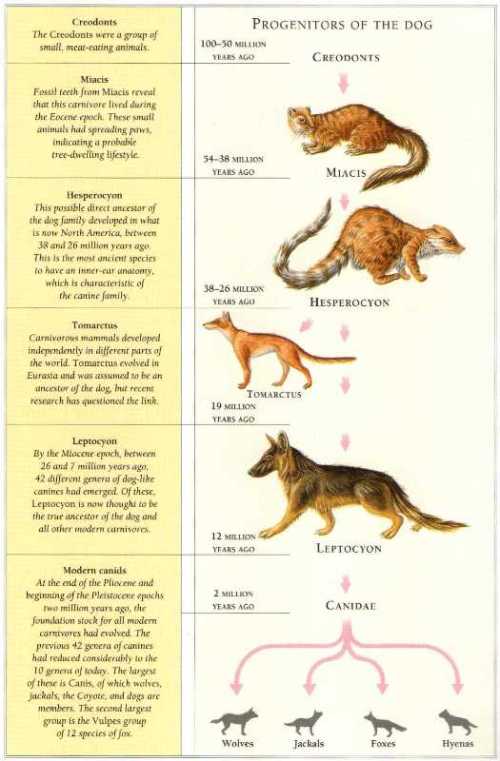
Basic evolutionary tree of canines.

Basic evolutionary tree of canines.

Wolfgang’s veterinarian had diagnosed him with a heart murmur a couple of years ago, which explained his occasional coughing / hacking fits.  Earlier this year, though, he began experiencing seizure-like episodes.  One in early May terrified me: he literally fell over onto one side; a cartoonish action that was anything but funny.  An X-ray proved his heart had enlarged and was clamping down on his airway.  The seizures, the doctor explained, were actually moments where Wolfgang couldn’t breathe.  He put him on two heart medications that would be a daily ritual for the rest of the dog’s life.  That life ended sooner than I’d expected – or even wanted.

“I just lost my father,” I whispered to him last Monday night, the 24th.  “You can’t leave me also; not now.”

His behavior was actually quite normal this last weekend and into Monday, the 24th.  Yet, by Monday evening, I could tell he had trouble breathing and began to suspect the worst.  Then it seemed the air around me had thickened, and I sense my father was nearby.

I tried giving Wolfgang the two medicines the doctor had prescribed back in May.  I literally had to shove them into his mouth; a little mouth lined with razor-sharp projectiles, backed up by eons of canid ambivalence.  I always tried to retract my hand as quickly as possible, but each time he managed to scrape my fingers.  Then, on Monday, he did something he’d never done before: he actually impaled one of his dental daggers into my right forefinger.  Blood oozed immediately from the gash, as I hurtled the tiny white pills into his food dish and marched into the bathroom.  My entire right hand throbbed.  It still aches.  But I don’t care.  He was just a dog.  More importantly, he continually spit out those pills.  I’ve found bits of them around the den area.  It was his last act of wolf-infused defiance and stubbornness.  Perhaps he sensed they were of no use at the moment.  He was done and wanted to move on from here.  Are dogs really that sentient?  Do they possess the same level of emotional capacity as their human counterparts?

A variety of studies over the past two decades suggest yes; dogs truly are more emotionally and psychologically complex than we ever realized.

I still find it amazing how we humans become so attached to certain animals.  For me, it’s always been dogs.  As far back as I can remember, I’ve held a special fascination with the canines among us.  Cats and horses are undoubtedly beautiful.  But I’m allergic to felines (as a 2004 allergy test proved), and horses are too big and expensive.  I’m an all-around animal lover, but dogs secured a tight grip on my mind and in my heart.

I often joked that Wolfgang wasn’t really a miniature schnauzer; he was a previously unclassified species of canine – a miniature wolf.  The big mocha brown eyes, soft fur and floppy ears (especially the right one, which rarely stood up, lest he tilt his head back at a certain angle) were just aesthetic ruses.  The mere mention of his name incurred occasional chuckles.

“The name fits,” I told people.

Artist depiction of Eucyon davisi, considered the direct ancestor of modern dogs.

Artist depiction of Eucyon davisi, considered the direct ancestor of modern dogs.

Miniature schnauzers are among the 148 breeds of domesticated dog recognized by the American Kennel Club.  In addition, there are more than 150 other breeds of domesticated dog not officially acknowledged by the AKC, such as the Russo-European Laika, the Peruvian Inca Orchard, and the Prazsky Krysarik from Czechoslovakia, the world’s smallest dog.  Zoologists have also identified more than 100 species of wild canine, such as the South American bush dog, the Australian dingo, and the African basenji, the only dog that doesn’t bark.  It produces something of a yodeling sound.  Altogether, an estimated 10 billion dogs exist on planet Earth today.

Dogs boast an extensive and impressive lineage.  Canines have a longer and more diverse history than any other predatory carnivore, which allowed them to spread across the globe faster than fellow mammals.  They belong to the family of mammals called canidae and to the order of carnivora.  Zoologists believe all mammals descend from Creodonts, a group of small, meat-eating creatures that first appeared about 100 million years ago.  About 55 million years ago, during the Eocene Epoch, a more refined (but not much larger) carnivore, Miacis, arose in North America.  Miacis then evolved into Hesperocyon, or Hesperocyoninae – traditionally regarded as the direct ancestor of dogs – between 38 and 26 million years ago.  Hesperocyoninae generated 28 sub-species.   They were followed by Borophaginae, which produced 66 sub-species, and Caninae with 42.  One member of this latter group, a fox-sized animal called Eucyon, played the most critical role in canine evolution.

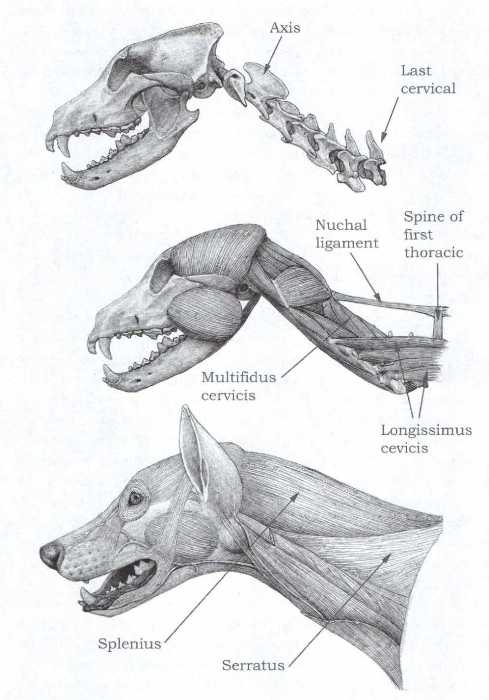
Arising in North America about 9 million years ago, Eucyon was omnivorous; a unique attribute that allowed it to survive longer than any of its predecessors and outlive even its contemporaries.  But Eucyon also had longer leg bones, especially the forelimbs, which increased its running efficiency and therefore, its ability to capture prey.  It had a shorter neck than most felines, another top predatory carnivore, which otherwise would have inhibited its ability to tear at flesh.  But Eucyon necks compensated for it with the nuchal ligament; a feature that permitted greater rotation of the entire neck column.

Adding to this was the extraordinary development of canine dentition (teeth) and the power of its jaw bones.  Together this allowed for actual bone-cracking of its prey.  The reason is obvious: inside animal bones is marrow, a rich source of protein.  Among all canine species the power of bone-cracking is no more evident than in the family of hyenas.  These wild African canines have been known to leave little evidence of a kill; they literally consume an entire animal.  Getting inside those bones with its mighty jaw strength helped canines retain their spot as top predators no matter where they migrated.

An artist’s rendition of the extinct Borophagus secundus canine from the late Miocene Epoch in North America displays the animal’s large dentition and low-angled skull that allowed it to engage in bone-crushing of its prey.  Courtesy Mauricio Antón.

An artist’s rendition of the extinct Borophagus secundus canine from the late Miocene Epoch in North America displays the animal’s large dentition and low-angled skull that allowed it to engage in bone-crushing of its prey. Courtesy Mauricio Antón.

Between 6 and 4 million years ago, Eucyon began migrating across what is now the Bering Strait into Asia.  There it developed into Canis lupus, the gray wolf.  Canis lupus then spread further throughout Asia, eventually making its way into Europe, Africa, and India.  It also evolved into both variations of itself and canines such as dholes and jackals.  About 800,000 years ago canis lupus began tracing its ancestors’ migratory paths back into North America where it continued evolving; again into other wolf species, but also into such animals as the arctic fox and the coyote.

Throughout the next several millennia, wolves continually metamorphosed into various breeds of dogs.  At some unknown point, they formed an alliance with humans.  How, when and why this occurred are among the top questions for zoologists.  It’s quite likely that a human somewhere along the way found an abandoned wolf puppy and, feeling empathy for the animal, kept it and managed to raise it.  It’s also likely that canines began following humans, realizing the two-legged beings had a knack for capturing and killing large prey.  When the humans moved on, the canines would descend upon the remains of whatever animal was left behind.  This, of course, would make dogs scavengers, instead of hunters.  But, in a brutal world of survival, that’s what was necessary.

It’s more probable, however, that all of these incidents took place a number of times, all over the world and over a number of years.  As with other animals, such as horses and bovines, canine evolution eventually fell in line with human evolution; that is, their domestication coincided with the development of more complex and wide-spread human societies.

Skull, cervical vertebrae and muscle structure of the extant Canis lupus (gray wolf).  The nuchal ligament allowed for greater movement of the head and neck.

Skull, cervical vertebrae and muscle structure of the extant Canis lupus (gray wolf). The nuchal ligament allowed for greater movement of the head and neck.

The close relationship humans generated with dogs means people began subjecting these animals to selective breeding, in which they were propagated for specific purposes.  Initially, dogs served two primary roles in their union with humans: hunting game and herding livestock.  Later, they were bred to be protectorates, guides, and, of course, companions.  Consequently, we now have a plethora of dog breeds.  No other animal displays such an extraordinary level of diversity in size, color and shape as canines.

Dogs’ sensibilities are extremely acute.  While their visual resolving powers are less efficient than humans, their eyes are more sensitive to light and movement.  Dogs can hear sounds four times farther away than humans and are able to locate the source of that sound in six-hundredths of a second.  Dogs’ olfactory capabilities are their most extraordinary attribute.  The average dog has over 200 million scent receptors in its nasal folds, compared to a human’s five million.

Dogs are certainly among the most intelligent of mammals; perhaps the smartest among non-primates.  Like humans, dogs appear to be sensitive to vocal inflections and emotional queues.  A study at the University of Lincoln, United Kingdom, that dogs “form abstract mental representations of positive and negative emotional states, and are not simply displaying learned behaviours when responding to the expressions of people and other dogs.”

The researchers presented 17 domesticated dogs with pairings of images and sounds conveying different combinations of positive and negative emotional expressions in both humans and dogs. The sources of sensory input – photos of facial expressions and audio clips of vocalizations (voices or barks) from unfamiliar subjects – were played simultaneously to the dogs, without any prior training.  Researcher noted the dogs spent more time looking at the facial expressions which matched the emotional state of the vocalization.

Another study in Hungary went further by conducting MRIs on 13 dogs – six border collies, five golden retrievers, a German shepherd and a Chinese crested.  The animals were trained to lie motionless during the procedures, although they were awake and unrestrained.  Researchers found that dogs processed words with the left hemisphere and processed pitch with the right hemisphere – just like humans.

We’ll never know when the bond between humans and dogs was established.  Whether they save our lives, protect our property, or provide simple companionship, dogs are an indelible part of the human existence.  For dog lovers such as myself, that relationship is indescribable.

Basic evolutionary tree of modern dogs from their wolf ancestors.

Basic evolutionary tree of modern dogs from their wolf ancestors.

* Name changed.

ASPCA


References:

Dogs: Their Fossil Relatives and Evolutionary History.”  Richard H. Tedford & Xiaoming Wang. Columbia University Press, 2008.

New Encyclopedia of the Dog.” Bruce Fogle, DVM. Dorling Kindersley, 2000.

3 Comments

Filed under Essays

No Defense Here

tow12

At some point in the late 1960s, a Mexican-American guy got arrested in Dallas for a series of robberies.  The incident garnered some media attention, but was pretty much a non-event.  Until someone at my father’s workplace mentioned it.

An older White man approached my father and said something to the effect that the police had arrested “your brother Rodriguez.”  He knew what the old man was talking about.  My father promptly reminded the man “my name isn’t Rodriguez, and that guy isn’t my brother.  Now shut your ass and leave me alone!”

The old man apparently was offended at my father’s brusque language and complained to the company owner, another old White (albeit Jewish) man who said something to the effect of, ‘What did you expect?’

My father often found himself in such uncomfortable situations; where some Hispanic individual would do something stupid and / or criminal enough to get media attention, and some non-Hispanics would assume my father was guilty by association.  It actually still happens.  A lot.  Just ask Black men when other Black men get arrested.  Or Hispanic men.  Or Native American men.  Even in this second decade of the 21st century, in a post-civil rights America, crime still often bears a Black, Brown or Red face.

That mess stormed into the public conscious last week when Republican presidential candidate Donald Trump dismissed a 2005 conversation with an entertainment journalist as “locker room banter.”  With a monster hurricane having just ripped through the Caribbean and the U.S. east coast and the Zika virus still a threat to public health, this is what the American media and much of the American public has focused on: eleven-year-old verbiage from two old men trash-talking on a bus.

The dialogue hasn’t discouraged Trump who is roaring ahead with his campaign – undoubtedly one of the most bizarre in recent memory – even as one woman after another jumps forward to proclaim they’ve fallen victim to the type of actions the business tycoon describes in that brief snippet.

There’s no getting around it: what Trump said in that piece is deplorable, and his attempt at an apology is as sincere as a 13-dollar bill.  Even before then, I didn’t like him.  But, aside from the rancor bubbling over this mess, it’s amazing the number of men who are also publicly proclaiming their ardent respect for women and disdain for Trump.  Athletic coaches at the high school and college levels are gathering their young male acolytes to warn them that such talk about females will not be tolerated.

Personally, I don’t feel the need to refute Trump’s so-called “locker room banter.”  I don’t have a guilt complex over it and I’m not hopping up and down trying to convince any female within ten feet of me that I’d never talk that way about them.  And neither should any other man.

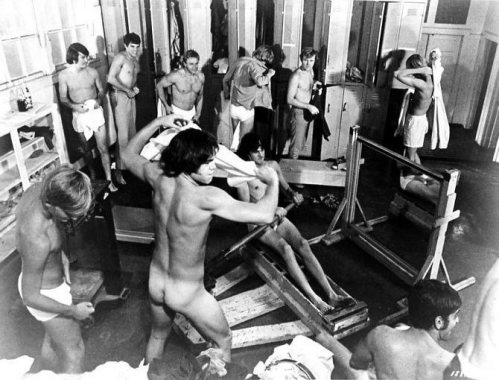
Since high school, I’ve spent time in men’s locker rooms and can say without wincing that I’ve never heard men talk like that about women.  Men say all sorts of stupid shit in locker rooms, but I cannot recall anything of that sort.  As a writer, I’m prone to listen in on other people’s conversations.  I’ve always wanted my characters to speak and behave as normal as possible, so they’ll be more realistic.  Yes, men do talk about sex in locker rooms.  (And, in other Earth-shattering news, the sun rises in the east.)  I’m certain women engage in similar talk, even though most won’t admit it.  Men also talk about body parts.  Mainly their own body parts.  Usually, though, we talk about work, home, family, cars, sports, our individual exercise routines – but never something so vile as sexually assaulting or molesting women.  I know some men have talked openly like that.  I’ve just never heard it.

But it’s not enough to point out that most men don’t talk in such a debasing manner about women.  It’s more important to realize that most men don’t act that way either.  The vast majority of men don’t harass and / or sexually assault women.  I know that contradicts feminist ideology, but it’s painfully true.  Men are much more likely to assault other men or even themselves than they are women.

Yet, while plenty of people like Trump think their wealth and power make them better than the rest of us, there are others who latch onto the Trumps of the world in the hopes of improving their own station in life.  Trump surely has no genuine respect for women overall, but a number of women swoon over men like him daily.  This is one thing that upsets most average men.  Women often claim they want a man who is honest and fair-minded.  But, as some men view it, women really just want a man with lots of money.  Even some of the most successful and well-educated women often still expect the men in their lives to earn more than them.  Why?  Just in case said woman decides she’s tired of working?  I don’t know.

Women, on the other hand, often say their lack of opportunities in life put them in a position where they’ve had to find men who have money, or at least a job that pays above minimum wage.  On average, women still earn less than men, but women are superseding men on the educational front.  If you break that down from a racial viewpoint, the gaps grow even larger.  Gender politics, like racial politics, is ugly, and no one wins the argument.

I’ve heard more than a few women engage in “locker room banter” – in public – in front of me and other men.  I’ve endured my share of harassment from both women and men.  It was never caught on video or audio.  And I rarely complained out loud about it.  I knew few would believe me, especially because I’m a man.  Therefore, I understand how some women feel about life in the work place during years gone by – long before the term “sexual harassment” was ever created.

Former Texas Governor Ann Richards once advised young women to complete their education and not depend on a man to take care of them; “when the Prince is middle aged with a pot belly and a wandering eye, you’ll be glad you have a degree and can support yourself if you have to.”  As expected, social and religious conservative across the state and the nation dumped their snarky bile on Richards; denouncing her as anti-family and anti-marriage.  Richards shrugged it off, even after losing her 1994 reelection bid.

Trump is in a class all his own – and I don’t mean that in a good way.  He’s harking back to those golden years gone by; when people didn’t have to be politically correct, especially White male people.  But, as part of that elite and much-reviled 1%, he obviously believes his wealth and power give him license to say and do whatever he wants.  Plenty of people in his social class possess such self-righteous haughtiness.  Despite all his money, Trump is still little more than a loud-mouthed bum.  He’s a disgrace to all men – White or not.

My paternal grandfather once said you can dress a donkey up in silk and satin, like a thoroughbred horse, but eventually it’ll start bucking and kicking like the animal it truly is.  Now, I don’t mean to disrespect donkeys by comparing them to Trump.  Talk about being disrespectful!  But I think you get the idea.

3 Comments

Filed under Essays

Just Leave Them Alone

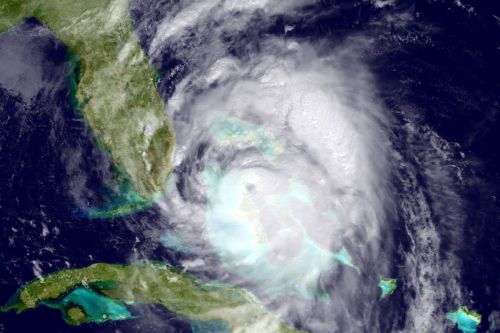
A National Oceanic and Atmospheric Administration (NOAA) image of Hurricane Matthew moving towards Florida on October 6, 2016.

A National Oceanic and Atmospheric Administration (NOAA) image of Hurricane Matthew moving towards Florida on October 6, 2016.

People living along the U.S. Gulf Coast were accustomed to this.  A massive hurricane was headed their way, and they had been warned to evacuate further inland.  It’s the price one must pay for a home with a spectacular view.  They didn’t need too much encouragement to flee from the chaotic beachfront.  Barely a decade had passed since Hurricane Camille had plowed into the Alabama-Mississippi coastline with winds of roughly 190 mph (306 km/h).  Camille was only the second documented Category 5 storm to hit the United States.  It had set the standard by which all future tropical storm systems would be measured and – more importantly – by how coastal residents and government officials would respond.

It was September of 1979, and Hurricane Frederic loomed menacingly on the horizon.  What had begun as a tropical wave off the west coast of Africa at the end of August metamorphosed into a Category 4 behemoth, with 135 mph (215 km/h) winds, upon entering the Gulf of México.  The National Hurricane Center issued warnings for much of the U.S. Gulf Coast, and some 500,000 people – from East Texas to the Florida Keys – heeded that ominous call.  Utilizing a new and innovative weather system called Doppler Weather Radar, the NHC had deemed the Florida Panhandle as the most likely strike point.  Locals remembered Hurricane Eloise very well, so most took no chances.

Then, seemingly at the last moment (as hurricanes frequently do), Frederic shifted further westward and landed at Gulf Shores, Alabama.  As they trekked back to their boarded-up homes and businesses, wondering if criminals had taken advantage of their absence, some Florida Panhandle residents were irritated that they were forced to flee a hurricane that didn’t hit.  Wasn’t this new-fangled Doppler thing supposed to cure such uncertainty?  Regardless, many vowed to stay put the next time.

Much of this same drama played out last week, as Hurricane Matthew terrorized the Caribbean and then teased the southeastern U.S. by remaining mostly offshore.  At one point in its early life, Matthew reached the rare and dreaded Category 5 status; the first such tempest in the Caribbean since Felix in 2007.  Matthew finally made official landfall in South Carolina October 8 as a Category 1 storm and is now – as of this writing – a post-tropical cyclone.  With more than 1,000 fatalities directly attributed to it, Matthew’s financial damage will take a while to tally.  And, as always happens with these things, a proverbial “lessons learned” compendium will develop.

One lesson is how best to warn people living in vulnerable areas that they must leave.  As Matthew neared the U.S., literally millions of people, from Florida to North Carolina, were ordered to evacuate.  I don’t like the idea of forcing people to flee a coming storm or any natural disaster.  Hurricanes are one of the few calamities that can be tracked from far away.  It’s only fair to warn people of some pending disaster and help them avoid it, if we can.

Yet, if somebody wants to remain in place, I believe we should just leave them alone.  Governors and mayors should never issue a mandatory evacuation, but rather, a necessary one.  Necessary in that it would be in the best interest of residents to flee.  But people should be allowed to make decisions about their own welfare without harassment or input from others.  I recommend a ‘No Rescue’ policy.  If, for example, a hurricane is estimated to make landfall on a Friday, anyone still on the beachfront after midnight is on their own.  First responders would not be required to respond to a frightened citizen whose million-dollar condo is starting to flood.  Police officers, firefighters and military personnel shouldn’t risk their own lives to save just one dumbass (usually a man) who thought they were tough enough to handle 100 mph winds and 20-foot tidal surges.  Advances in automobile technology have given people a false sense of personal security; therefore, they may not drive too carefully.  Advances in meteorology have had the same deleterious effect.

Photographer Frankie Lucena captured this image of “red sprite bursts” above Hurricane Matthew, as the storm lingered between Colombia and Aruba on October 1.

Photographer Frankie Lucena captured this image of “red sprite bursts” above Hurricane Matthew, as the storm lingered between Colombia and Aruba on October 1.

In September of 1999, Hurricane Floyd headed straight for the Georgia-Florida area, prompting the governors of both states to issue that dreaded mandatory evacuation.  Some 4 million people heeded the warning and fled westward.  As usual, store shelves were emptied out, gas stations were drained, and highways became clogged with frightened coastal residents.  But then Floyd suddenly turned north and plowed into North Carolina’s Outer Banks, before marching up the East Coast.  It missed the Georgia-Florida line altogether, and many of those residents who had been ordered to leave got pissed.  With all of the advances in weather forecasting, they declared, you’d think meteorologists would know exactly where a hurricane will strike.  How pathetically arrogant.

But the public’s salacious desire to watch these disasters unfold is matched only by the media’s desire for high ratings.  As Matthew approached Florida, news outlets planted their reporters on beach fronts and empty streets to help viewers vicariously live the power of the wind and rain.  It’s almost comical watching someone holding onto a street sign or lamp post with one hand and a microphone in the other; adorned in the requisite rain coat and / or ball cap; describing how bad it is “out here” and stating the obvious: “conditions have deteriorated.”

Several years ago I watched the national news as a brutal series of wild fires ravaged Southern California.  People were angry they had to leave their million-dollar homes.  And, of course, media outlets dispatched their own people to show and maybe speak with locals packing up all they could and fleeing the area per the mandatory evacuation orders.  I recall seeing one angry man being led away from his house by some police officers; he had been reluctant to leave.  He looked into the camera and screamed about being forced to leave his home, while “the fucking media” were allowed to stay.  I empathized with him.  If he wanted to stay, he should have been allowed to do that.

After Hurricane Katrina tore into the Gulf Coast in August of 2005, thousands of people who didn’t evacuate subsequently refused to leave; despite the warning by then-New Orleans Mayor Ray Nagin that the city “isn’t safe.”  A large swath of the region, from Southeastern Louisiana to the Florida Panhandle was in chaos, and no, it wasn’t safe.  But no area directly impacted by a natural disaster is safe in the aftermath.  Still, if people want to stay and protect their property, the government shouldn’t force them to leave anyway.

Harry R. Truman refused to leave his home on Mount St. Helen’s, despite its pending eruption in May of 1980.

Natural disasters have a unique way of putting humanity back in its place and making us realize we’re not its master.  On March 11, 1888, a massive blizzard rolled over the east coast of North America, killing more than 400 people and dropping as much as 55 inches of snow in some areas.  The storm practically paralyzed major metropolitan areas, such as Boston and New York City.  Most of the fatalities occurred among urbanites, while folks out in the country just considered it another really bad storm.  Human vanity reached a new level with the R.M.S. Titanic in 1912.  Branded as “unsinkable,” the massive vessel met its fate on its maiden voyage, courtesy of a wayward iceberg, taking more than 1,500 lives with it.

Saving people from themselves is not just virtually impossible; it’s impractical.  It’s also a waste of time and energy.  Give individuals the necessary information and a means to escape.  After that, just leave them alone.

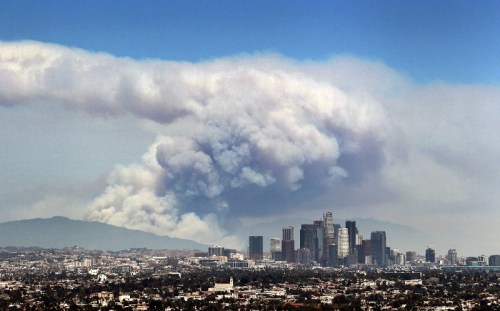
Smoke from wildfires burning in Angeles National Forest filled the sky behind the Los Angeles skyline on June 20, 2016.  Image courtesy of Ringo H.W. Chiu / AP.

Smoke from wildfires burning in Angeles National Forest filled the sky behind the Los Angeles skyline on June 20, 2016. Image courtesy of Ringo H.W. Chiu / AP.

Leave a comment

Filed under Essays

Maids, Beauty Queens and Other Stupidities

7517861_orig

Recently, Republican presidential candidate Donald Trump – trying desperately, yet involuntarily to retain his title as “Asshole of the Year” – defended his previous criticisms of 1996 Miss Universe Alicia Machado.  The Venezuelan-born Machado apparently had gained too much weight at the height of her reign for Trump’s taste and subsequently referred to her as “Miss Piggy.”  He later also dubbed her “Miss Housekeeping,” an obvious reference to her ethnic heritage.  While millions of women across the U.S. (and I’m quite certain, across the globe) resent the “Miss Piggy” sleight, I focused on the “Miss Housekeeping” comment and thought, ‘Here we go again with the racial crap.’  Once more, Hispanic women are being dropped into the narrow categories of maid, housekeeper, etc. by (imagine this!) an old White male.

Trump has made racism and misogyny hallmarks of his campaign.  But this latest verbal assault against Machado struck me personally and harder than his previous idiotic statements.  As the son of a German-Mexican mother, I’ve heard more than a few stories of bigotry about the American workplace.  But, as someone who labored in the corporate world for more than a quarter century, I know that Hispanic women fit into more than the standard housekeeper / maid job role.  Regardless of race or ethnicity, women overall comprise roughly 57% of the American workforce; both full-time and part-time.  It’s the first time in U.S. labor history that more women than men are working.  Such a figure would have been incomprehensible a generation ago.

Not long after I was born in 1963, my father demanded that my mother stay home and raise me; thus becoming a traditional mother and housewife.  He was invoking the machismo persona of the average American male.  Few women worked after having a child in those days – or at least that’s what the general philosophy held.  In reality a number of women entered the workforce after having children, long before it became socially acceptable.  Many had no real choice.  My mother may have had a choice, but she refused to bow to pre-defined roles.  She had already gone against tradition by telling a Catholic priest shortly before my parents married that she didn’t plan to have a child every year, as the Holy Roman Empire dictated.  It upset the priest so badly that he told her maternal grandmother, a woman who had raised her and her three siblings after their mother died in 1940.  The grandmother, in turn, expressed her frustration to my mother who stood her ground.  Unless the Church was willing to finance her progeny, my mother absolutely would not have a child every time my father got an erection.  It’s a good thing.  My mother had enough trouble with me.  She had lost two pregnancies before I was born and another afterwards.  Considering some of the financial troubles my parents experienced later, it’s a good thing my mother returned to work in 1965, when I was 18 months old.  She retired in 2003 at age 70.

In reviewing contemporary TV shows, I believe there are about as many Hispanic characters now as there were fifty years ago; meaning they could probably all be counted on one hand.  Among the most popular today is “Modern Family,” featuring Colombian-born former model Sofia Vergara.  (Apparently there weren’t enough Hispanic actresses in Hollywood needing an acting job, so the show’s casting director yanked this nitwit from the gutter of foreign refuse to fill an otherwise blatantly stereotypical role.)

In 2003, NBC presented “Kingpin,” a series about (surprise!) a Mexican drug cartel family caught between the brutal worlds of narcotics trafficking and the U.S. Drug Enforcement Agency.  I guess these conflicts were supposed to induce some sort of dramatic intoxication in the viewer.  Entertainment insiders noted the show presented a number of Hispanic performers; folks who normally wouldn’t find much long-term work in Hollywood apart from character clichés.  Those of us outside of that insulated fantasy factory – that is, those of us with a firm grip on reality – saw it for what it was: yet more Hispanics in formulaic characters.  The cacophony of anger was loud enough for NBC to cancel the series after just six episodes.  They claimed it was actually due to poor ratings.  As far as I can tell, industry outlets such as “Entertainment Tonight” didn’t spend much time highlighting the glaring racism in the series.  But I’m certain if a similar show about Blacks or Jews had come out, protests would be louder than the sound of Donald Trump dropping another wife.  Hell, when “Seinfeld” went off the air in 1998, it made national news!

This past June the USA Network premiered a show titled “Queen of the South.”  Such a name might make viewers assume it focuses on the antics of a cynically witty granddame-type in Georgia or South Carolina; an old gal who sips mint julips, dons “Gone with the Wind” regalia every December 20 and longs for the old days Negroes had to sit at the back of the bus.  That, of course, would be more than enough to get a show bounced of the air.  But “Queen of the South” revolves around a woman named Teresa who grew up poor and loveless in a Mexican slum and falls in love with (wait for it) a Mexican drug cartel leader.  When he’s killed, she flees to South Texas and becomes involved with someone from her past in an attempt to avenge her boyfriend’s murder.  That’s bad enough.  Yet it gets worse, as Teresa realizes the narcotics lifestyle is just too good to pass up and subsequently becomes a drug czarina in her own right.  It’s a quirky spin on the life and murderous legacy of Griselda Blanco, a.k.a. “The Cocaine Godmother.”  In fact, Blanco’s story is currently metamorphosing into a Hollywood biopic starring Jennifer Lopez who – like the late Michael Jackson – is gradually turning Whiter as she gets older.

Once again, though, Hispanics and illegal drugs are linked.  Actually Hispanics are still paired up with almost anything illegal: gang members, prostitutes, immigrants sneaking across the border and the like.  If going from maids and groundskeepers to drug cartel leaders is supposed to be an improvement, I’ll stick with the maid / groundskeeper type.  It’s sort of like this year’s elections: one has to choose between the lesser of two evils.

Looking through production credits for some of these shows, I’ve noticed none had Spanish surnames.  It’s obvious, then, from the initial concept down to the actual filming of the program, people of Northern European extraction are in control.  A good number of them are Jewish.  Therefore, I dare any of them to produce a television show displaying Jews (or any-Hispanic) as crooks.  Let’s see if it even gets past its debut episode.

close-up-of-hispanic-african-american_work

I’m pleased to see plenty of Blacks and Asians (many of them women) in non-traditional roles; business professionals and law enforcement characters who actually speak perfect English.  The same doesn’t hold true for Hispanics, or Native Americans for that matter.  We’re still the drug dealers, maids, groundskeepers and / or illiterate wetbacks who comprise the much-despised “Other” group of degenerates; people who are too lazy or stupid to get a decent education and find a legitimate career.  People Donald Trump wants to wall off and deport.

I don’t want to be around drug dealers or prostitutes either.  But that’s simply because I don’t belong to either of those groups.  Nor does anyone in my family and nor do most Hispanics.

We’re educated and career-driven.  We’re concerned about national security and the economy – just like any other citizen of this country.  Race and ethnicity are wedge issues that some people love to exploit.  We’re fully aware of the myriad stereotypes that plague us as a group; whether it’s on television or in political discourse.  We’re fully aware that Donald Trump is appealing to the traditional Republican base: older White men who watch in dismay as the world they thought only they would inherit slowly slips into the chaos of what the U.S. Constitution promised – freedom and equality for all.

Hispanic and other non-White women (or “women of color” – whatever the hell that’s supposed to mean) are double minorities in this society because of two factors: their gender and their ethnicity.  Non-White women with college degrees, for example, often earn as much (or as little) as a White male with only a high school diploma.

Having grown up with a working mother – and seeing other Hispanic women struggling both to get educated and to maintain their jobs – I understand that the American entertainment machine and people like Donald Trump just can’t (or won’t) accept the truth.  Old prejudicial concepts are tough to eradicate.  But reality is reality.  And the reality I know is that beauty queens and housemaids aren’t the only roles where Hispanic women are allowed to exist.


Top image “Sonhos do carnaval” (Carnival dreams, 1955), courtesy Emiliano di Cavalcanti.

Leave a comment

Filed under Essays

This Is What I Know

Questions?

Questions?

I’ve learned a few things in the more than half-century I’ve spent on planet Earth.  Actually, more than a few things.  Much of it has been about myself.  I’ve developed my own set of core beliefs.  After years of listening to other people, working in corporate America, reading, writing, eating, drinking and masturbating, I’ve come to realize there are some things that are inherently true and others that are inherently false.

Therefore, I present this random list of things I’ve come to know are factual.  I know plenty of folks – some I actually like – will dispute a few of them.  Oh well… Other people’s rules don’t apply to me.  Deal with it.


  • Most animals are cool, but most people are assholes.
  • Women are better at some things than men, such as negotiating and cooperation; and men are better at some things than women, such as planning ahead and taking action.  Neither set of attributes is superior to the other; they’re complementary.
  • Organized religion – especially Judaism, Christianity and Islam – serves no purpose.
  • “Seinfeld” isn’t funny.
  • Not everything wrong in the world is the fault of White males.
  • Children should learn to read and write before they learn to shoot a gun.
  • Politics is intrinsically evil.
  • Lesbians aren’t always hot and sexy.
  • Bill Clinton was the last great president the United States had.
  • Dwight Eisenhower was the last great Republican president.
  • Most Hispanic-Americans are concerned with more than just immigration.
  • AIDS is not the only disease that matters.
  • Fathers serve a purpose beyond financial support.
  • It’s okay for men to be bisexual.
  • Old people aren’t always angry, but they have a right to be pissed off.
  • Jews aren’t the only people on Earth who’ve suffered, nor have they suffered more than anybody else.
  • Real men wear condoms and don’t expect only women to provide birth control.
  • People with British accents aren’t necessarily classy or smart.
  • The biblical story of creationism is just that – a story.  Anyone who believes it is an idiot.
  • It’s alright if you drink alcohol and eat meat.  Don’t get me wrong!  I love vegetarians.  I eat one almost every day.
  • There’s life on other planets – and I don’t mean just single-celled stuff.
  • Writers, painters and other artists are weird – but we serve a greater purpose than professional athletes.
  • Women should register for Selective Service.
  • Going to church every Sunday morning is a waste of a good Sunday morning.
  • Going to a synagogue every Saturday morning is a waste of a good Saturday morning.
  • Julia Roberts is a lousy actress.
  • There are only two genders; female and male.  Transgendered folks don’t comprise a third sex; they’re fucked up.
  • Red hair is beautiful.
  • Some of the most well-educated people I’ve ever met are also some of the stupidest people I’ve ever met.
  • Male circumcision needs to be banned.
  • It’s odd that almost everyone in the Black community has a mother and a pastor, but no one seems to have a father.
  • It’s okay to have brown eyes.
  • Some people are totally worthless pieces of shit and need to be executed.
  • Women should be allowed to go topless in public, just like men.
  • Sex is way overrated.
  • If you wear socks with flip-flops or sandals, you have no idea how stupid you look.
  • Income inequality and climate change ultimately will destroy any society.
  • There’s only one race on Earth – the human race.

4 Comments

Filed under Essays

Conduit

thumb_colourbox5693043

Now that we’ve reached another major milestone with the 09/11 attacks – 15 years – with more moments of silence, replays of news footage from that awful day and myriad personal stories, I have to express my growing cynicism about those events.  Short of joining the cadre of unrepentant hawks who believe it was all a well-orchestrated conspiracy, I’m at least settled in the belief that those in charge of national security – from the White House occupants to the guardians of airline safety – failed in every sense to anticipate something like this.  You mean to tell me that no one, absolutely no one, in any role above a street cop didn’t think for a moment that someone could hijack a large jet liner and slam it into a building?  Did no one overseeing the nation’s immigration system not postulate that people overstaying their work or tourist visas could pose a legitimately fatal threat to a large segment of the populace?  In retrospect, I guess not.

We’re the country that developed both the first fully-functioning automobile and airplane and were the first to reach the Earth’s moon.  We were instrumental in developing radio, television, air conditioning, computers and cell phones.  We rose up from the depths of the worst economic downturn in our brief history to help defeat some of the most brutal dictators the world has ever seen.  Did no one – not even a secretary – sitting in an FBI office think, ‘Hm…you know, box cutters could be pretty nasty.’

The U.S. has failed before on such grand levels.  In the fall of 1979, we were still so concerned about the threat of nuclear annihilation from the Soviet Union that we didn’t think a handful of really pissed off university students could overwhelm our embassy in Tehran, Iran and hold people hostage for fourteen months.  Less than four years later we had military personnel in Beirut, Lebanon when a dynamite-laden box truck plowed into a compound and took 299 lives.  Again, it seemed no one thought these events were possible.

On the other hand, someone did think of crashing a plane into the White House.  In February of 1974, Samuel Byck, a failed Philadelphia businessman, planned to hijack a plane and nose dive it into the White House.  Upset, in part, because the Small Business Administration didn’t grant him a loan to start his own company, Byck had actually come to the attention of the U.S. Secret Service more than once before his enacting fateful ploy.  But, in the days when people could literally walk onto an airplane carrying more than just a bottle of water, Byck stormed aboard a Delta Airlines flight; killing first a policeman and – after firing through the cockpit door – the co-pilot with a stolen .22 revolver.  After forcing a flight attendant to close the cabin door, he announced that he wanted the plane flown to Washington, D.C.  He had even nicknamed his plot: Operation Pandora’s Box.  The bomb he claimed was housed in his briefcase was actually two Valvoline containers filled with petrol, but it had no ignition device.  Out on the tarmac police tried to disable the jet liner by blasting away at its tires.  Finally another police officer fired directly through the cabin door, subsequently and fatally wounding Byck.  Officials learned much about Byck’s plan from the audio tapes he left behind.  However, both the media and the nation were enthralled with the brewing Watergate scandal, so Byck’s failed hijacking warranted little attention.  Still, did no one with some degree of authority at the FBI – beyond that nosy secretary – not view this event with ominous potential?

In the aftermath of the 09/11 attacks, the country – already heavily divided over the previous year’s presidential elections – united in a way not seen in years.  It’s a shame how people don’t often see the value of humanity or realize the fragility of their existence until someone dies.  When death occurs on such a massive scale, though, it’s akin to a natural disaster: we lowly bidepals suddenly get it that we’re just a speck in that hourglass of time.  But, no sooner had we come together in one of those Kumbaya / We-Are-the-World kind of ways than politics crept up from its sewer of a home and started ruthlessly dissecting the national conscious (as it’s wont to do).  Among the first notable reactions was our descent into Afghanistan.  Once a beacon of literature and mathematics, Afghanistan – by the start of the 21st century – had toppled into the madness of religious fervor and extremist conservatism.  The Taliban had taken over a decade earlier and – as the U.S. became drunk on a newfound economic boon – Afghan war lords never forgot the promises our nation made for helping them defeat the Soviets: promises of new infrastructure, health care and all that comes with nation rebuilding.  They didn’t forget.  The U.S. did.  Any average person knows one of the worst friendship betrayals is to forget a heartfelt promise.  Hell – some people get pissed off if you forget their birthday!  But forget about building a new hospital?!  The one holding that bloody promissory note damn sure doesn’t!  Hence, 09/11.  So the U.S. invaded – and still hasn’t left.

Next came the Patriot Act.  This Hallmark-style gem blossomed from the hearts of the U.S. body politic as a concerted effort to prevent any future terrorist attacks.  It snagged tools already in place to fight drug trafficking and organized crime and reconfigured them into a tool to infiltrate terrorist organizations.  In that case, I wonder why they haven’t gone after the IRS.  But it quickly metamorphosed into a pathetic dogma allowing social conservatives to dictate what they felt was un-American.  Any suspected anarchist – you know…gays, lesbians, atheists, abortion doctors, Negroes, Hispanics, Native Americans, feminists, Muslims, Roman Catholics, environmentalists, vegans – fell under the proverbial microscope of questionable behavior.  So, what’s new in America?

One of the most curious – and most comical – of responses was the passage of a bill by the U.S. Congress declaring that French fries in the commissary would be renamed “freedom fries”.  This was strictly due to the fact that France refused to let itself get hoodwinked into believing the Bush Administration’s claim that Iraq possessed weapons of mass destruction (WMDs) and should therefore be invaded.  Freedom fries?!  Yeah!  Showed those Frenchies a thing or two about pissing off Americans!

Here’s the crux of my argument: the single greatest response to the 09/11 attacks is the equally catastrophic reaction of the Bush White House’s decision to invade Iraq because they maybe-kind-of-sort-of-in-a-way had something to do with killing nearly 2,900 people on that gorgeous Tuesday afternoon.  The invasion of Iraq, along with passage of the Patriot Act and overall mismanagement of the Afghanistan War, annihilated our collective response of unity and hope rising from the ashes of the 09/11 carnage.

I’m old enough to recall Watergate and the destructive impacts it had on the collective American psyche.  It brought down the notion of the imperial U.S. presidency, when we learned that Richard Nixon was a bigoted, foul-mouthed jerk.  Americans shouldn’t have been shocked, though.  Presidents are people, too.  But then again, that level of authority imbues a certain degree of responsibility the average person can’t fathom.  Or it should.  There’s an exception to everything, and Bush certainly was exception to the concept of personal responsibility and high-caliber ethics.

George W. Bush had a prime opportunity to seal his future as one of the greatest Chief Executives ever to occupy the highest office in the land.  Instead he screwed it up royally because of his own incompetence and narrowmindedness.  That’s, in part, because he was nothing more than a puppet of right-wing extremists who targeted the White House and the U.S. Congress long before the 09/11 terrorists started plotting.  Some large oil and energy corporations here in the U.S. set their sights on Iraq in the 1990s, strictly because of its vast reserves of natural resources.  I’ve consistently pointed to one critical, almost overlooked fact: in 1998, Kenneth Derr, then CEO of Chevron declared, “Iraq possesses huge reserves of oil and gas-reserves I’d love Chevron to have access to.”  Derr later became CEO of Halliburton – the same company Vice-President Dick Cheney lead until May of 2000, when he abruptly resigned and moved from Texas back to his native Wyoming.  In 2000, Chevron, Exxon, BP and Shell dumped millions into the Bush presidential campaign; more than any other presidential race.  Their efforts seem to have paid off.  Less than two weeks after Bush took office, Cheney chaired the newly-formed National Energy Policy Development Group whose entire purpose was to lay out the course for America’s energy future.  In March 2001, the group outlined Iraq’s oil production capacity.  In 2004, Bush’s first Treasury secretary, Paul O’Neill, said, “Already by February (2001), the talk was mostly about logistics.  Not the why (to invade Iraq), but the how and how quickly.”

In November of 2002, the Bush Administration RELUCTANTLY established the National Commission on Terrorist Attacks Upon the United States, known affectionately as the “9/11 Commission.”  The bipartisan group pulled as many high-ranking political and national security officials beneath the magnifying glass glare of its hearings.  Watching bits of the hearings again recently, I noticed a few phrases kept popping up: ‘I’ll have to get back to you on that.’  ‘I can’t say right now.’  Here were some of the most critical figures in U.S. national security and they didn’t know that, for example, many of the 09/11 hijackers had expired visas?  Or that “Bin Laden determined to strike US” could translate into: bombs on planes or even planes used as bombs?  Seriously!

I have one question: what the fuck were you doing in that job anyway?

If, for any reason, I had ever told a supervisor questioning me on something in a past job, “Let me get back to you on that,” there’s a good chance I’d get fired.  I’ve actually seen it happen to people.  Long before 09/11!

When you reach that level of authority in government (or business, for that matter), you are held to a greater degree of accountability than, say, someone mopping the floors at Wal-Mart.  It’s why the police aren’t really granted the benefit of an “honest mistake” when they reach for their guns and pull the trigger.  But then, we’re talking about the Bush White House.  Its people weren’t held to a higher standard than the rest of us.  They got away with it, too.

In September of 2009, political activist and author Van Jones resigned his new-found position as “green jobs czar” in the Obama Administration due to his affiliation with self-proclaimed 9/11 conspiracy “truthers.” The group claims the Bush White House was complicit in the September 11, 2001 terrorist onslaughts.  Within their own ranks they generally fall into two camps: those who say the Bush Administration (and, to some extent, the Clinton White House) dismissed a growing body of intelligence beginning in the late 1990s that the attacks were imminent; and those who declare the Bush gang actually planned and carried out the events with the express intent of invading either Afghanistan or Iraq and accessing their natural resources.  Or invading both countries.  Either theory is plausible.

Consider – among other things – that 511 executives at 186 large corporations, such as Halliburton and Exxon-Mobil, hoarded stock options towards the end of September 2001 at a rate never seen in corporate America before.  Or that one company, Teradyne, laid off a slew of employees just hours before the 09/11 events, and its chairman gathered 602,589 stock options just two weeks later.  Or that KBR, a Halliburton subsidiary, received $39.5 billion in no-bid contracts to rebuild Iraq – the most of any company.  Remember, Dick Cheney had been CEO of Halliburton before assuming the vice presidency.

There are a few figures who have become lost in questions over 09/11.  One is William Rodriguez.  Rodriguez was one of the last people who made it out of World Trade Center Tower 1 before it collapsed.  A maintenance worker with 20 years on the job, Rodriguez is considered a hero because he unlocked doors for arriving firemen.  In testimony before the 09/11 Commission, he claimed he heard an explosion in the basement of that building as he arrived for work; which was just before the plane hit.  Kenneth Johannemann, a part-time janitor in WTC1, stated he also heard the explosion.  And a maintenance worker in Tower 2 reported a similar explosion just before the plane struck that building.  Barry Jennings, a former New York Housing Authority Emergency Coordinator, had been in World Trade Center Tower 7 (the Deutsche Bank Building) and claimed he and another man, Michael Hess, had been “blown back” by an explosion in the structure hours before it and WTC Towers 1 and 2 collapsed.  They also claimed to have stepped over dead bodies in WTC7 as they fled.  WTC7 had not been struck by an airplane, but it caught fire and crumbled within hours after Towers 1 and 2 fell.  Other occupants claimed they’d heard explosives go off in the building some time before its downfall.  But the National Institute of Standards and Technology (NIST), which investigated the collapse of the three edifices solely from a structural standpoint, highlighted the amount of debris (including flaming refuse) that fell onto WTC7 from Towers 1 and 2.  Still, conspiratorialists point to the fact that Jennings died under suspicious circumstances on August 19, 2008.  Twelve days later Johannemann also died; in this case, from a self-inflicted gunshot wound.

There are other mysterious deaths of people with direct and indirect ties to 09/11.

Beverly Eckert, whose husband died on 09/11, co-founded Voices for September 11th, an advocacy group for 09/11 survivors and their families.  Eckert had also pushed for the U.S. to allow legal action against the government of Saudi Arabia, pointing out that 15 of the 19 09/11 hijackers hailed from the oil-rich kingdom.  She and others claimed that, like the U.S., the Saudi government helped to facilitate the attacks.  Eckert died in a commuter plane crash on February 12, 2009.

Christopher Landis was Operations Manager for Safety Service Patrol for the Virginia Department of Transportation in 2001.  He had an unobstructed view of the Pentagon, which was struck by American Airlines Flight 77.  Landis had taken photos of the area in the days immediately preceding 09/11; many show light poles that were down near the Pentagon.  Afterwards Landis turned over the photos to authorities.  But he also kept copies and handed the same batch over to “The Pentacon,” an organization dedicated to investigating military injustices.  Jason Ingersoll, who worked for the U.S. Navy, took pictures of the same area in the moments after Flight 77 plowed into the Pentagon.  In some of the photos, the same light poles as in the Landis shots are knocked down.  In November 2006, Landis committed suicide.

Bertha Champagne was a babysitter for the family of Marvin P. Bush, a younger brother of President George W. Bush.  Often dubbed the “neglected Bush,” he had served on the board of directors for Securacom/Stratesec, a Kuwaiti/Saudi-backed company, from 1993 June 2000.  Securacom/Stratesec provided electronic security for the World Trade Center Complex and Dulles International Airport from where American Airlines Flight 77 originated.  By September of 2001, Marvin sat on the board of HCC Insurance Holdings (now Tokio Marine HCC), which insured parts of the WTCC.  On September 29, 2003, Bertha Champagne was crushed to death by her own vehicle on the grounds of Marvin’s family home in Fairfax County, Virginia.  The car inexplicably rolled forward and subsequently trapped Champagne against a small building beside the driveway.  There were no witnesses, and nothing was stolen from either Champagne or the Bush home.  Champagne’s death appears to have been purely accidental, but it wasn’t reported in the media until October 5.

It’s all circumstantial evidence that can point to a deliberately wicked machination.  Or not.  There’s nothing like a good conspiracy, though.  Even the pragmatic, ever-cynical Chief Writing Wolf loves one.  Yet, amidst any great national tragedy, people will always make tangential connections between seemingly unrelated events and individuals.  Marife Torres Nichols, the Filipino-born second wife of Oklahoma City bombing conspirator Terry Nichols, had lived briefly in a New York City building where a man named Ramzi Ahmed Yousef also occasionally resided.  A Kuwaiti national, Yousef helped to plan and bomb World Trade Center Tower 1 in February 1993.  He and another man drove an explosives-laden truck into the building’s garage.  The resultant explosion killed 6 and injured more than a thousand.

If you think the U.S. federal government doesn’t engage in such unseemly practices, I have a couple of vials of Jesus Christ’s blood in a Tupperware container beneath my bed I’d like to sell you for $25,000 a pop.


Regardless of whether the tragic events of Tuesday, September 11, 2001 were a carefully-conceived Mephistophelean drama or the end result of people in government who just should have known better, it all served as a conduit for poor behavior at the highest levels of authority; gateway, if you will, for a small cadre of government and corporate elitists to twist reality into a new and more affluent life for themselves.

The rest of us were forced or tricked into submission via personal shaming or voter intimidation.  Just when we progressive futurists felt two centuries worth of human rights advances had finally produced a casteless society, we got shot down like…well, like a bird out of the sky.  Many of us saw this coming.  The hijacking of four airplanes was preceded by the blatant hijacking of the 2000 presidential elections.  Once again, the message was clear: White male privilege is not to be questioned.  (And, in case anyone forgot, the Chief is mostly of the Caucasian persuasion.)

Like microwaved French fries (yes, that’s what they really are), it leaves a bad taste in my mouth.  And in my soul.

Let political and business titans tap-dance on the graves of those who perished – were murdered – on 09/11, if it makes them feel empowered.  They can’t take that feeling with them when they meet their own fate.

Leave a comment

Filed under Essays

Still Here

Who’s there? Wolfgang peering into my parents’ bedroom on August 1, 2016.

Who’s there? Wolfgang peering into my parents’ bedroom on August 1, 2016.

My gaze remained fixed on my computer – as it always does, when I become engrossed in either a news article or my own writing, leading to that vicious brand of dry eye syndrome – and not paying much attention to anything around me.  But, out of the sandy corner of my right eye, I noticed Wolfgang lift up his head.  It wasn’t a gradual rise, like he’d heard the refrigerator door open and hoped someone was reaching for a snack.  Rather, it was more of a sudden jolt, as if a wayward noise had startled him.  Often, I don’t hear those same noises.  As a dog, millennia of canid sensory attributes finely-tuned and ground deep into his mind and body, he can hear a bug crawling in the next room, on carpet, with a rainstorm battering the house around us; he could see that same bug – minuscule as it may be – ambling across the carpet.

But this was different.  No refrigerator door; no bugs; just…something.  It was enough to make me stop; giving my eyes a much-needed break.  Then I saw a shadow; a nanosecond of movement.  Wolfgang whipped his head around, and so did I.

A couple of years ago I wondered, in an essay, what it would be like to be deceased.  I’m in no hurry to find out, but as both a spiritual person and a writer fascinated with the gothic (even the macabre), I’ve thought about it for most of my life.  It’s become an especially important matter to me in the three months since my father’s death.  Raised Roman Catholic, I was taught to believe in angels and saints.  But, when I heard an elderly nun once say “there’s no such things as ghosts,” I couldn’t reconcile the two.  Angels exist; ghosts don’t.  What’s the difference?  My first views of angels came from the stained glass windows of the church where I became an altar boy in the mid-1970s.  I acquired a more salacious vision from John Phillip Law’s “Pygar” in “Barbarella.”  (I actually prefer the latter.)

Having divorced myself from the Catholic Church years ago, I seek emotional fulfillment in the simplest of things: reading, writing, exercise, music, vodka, and, of course, Wolfgang.  I still believe in a Supreme Being, but I don’t subscribe to any religious ideology.  It’s too confining.  Yet the concept of an afterlife has remained a constant fixture in my mind.

Over the past three months Wolfgang’s behavior has become more curious.  His attention is being constantly diverted.  He lifts his head and stares at something – or someone – in the distance.  He’ll just hold that gaze – not for a few seconds, but several minutes.  One night, as I worked on my computer, and my mother sat in the den reading, Wolfgang perched himself just outside my parents’ bedroom…and stared straight ahead.  He didn’t move for what seemed like an hour.  Finally he stood and entered the room.  Turning to his left, in the direction of a nightstand, he sat after a few minutes.  And remained there for the longest time.  I didn’t want to disturb him, so I left him alone.  After a while, he ambled back to a spot near me and plopped down…still looking ahead into my parents’ bedroom.

“What’s that?” I asked him.  I knew the answer.

His eyes, bright pools of dark chocolate, bored into my face.  Those eyes – and his animated expressions – always conveyed more than the average person.

Of course, I’m biased – not just because he’s my dog.  More so, because I love dogs – and most animals for that matter – than I do people.  Animals don’t gossip; call you names; cut in front of you while driving; throw a self-righteous attitude in your face; or believe the world revolves around them, and science just needs to prove it.  In other words, animals don’t piss me off just for the hell of it.

I’d have no problems pulling out a gun and firing into the windshield of a car whose driver almost ran me off the road because they were engrossed in their cell phone.  But I’d think twice about putting down a dog that bit me out of its own fear.

México won’t execute drug kingpins because they don’t have the death penalty.  Yet, they retain the brutal tradition of bullfighting and conduct rodeos where horses routinely break their necks.  Tell me I’m not the only one who thinks that’s twisted.

I created a controversy on Facebook about five years ago, when I stated that I’d rather see a thousand drug addicts and / or sexually-irresponsible people died of AIDS than see one animal suffer because of human neglect and abuse.  Just about everyone missed the “drug addict” and “sexually-irresponsible” part.  How dare I think someone who fucks around like a rabbit on Viagra shouldn’t cry too loudly when they come down with something a tad bit more severe than gingivitis.  If political incorrectness was a course, I’d fail miserably.

“What’s that?” I asked again.  He just looked at me, and I gathered he was telling me exactly what was going on.  Domesticated animals comprehend a bevy of our words.  How many of their vocalizations do we humans understand?  I just had to figure out what those expressions meant.

And I finally figured it out.  He knows things; meaning, he sees and hears things that are there; others who are there.

And I know that who’s often there isn’t visible to the eyes of the contemporary human; our brains having become too cluttered with practicality and technology.  Yet, even before now, I had proof.  Nothing that can be verified independently, but proof to me nonetheless.

One weekday in the spring of 2011, as I crouched before my computer – making a concerted effort to launch my freelance writing career, while trying to ward off the dreaded office-chair butt affliction – I sensed someone move behind me.  At the same nanosecond, Wolfgang bolted into the hall from his spot near my chair; a modest growl spilling from his snout.  Both him and that ubiquitous figure unnerved me; giving my eyes that much-needed break.

But I kept my focus on Wolfgang.  He stood in the hall, looking towards the den.  His head cocked to one side slightly and – apparently satisfied no danger lurked – returned to his place near my chair.  He circled around that few square inches of carpet, before plopping down.  He sensed my confusion and tossed me a comforting gaze.  “Don’t worry,” his eyes reassured me.  “I got it settled.”

Settled what?  He sighed, exasperated.  I’m certain he was thinking what a naïve dumbass I must be.  In retrospect, I’d agree with him.  But I stepped into the hall and peered towards the den.  That figure – that someone – I thought, was an old woman.  I returned to my chair.

Wolfgang gave up trying to explain it to me and resumed napping.

Then my mother came out of her bedroom.  Hugging the doorframe, unsteady from a midday slumber, she gave me a confounded look and asked, “Where’s grandmother?”

I squinted at her.  “Who?”

“Where’s grandmother?” she repeated.

I hesitated, equally confused.  I knew who she was talking about, but I didn’t know why.  “Why are you asking me that question?”  It really startled (upset) me.

She woke up and rubbed her eyes.

I turned briefly to Wolfgang.  I was trying to tell you, his eyes said.

Aside from my mother’s three siblings and their father, I only met a handful of her relatives – all from her father’s side of the family in Michigan.  I got to know the Mexican side through antiquitous photographs and stories; ghost stories, in a way, stuck in my mother’s memory.

My maternal grandmother died in México City on Christmas Day 1940 from some miscellaneous stomach ailment.  Her own mother, a widow by then, had returned from living in Washington, D.C., where she worked as a nanny for the daughters of a U.S. Navy admiral.  Along with being a good cook and natural-born caregiver, she was self-educated, which included teaching herself English, and an opera aficionado.  She stepped in to help her son-in-law (my grandfather) raise his four children.

She had led a life mixed with hardship and religiosity (the latter supposed to hinder the former).  But then again, what woman born in 19th century México – or anywhere outside of royalty and the industrial elite – didn’t?  At the age of 14, a handsome, 21-year-old young man with steely blue eyes spotted her in the yard of school she attended, introduced himself and decided to make her his bride.  A few months later her mother dropped her into a wedding dress.  He gave her five children, two illegitimate children, a bout of syphilis and an early widowhood.  By the time my German-American grandfather, Clarence, arrived in México City with an uncle selling farm equipment in the mid-1920s, my great-grandmother’s husband was already gone.  When my grandfather met the brown-eyed beauty named Esperanza who would become his wife, he apparently was smitten.  He actually courted her, and it was a little while before they got married.  My great-grandmother didn’t want to impose her marital tribulations upon her own daughters.  Clarence and Esperanza married in 1927.

Esperanza’s mother was a curiosity, my mother recalled.  Not even five feet tall, her internal organs were switched; her heart, for example, rested on the right side of her torso and was too big for her body.  They could see the veins on the sides of her neck pulsate, a feature that made her wear high-necked clothing.  Her eyes were more golden in color; “ojos de un perro,” is how she described them – “eyes of a dog.”  But, more intriguingly, she also bore enough personal faith to build a bridge between her heart and the spiritual netherworld.

Supposedly women possess that unique ability more than men.  I believe women are just more willing to admit it.  Acknowledgement of contact with “The Other Side” is conceding, in a way, a dependence on the inanimate – the emotional.  And men aren’t permitted such comforts.  In México, in the U.S., or anywhere they want to call home and be considered valuable.  But I feel that having no spirit is akin to having no soul.

Shortly before the death of someone my great-grandmother knew – a relative, a friend – she would encounter a mysterious figure; a woman cloaked in black with a veil-like accoutrement almost completely covering her face.  She’d mutter the name of the individual – whoever was about to die – and then vanish.

My mother and her older sister, Margo, never really believed her, she told me.  Their grandmother was just an old woman with a strange little mind carved up by Roman Catholicism and too many health problems.  Until one afternoon shortly before Christmas 1940.

Esperanza had fallen ill, and no one could figure out why.  My mother and Margo accompanied their grandmother to a local open-air market; the type that were so common back then and now quaintly occupy a spot on travel shows.  A woman, clad in black, suddenly stood before them.  All Margo and my mother remember was hearing their own mother’s name – Esperanza.  It seeped through the woman’s lace veil and into their ears; a sound that abruptly instilled an overwhelming sense of dread in the two girls.  Hearing them both recount the incident some four decades later made my skin tighten.  Less than two weeks later, Esperanza was gone.

My grandfather was headed back to Michigan in the summer of 1942, when the train he rode stopped in Dallas.  A job ad in a local newspaper caught his attention.  It offered something like $20 per day as a machinist, a fortune in those days.  He applied for and got it.  He moved into a nearby boarding house and, within a year, had managed to save enough money to buy a house in the Oak Cliff section of Dallas.  In September of 1943, his four children arrived with his mother-in-law, after a three-day trek by train from México City.  He felt he had to move.  As an American in México during a global war, he didn’t just feel out of place – he was out of place.  By then my great-grandmother had secured her role as de facto matriarch.

She died in Dallas in August of 1963; less than three months before I was born.  At the funeral, my mother almost passed out, as much from the emotional loss as from the intense heat.  Standing outside in Texas during August is not a pleasant experience.  My great-grandmother had blessed my mother’s stomach just days earlier; holding a tiny wrinkled hand above my restless unborn self, her other hand clutching an aged crucifix.

My father’s older sister, Amparo, was at the same funeral.  She knew how close my mother had been to her grandmother and (knowing those damned Texas summers) had brought a large jar of cold water.  After my father helped my mother back to the car and had her drink some of that water, my mother looked up.  And, as she recalled years later, she spotted a small figure dressed in black some distance away – a woman with a black veil covering her face.  “Go away,” my mother said into the hot air, and the woman left.

That crucifix, now over a century old, hangs unimposingly above my bed – just as it did throughout my childhood and through the three apartments I lived in before returning to my parents’ home a few years ago.  And, thinking back now, on that spring afternoon in 2011, I realize Wolfgang must have seen my great-grandmother.  Her presence most certainly startled him at first; he’d never seen her before.  But she assured him she meant no harm; she’s one of us.

On another nondescript afternoon, I was trying to help my mother find a pair of small scissors.  She always kept them in her nightstand, but she couldn’t even find the scissors there.  I looked through it, too, albeit with a greater sense of frustration.  I was enmeshed in one of those “Moods.”  How did I end up like this?  Unmarried, childless, 40-something, scarcely employed with a bad back, helping my mother search for a pair of miniature scissors.

I turned to see Wolfgang.  “Really?” his eyes bemoaned with a frustrated sigh.  “This is bothering you?”  His gaze slithered around me and towards the nightstand; he then scampered away.  “You’re getting on my last nerve!” he grunted.

I almost followed him, but something made me stop.  Look again, I heard in my subconscious.  I opened the bottom drawer of the nightstand and filtered through a menagerie of items.  My fingertips grasped a small envelope, which held a black-and-white photograph…my mother’s maternal grandmother.  It was her passport photo, probably taken in 1943 in preparation for her move to the U.S.

My father had said frequently he hoped he’d go before Wolfgang.  He’d grown so attached to him that the dog’s death would be too much to handle.  I told both my parents a while back, though, I believed he’d go before them.  I also told them that we needed to prepare ourselves for his inevitable demise.  In 1985, when we had to put down our beloved German shepherd, Josh, we had never considered the impact such a death would have on us.

Now my father is gone, having passed away in this house – just as he wanted – and Wolfgang keeps tossing his gaze around.

So I look at the various photos of my father and know for certain – he’s still here.
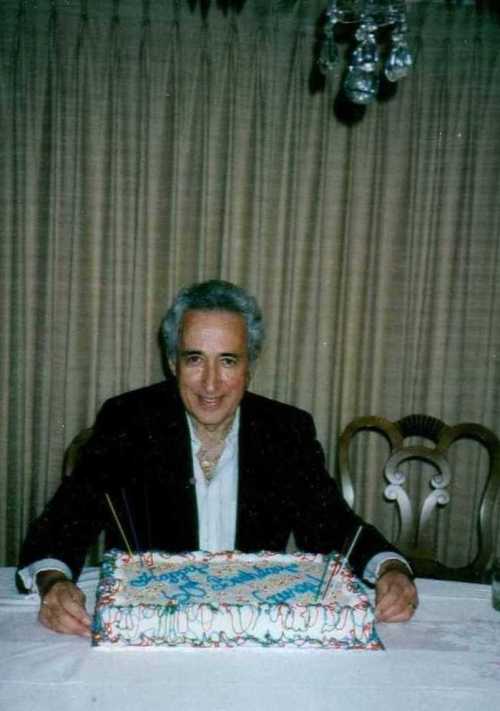
My father at his 60th birthday party in 1993.


My father at his 60th birthday party in 1993.

Leave a comment

Filed under Essays

Father Wolf Transitions

My father in 1949 at age 16.

My father in 1949 at age 16.

At one family Christmas gathering in the 1980s, someone had invited an older couple most everyone knew.  They often provided musical entertainment at such gatherings; with the man playing a guitar, while he and his wife sang.  During this particular evening, the woman brought out a set of maracas and began yodeling.  I have to concede that – up to that point – I had never heard a Mexican yodeling.  I always thought yodeling was a characteristic unique to people only of Nordic extraction.  Even though I’m one-quarter German, I don’t possess such a talent.  But, if you’ve ever heard a Mexican yodeling…well, imagine a Chihuahua having a Maalox moment from hell.

Some of my male cousins and me tried to sustain our laughter and wondered how long this would continue.  The gathering took place in the house of one my aunts, Teresa, and her husband, Chris.  A massive abode with a wide, marble-laden foyer, a living room or seating area sat off to the left upon entering, and a formal dining room to the right, which allowed entry into the kitchen.  Most everyone had gathered in the spacious den, with several others in the kitchen and another dining area.  I stood in the den, with my cousins, our backs to the covered patio, with a clear view of the foyer and the front door.

As the woman yodeled, my father suddenly catapulted from the dining room into the living, straddling a broom like it was a toy horse.  He sported a bright smile and waved to the crowd in the den.  Those of us who saw him burst into hysterical laughter, while those closer to the kitchen, against the fireplace, or against the wall parallel to the entertainment duo jumped to their feet.  They clustered en masse in the center of the den, just in time to see my dad gallop back across the foyer into the dining room.  The woman singing saw him on the return jaunt and almost lost control of her voice.

It’s those moments that kept circulating through my mind these past several days, as my father, George De La Garza, began his transition into his next life.  It began last Monday, June 6.  After enduring an array of health problems over the past few years, capped by two weeks in the hospital just last month, he’d finally had enough.  We had a brief memorial service Saturday morning, the 11th, at a local funeral home.  Both my parents were wise to make funeral arrangements five years ago.  They had initially bought cemetery plots, but decided afterwards to be cremated and sold the plots back to the funeral home.  My father didn’t want an extended funeral; no real funeral at all, in fact, with a Catholic rosary, a lengthy mass, a parade of limousines and another service at the grave site.  His philosophy was simple: “just throw me in a box, toss me into the ground, say your prayers and go on with your own lives.”

I had written of my father previously, but he didn’t like too much attention bestowed upon him.  He was a unique character who liked to make people laugh and who often made himself the butt of his own jokes.  As a teenager, he’d often play pranks on his mother, Francisca.  Once she sent him to the store with a list of items to buy.  He left the house briefly and sneaked back inside and went into his parents’ bedroom; where he called the home phone number.  In those days, if you had more than one phone in the house, you could actually call your own number from within, and the other phone would ring.  His mother picked up the phone in the kitchen.  My father pretended to be at the store and confused by what she’d written on the list.  He aggravated her, until finally he set down the bedroom phone and startled her by walking into the kitchen.

My paternal grandparents had eleven children, but four of them – two boys and two girls – died either as infants or toddlers.  That was common in those days – couples would have several kids and some may die not long after birth.  But my father often said his parents had so many kids because his mother was hard of hearing.  As they got ready for bed, my grandfather would ask, “Well, do you want to go to sleep, or what?”  And my grandmother would respond, “What?”

My mother certainly didn’t escape his humorous wraths.  He told me that she and her younger sister, Angie, were so mean and bitter because they’d grown up in México picking avocadoes.  When their father decided to move the family to the U.S. in 1943, my father said, he could only afford train fare for four people.  So he went, along with his oldest daughter, his son and his mother-in-law.  For my mother and Angie, according to my dad, my grandfather leased a donkey and told them just to ride north until you run into bunch of White people speaking only English.

Like most men, he was fiercely protective of his family.  My mother told me years ago that, if my father knew how some of the men talked to her at the insurance companies where she worked her entire life, he’d probably be in prison; meaning, he’d most certainly kill more than a few.  He always said he’d know I would be a boy.  One particular picture he took of me as an infant, he said, was the mirror image of what he’d dreamed about while my mother was still pregnant.  She almost lost me twice during what she said was a 10-month pregnancy and was in labor for several hours.  While they languished at the hospital, the staff was trying to reach the pediatrician; this being a time before pagers and cell phones.  When he finally showed up, my father asked where he’d been.

“What’s the big deal?” replied the doctor.  “You have a date tonight?”  I guess he was trying to be cute.

But my father – usually catching the humor in someone’s tone of voice – grabbed the man by the lapels of his jacket and slammed him up against a nearby wall.  “Listen, you bastard!  My wife is in pain, and I want to know what the hell you’re going to do about it!”

My dad could still find some way to turn a bad situation around.  During the extended funeral of John F. Kennedy, my parents had gathered with other friends and relatives at the home of my father’s older brother, Jesse, and his wife, Helen.  At one point, Helen asked why the “flags were halfway up the poles.”

“Because they ran out of string,” answered my father.

About fifteen or so years ago, my parents agreed to watch the pet goldfish belonging to the daughters of some neighbors; a younger couple who are about my age.  One day my mother changed the water in the fish bowl.  The next day the fish were dead.  My parents hurried to a pet store to buy two more goldfish; hoping the neighbors wouldn’t notice.  But those fish also died.  My father told me what happened, adding, “Damn!  I didn’t know I was married to a serial killer!”

I stare at pictures of my father scattered throughout the house and notice, in almost all of them, he’s smiling and / or laughing.  He was that rare type who never met a stranger.  Unlike me, he was an extrovert.  I always admired that about him.  He could never understand why it was so hard for me to make friends.

His health had begun to take a more dramatic turn for the worst at the end of 2014.  Following a partial colectomy, he was hospitalized twice for kidney failure.  He vowed he’d never allow himself to be taken to the hospital again.  “I want to die here at home.”

But, one weekday morning a month ago, he had a change of mind.  “I think I need to go the hospital.  I want to live.”

So I called 911 and had him hospitalized.  He again was suffering from kidney failure, but this time, his gall bladder had also become infected.  They got him as stable as possible, and after two weeks, I convinced the doctors to let him go.  Technically, from a medical standpoint, he wasn’t actually ready to be released.  But I made it quite clear to all the attending physicians that he needed to be home.

I had asked him only once the previous week, if he wanted to go back to the hospital.  He shook his head no.  He knew this was it.  The end for him was near.  I knew it as well, but I was still trying to get him healthy.  It’s so difficult to see a loved one in the grip of such physical agony.  It was so tough to see a man who radiated vitality – even into his 70s – gasping for air and barely able to move.  I had prayed for his suffering to end.  And we all know the old saying, ‘Be careful for what you wish for; you might just get it.’  Short of a miraculous recovery, my father’s health just wasn’t going to improve.

He wanted to die at home.  He wanted to pass away in the house he and my mother had worked so hard to buy and to keep.  And I wanted to grant him that wish.

My dog, Wolfgang, who will turn 14 this week, initially wandered throughout the house looking for my father.  Then, over the past few days, I noticed that something seemed to be catching his attention.  He’d suddenly sit up or prick up his ears.  And then relax.  I believe animals possess a stronger sensory perception than we humans.  It’s their one superior trait.

My grandmother Francisca died in February of 2001, almost three years to the day after the death of her eldest daughter, my Aunt Amparo.  The next two deaths were my Aunt Teresa and my Uncle Jesse, both in 2004.  Several months after Jesse’s death, my father had a strange dream that he couldn’t explain until after he told me about it.  He was perched on a tractor lawn mower, plowing through a large expanse of grass, when he noticed a group people perched beneath a tree.  As he got closer, he realized they were his parents and three older siblings.  He could see his father completely, but he could only see the top halves of his mother and Amparo.  Teresa was covered by a black veil, and Jesse was off to one side, shrouded in darkness.

My grandfather motioned for him to come closer and then asked him if he wished to join them.  Was he – in effect – ready to give up on this life?  My father said he turned to the field of grass and said no – he had too much work to do.  And then he woke up.

I realized the grass was a metaphor for all of the things my father still wanted to do in his life.  It was symbolic, too, because he loved gardening.  I also realized that – as my father had described them – the family’s appearances represented their time on the other side.  His father had died in 1969, so his spirit had time to metamorphose into what was a familiar figure.  His mother and Amparo had only died a few years earlier.  Teresa and Jesse and arrived on that side the year before, so their spirits hadn’t had enough time to take shape into people he’d recognize.  He only knew it was them because they each spoke to him.

I don’t believe the human soul has any definite shape, color or mass.  It’s not like what we see here.  I’m also much more spiritual, even though I started off the memorial service with the Lord’s Prayer.  I want to pray to my father to help me through the ensuing difficulties with my mother.  He’s just begun his transition into that new life, however; so I don’t want to disturb him too much.  Allow me to be greedy, though.  I miss him terribly.  My heart still aches, but I’m more at ease now than I have been in over this past week.

On Sunday night, June 5, my father kept pointing forward and uttering something.  After a minute or so, I finally understood what he was saying, “Door.”  There was a door in front of him; not the bedroom door.  That other door.  He was finally able to step through it.  And that’s what needed to happen.  At some point in time, we all step through that door.  No one really dies.  The body perishes, but the good souls remain alive.

My father and me in 1966.

My father and me in 1966.

6 Comments

Filed under Essays

God Damned Texas

texas

Well, hell!  God must have, considering the gallery of lunatics the Lone Star State has put into public office in recent years!  I can honestly say I’ve never been more embarrassed to be a Texan (or an American, if you look at the current presidential race) than I am now.  I opined two years ago that I hope Ted Cruz runs for president and gets his ass slaughtered in the process.  So far, he’s one of only three survivors in the Republican field.  I eagerly await the political bloodbath at the GOP convention in Cleveland this summer.  I have a perverted fascination with seeing arrogance publicly butchered.  Cruz has made a number of incendiary comments, including that the United States will collapse into the fires of Satan’s lair because gay marriage is now legal – as opposed to the centuries of European-induced Indian genocide and Negro slavery where nothing so calamitous occurred.  There are too many idiocies that came from his mouth to highlight here.  I mean, I wouldn’t know where to begin!  But one recent revelation is that he tried to uphold a state law banning the sale of sex toys, which he said safeguards “public morals”; adding that “police-power interests” are a tool (pun intended) in “discouraging prurient interests in sexual gratification, combating the commercial sale of sex, and protecting minors.”  That’s right.  Cruz believes police have the power to invade your home and yank a dildo out of your ass or vagina!  All in the name of protecting children, of course.  Like so many right-wingers here in Texas, Cruz is willing to move heaven and Earth to protect children from wayward sexuality, while ignoring the fact most of those children are uninsured.  Priorities, people!  Priorities!

Canadian-born, Cuban-Italian Cruz certainly isn’t the first Texas official to spout out such twisted logic.  This state has a long history of generating some colorful characters.  During the 1990 governor’s race, Republican oilman Clayton Williams said, among other gaffes, that bad weather was like rape; it’s inevitable, so you might as well lay back and enjoy it.  As you might expect, the old bastard also insulted Blacks and Hispanics.  But here’s the sad part: he garnered nearly 40% of the votes.  Fortunately State Treasurer Ann Richards won.  Unfortunately, she lost four years later to the grandest of all Texas political goofballs: George W. Bush.  It’s around that time when Texas politics began sliding into the surreal – enough to make Salvador Dalí jealous.

But the past decade alone has seen the dramatic rise of Texas’ quirkiest politics stars.  I now present the following three jewels of cluelessness.

Ken Paxton – The state Attorney General has been in legal trouble almost from the moment he was sworn into office.  In July 2015, Paxton was indicted on felony charges for repeatedly breaking state securities laws during his tenure as a state lawmaker.  Then a new charge that he deliberately misled investors in a technology company arose.  Amid raising thousands of dollars from the investors, Paxton supposedly also received commissions – something he didn’t reveal and something that’s, you know, kind of illegal.  His attorneys tried to get all the charges dropped, but the judge handling the matter refused and ordered Paxton to be arrested in Collin County, just north of Dallas.  Paxton had to undergo the usual rigmarole of fingerprints and mug shots.  Whenever people in Collin County, Texas are arrested, officials wrap a white towel around their necks before taking the requisite glory shot.  But, because Paxton is a high-ranking state figure, he got the anticipated special treatment and was photographed sans towel.  (Trying to be discreet, Paxton had met with William Mapp, one of the energy company’s co-founders at a Dairy Queen in McKinney, which is in Collin County, in the summer of 2011.  According to most Texans, Dairy Queen is a step above Burger King.)  While Paxton is currently trying to stop a group called Exxotica from staging a sexually-oriented exposition in Dallas this summer, news reports now reveal that Paxton is still paying top aides who left the attorney general’s office more than a month ago.  The Securities and Exchange Commission (SEC) is investigating the investment deal, and Exxotica is threatening to sue the city of Dallas, if it violates their contract to proceed with the exposition.  I truly hope the SEC wins, and then, I’ll join them at the Exxotica convention.

Louie GohmertThe East Texas congressman takes outlandishness to a new level.  As with most right-wing political figures, Gohmert doesn’t want anyone telling him what to do with their guns, but he feels the urge to tell people what to do in their own bedrooms.  Aside from his staunch opposition to abortion (a given trait among conservatives), he’s compared limiting the size of ammunition magazines to bestiality and opposes gays from serving in the military because they’d spend more time giving each other massages on the front lines than fighting.  (What the hell’s wrong with massages?!)  In light of President Obama’s election wins, Gohmert has co-sponsored a “birther” bill that would require presidential candidates to submit their birth certificates as proof of eligibility to run for the White House.  Recently he opposed a bill that would have directed education funding to recruiter more women in the sciences by claiming it’s gender-biased and that even Martin Luther King would have opposed it.  Not knowing when to shut the hell up, Gohmert went on to add that such a bill would have distracted Marie Curie’s research and put “millions and millions of lives” in jeopardy.

Sid Miller – Like most politicians, the state’s Agriculture Commissioner has a penchant for travel.  And, like most politicians, he claims it’s all done in the name of state business, and therefore, he’s justified in charging taxpayers for his expenses.  But the $2,000 he spent on a 2015 trip to Mississippi to compete in a rodeo for prize money probably doesn’t fall into the business category.  He engaged in calf-roping events and won $880.  He tried to explain the trip’s importance by claiming he had set up a “work meeting” with Mississippi’s agriculture commissioner and other business people.  But wait!  It gets weirder.  Miller also may have charged Texas taxpayers the $1,000 it cost to fly to Oklahoma to visit an old friend, Michael Lonergan, a discredited Ohio doctor, for a “Jesus shot.”  Yes, Miller – who apparently suffers from chronic back pain – needed the spirit of the Lord pumped into his tired body via a concoction of unknown ingredients that’s injected into the upper arm.  Lonergan served prison time in Ohio for tax evasion and mail fraud, before relocating to Edmond, Oklahoma.  Miller is reimbursing the state of Texas for the trip “out of an abundance of caution,” according to his spokeswoman.  But the Texas Rangers, a state police agency, is still investigating.  My idea of a “Jesus shot” is a heavy duty screwdriver made with Smirnoff citron vodka and a bottle of baby oil; then shouting, “Jesus!” as I wipe my face.  I have videos in exchange for contributions to a charity of my choice – mainly my freelance writing fund.

Miller spent $55,000 decorating his office.

Miller spent $55,000 decorating his office.

Mary Lou Bruner – The 69-year-old retired teacher is seeking to be the next president of the Texas State School Board, the entity that has made all of Texas the literal laughingstock of the nation.  Bruner subscribes to the usual right-wing ideology: the Earth is only about 6,000 years old; there was a man named Noah who built a massive ark and that dinosaurs were among its passengers; climate change science is leftist bullshit; and 20th century liberals rewrote the history of the Civil War only to make it look like slavery was the root cause.

But, among her myriad Facebook rants is this lovely tidbit: “Obama has a soft spot for homosexuals because of the years he spent as a male prostitute in his twenties. That is how he paid for his drugs. He has admitted he was addicted to drugs when he was young, and he is sympathetic to homosexuals; but he hasn’t come out of the closet about his own homosexual / bisexual background. He hasn’t quite evolved that much! Since he supports gay marriage, he should be proud of his background as a homosexual/bisexual. He is against everything else Christians stand for, he might as well be for infidelity.”

Facebook forcibly deleted that post, and even some of Obama’s most ardent critics here and across the country thought that went too far.  Of all the disrespectful crap lodged at our first biracial president, that’s the most slanderous.  As far as I can tell, though, she’s never apologized for it.  A spokeswoman for the Cherokee County, Texas Republican Party dismissed the response to Bruner as excessive; describing her as “a nice older lady who doesn’t understand social media and the impact that it can have.”

No one has to “understand social media” to realize calling somebody a prostitute and a drug addict is offensive and just plain stupid.  Do you need a PhD in astronomy to understand that the sun rises in the east and sets in the west?  What’s worst, however, is that – given Texas’ dismal voting record – Bruner stands a good chance of actually winning that coveted seat on the school board.

There’s also a good chance Paxton and Miller will both remain in office.  In the U.S., a true double standard exists when it comes to elected officials facing criminal charges.  People are routinely thrown in jail for possessing a pinch of marijuana or talking back to a police officer.  Sandra Bland, anyone?  But use your official power to skirt the system?  Well… that’s up for discussion.  I have no hope for the future, but will keep writing to avoid a visit from the FBI.

Although Texas gave the nation – and the world – Dick Cheney and Enron, it also produced the U.S. space program, Buddy Holly, Janis Joplin, ZZ Top, Beyoncé, Eva Longoria, frozen margaritas, Shiner Bock, Whole Foods Market, silicone breast implants and, of course, Chief Writing Wolf.  So, things aren’t that bad down here!

On a side note, I really do plan to patronize Exxotica and display my version of the “Jesus shot”: a bathtub filled with Mike’s HARD Lemonade; a liter of Red Bull; a sounding rod; heated Vaseline and a high-definition video camera.  I’ll email copies to Bruner and Cruz to show what they’re missing while campaigning.  After all, politics is bad for both body and soul.  Yee-hah!

Leave a comment

Filed under Essays