Category Archives: Essays

Drawing Lines

Masked-gunmen-stormed-the-headquarters-of-the-weekly-Charlie-Hebdo-in-Paris

In March of 2003, the Dixie Chicks prepared to take a stage in London, when lead singer Natalie Maines declared that she and her bandmates were “ashamed the President of the United States is from Texas.” She was referring to George W. Bush (who was actually born in Connecticut), and the U.S. was on the verge of invading Iraq. In a sense, Maines was joking, but within hours, her comment thrust the group into the most unfavorable of positions. Country music fans across the U.S. demanded their local radio stations stop playing the Dixie Chicks music, and the group became the subject of hate mail and death threats. Shortly afterwards, ABC correspondent Diane Sawyer interviewed the group, during which she repeatedly asked Maines why said something so disparaging about the president of the United States. In all my years of watching politics and paying attention to how our elected officials interact with the news media, I’d never seen so much antagonism launched at one individual over a simple comment.

For one thing I am embarrassed that Bush claims he’s from Texas. I remain embarrassed that this state put him in the governor’s mansion twice and helped to place him in the White House twice. Bush is one of the worse presidents the U.S. has ever produced. I know plenty of people who would disagree with me, and we could argue about it for days. But one thing is certain: we all know we have the right to feel that way and we certainly hold the right to express our sentiments about the matter. After all, Maines didn’t curse; nor did she call Bush an idiot or a mass murderer. She didn’t threaten his life. She just opened her “big mouth again,” as she later stated, and said something. The trio eventually got their careers back on track, but I don’t think the band has fully recovered in terms of popularity.

I thought about the fiasco surrounding Maines’ comment, when the massacre at the offices of Charlie Hebdo exploded the other day. Three Islamic fundamentalists, apparently angry that the long-running satirical French magazine had the audacity – yet again – to insult their religion and the prophet Mohammed, stormed into the building and gunned down 11 staff members. They’d also gunned a Parisian police officer – a Muslim – outside the building. One of the men turned himself into authorities immediate, while the other two fled and – as of this writing – have been killed. The tragedy reminded many of the 2005 publication of a cartoon of Mohammed in Denmark’s Jyllands-Posten and the vitriolic response from many in the Muslim world.

First of all, it is an offense to Islam to publicize any delineation of Mohammed; unlike, say, Roman Catholicism, which is virtually idolatrous with its many renditions of Jesus, Mary and their gallery of saints. Second of all, I don’t care. If anything, Muslims should be upset by the September 11, 2001 attacks on the U.S.; the March 11, 2004 Madrid train bombings; or the July 7, 2005 London train bombings. I imagine most were. I’m not one to be judgmental, but I am a strong supporter of free speech. So were the folks at Charlie Hebdo. And now, most of them are dead.

It’s a tricky thing – free speech. Just about everyone I know has expressed their strong support for it. It’s a critical element of any truly democratic and civilized society. But, as with all other freedoms, it’s cumbersome when you confront the words of those who are your ideological opposites; people who say things you find offensive, even vulgar. Free speech (and its ideological cousins, freedom of expression and freedom of religion) was at the center of the push to legalize pornography in the U.S. in the early 1970s. In the spring of 1977, it was a key component of the right a group of neo-Nazis proclaimed when they petitioned to march down the streets of Skokie, Illinois, a community with a large Jewish population. The Westboro Baptist Church relied solely on the First Amendment to the U.S. Constitution to protest at the funerals of deceased military personnel, claiming the latter died for a country that supports abortion, homosexuality and other perceived evils. Their case made it all the way to the U.S. Supreme Court where they won. It’s not okay to call someone a murderer, but it’s apparently okay – according to the decision – to shout, ‘Thank God for IEDs.’

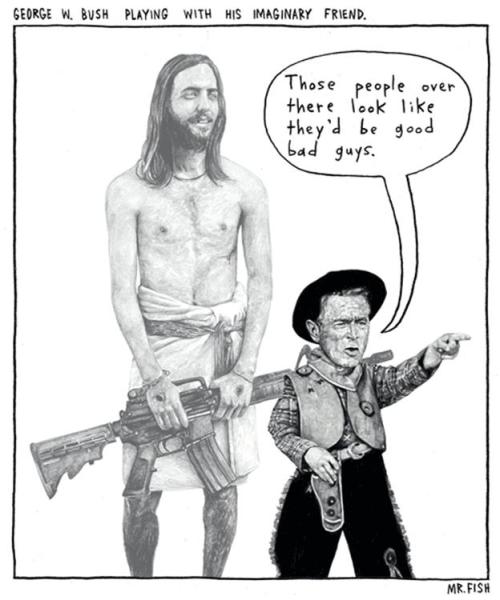
This 2007 cartoon by “Mr. Fish” upset plenty of people.  I still think it’s funny and truthful.

This 2007 cartoon by “Mr. Fish” upset plenty of people. I still think it’s funny and truthful.

Where should that line be drawn? Or should there even be a line?

In February of 2008, my then-ISP, AOL, published a story on how, in 1504, Christopher Columbus allegedly deceived Jamaica’s indigenous Taino Indians into believing the gods were unhappy with their treatment of him and his stranded crew and would cause the moon to turn blood red. Columbus apparently knew of an upcoming lunar eclipse on February 29 of that year. When it did occur, the Taino supposedly became terrified and were convinced Columbus was some kind of deity. There are countless stories like that about early interactions between Indigenous Americans and Europeans. I had never heard of that particular story until I saw it on AOL in 2008. Then I saw something else. Someone had commented that, despite everything “no one has suffered like the Jewish people.” What the hell?! I thought. Where did that shit come from?! It was like commenting how much you like glazed doughnuts in an article about refurbishing your dining room. I quickly responded with a profanity-laced diatribe, pointing out that Jews haven’t endured one fraction of the suffering in the Western Hemisphere that Indians and the African slaves brought over to replace them have. I was careful to mention ‘in the Western Hemisphere.’ Apparently either that original commenter or some other fool got their little feelings hurt and reported me to AOL. AOL then deleted the comment and put me on “probation,” which meant preventing me from commenting on anything on their site for a while. Gosh, can you imagine how mortified I was? When I called AOL tech support in India (the land where Columbus thought he’d landed), a representative couldn’t (or wouldn’t) tell me who had reported me. I noted that, here in the U.S., foul language fell under the regimen of free speech. After all, I didn’t make a bomb or death threat against anyone. I didn’t accuse anyone of being a pedophile or arsonist. I just called some Jewish guy a dumb fuck, which he was, because of what he said. The tech rep refuted my claim and said she could do nothing about it. Eventually they let me off probation. God, I was so relieved! I wouldn’t have been able to live otherwise.

The cartoonists at Charlie Hebdo always pushed the boundaries of personal tastes. Their efforts seemed destined to offend anyone and everyone. It’s curious, though, that France finds itself in this situation over a cartoon. According to Human Rights Watch, between 2004 and 2011, French law enforcement fine 594 Muslim women for wearing the niqab. Yet, in 2008, legendary French actress Brigitte Bardot went on trial for the fifth time because she’d insulted Muslims. She had said that Muslims were “destroying our country.” A devout animal rights activist, Bardot had gotten into trouble previously for disparaging the Muslim custom of slaughtering goats during the Eid al-Adha festival. She was literally dragged into court over these matters. Seriously? In freedom-loving France, it seems political correctness is meted out with a vengeance.

Again, I ask where is that line between free speech and common decency supposed to fall? Whose free speech? And whose decency? It’s a never-ending debate.

Mr. Fish.

6 Comments

Filed under Essays

Writing Lives

603cuneiform

Think about what it takes to create a writing system from scratch. Imagine the intellectual aptitude of someone who draws an image on a rock, in the sand, or anywhere and declares that it represents something – a word, an action, a single sound. What is required of somebody to actually sit down and do that?

Not long after I began walking and talking around the age of 9 months, my parents started teaching me to read. The books were those simply-worded “See Spot Run” types, but I took to them with an uncannily inborn sense of ease. Whenever my folks became engaged with some task around the tiny two-bedroom apartment where we lived, they made sure I was either asleep or sitting on the couch with one of those books. Many of those colorful little pre-school tomes were “Golden Books,” the classics of childhood literature that helped to educate the young masses. I still have scores of them stored away neatly in boxes; surely they’d be collector’s items by now.

By the age of 5 – even before entering kindergarten – I was writing stories. Although I could speak in complete sentences and use seemingly grown-up words (my parents never “baby-talked” to me), putting those thoughts into written form became my primary means of communication. I’ve been reading and writing ever since.

My precociousness wasn’t always viewed with admiration. As a first-grader at a Catholic parochial school in Dallas, me and my fellow students were required to look at our name plates before carefully copying our names onto sheets of paper. I looked at mine once and, upon the second time I had to write it, I simply did so from memory. Proud of my accomplishment, I displayed the sheet of notebook paper to the nun teaching the class.

Her reaction was harsh. “Don’t ever do that again!” she chided.

It didn’t seem to matter that – all of 6 or 7 years of age – I successfully reprinted my name after having looked at the plate once. So I sauntered back to my desk, feeling humiliated and dejected.

Bitch!

I recounted the incident to my parents that evening at dinner, and they beamed with pride. My father reassured me I did nothing wrong and told me, from that point onward, just “pretend” to look at my name plate. I followed his advice, confident in my new-found ability. I never again looked at that stupid name plate; neither did I try to impress that decrepit nun. I surmised some time later that a vow of poverty, coupled with a life of celibacy and a cardboard headdress, must have a nasty impact on a woman’s cerebral capacity.

Another incident at that same school a few years later, however, made me question everyone in the education field. A lay teacher arrived at the school in the fall of 1976 to teach English. She and I got along nicely at first. But my impulsive audacity to question certain things apparently made her head hurt, and she’d stare at me from behind those gigantic 1970s-era glasses (the kind that now would qualify as motorcycle windshields) and seethe with frustration.

Other students in the class loved when her and I got into those “fights,” as one boy described them. That teacher certainly didn’t enjoy it and used every opportunity she could scrounge up to humiliate me in front of my classmates. Then, one morning, things came to a head between us over a single word: llama.

Because it’s a Spanish-language adaptation of an Indian term for the only draft animal to evolve in the Western Hemisphere, I knew it was pronounced “yama.” In Spanish, a double “L” bears a “Y” sound. The teacher shook her head no and insisted it was pronounced “lah-mah,” with the “L” clearly enunciated. I didn’t budge. I knew I was right.

Yet our constant linguistic tennis match finally made a few of her precious brain synapses explode, and she literally yelled at me to shut up and pronounce the word the way she saw fit – with that Anglicized “L” sound.

A near-deadly pall enveloped the room like a tsunami accosting a beachfront. Everyone fell silent, and the teacher ordered me to remain after class. My heart sank, and my stomach felt hollow.

After my fellow students departed, the teacher stuck a well-manicured fingernail into my quivering face and told me never to question her authority again. “Do you understand me?” she growled.

A weak “Yes, ma’am” tumbled from my lips. That evening at dinner I recounted the entire episode to my parents. This time they didn’t offer any coy suggestions for me to remain quiet. Arriving at school the next morning, both of them promptly entered the building with me and demanded to speak with that teacher.

The principal, a feisty and intimidating nun named Jean, told them they either had to make an appointment or wait until an upcoming parent-teacher conference.

My father, who was growing increasingly disillusioned with Roman Catholicism altogether, leaned forward onto the paper-cluttered desk and said, “Jean, get her in here now, or I’ll go find her and drag her ass in here myself.”

Sister Jean’s eyes widened, and her self-righteous demeanor crumbled faster than a Ku Klux Klansman accidentally entering the Pine Ridge Indian Reservation with a suitcase full of Christian bibles. The lay teacher arrived, and, as I waited outside by the secretary’s desk, she tried to explain her side of the story. My parents had always been renegades, but they were also fair. I don’t know what all was said amongst them, but my father made it clear that she was never to yell at or humiliate me in front of the class. He and my mother also made that teacher realize my pronunciation of the word “llama” was correct. Technically, everything was settled, but she still gave me a “B” for that spring semester. It didn’t matter. I graduated from the school shortly thereafter and was more than glad to get the hell out of there.

Neither of those situations diminished my love and passion for the written word. I’ve remained an avid reader and writer. And, just like I resisted the demands of those two teachers to think and behave differently, I’ve resisted any attempts to downgrade my intellect or circumvent my literary aspirations. As we stand on the threshold of this pioneering electronic medium called blogging, I think of the countless writers and poets who simply wouldn’t give up on their dreams to describe the world as they see it, or to tell the truth as they know it. I’m a strong advocate of the First Amendment to the U.S. Constitution, which guarantees free speech. But the power of the written word transcends that.

Writers have always been at the forefront of social and political changes. Powerful elites have tried to silence us; lest the truth gets out to the otherwise loyal masses who then should dare to forget their places in a carefully-structured society – places designated by those same powerful elites. Education and literacy are the best tools against tyranny and oppression. Once someone learns how to read and write, they start to think for themselves. And, while that’s good for society as a whole; for some, it forebodes danger. It’s why, for centuries, the Catholic Church tried to keep books out of the hands of commoners, especially women. It’s why, in the aftermath of the American Civil War, some Whites tried to do the same with the freed Negro slaves.

In more recent years, a number of journalists have been murdered in México, as they covered that nation’s ongoing war against the drug cartels and linked some of that violence to government and law enforcement officials.

Of course, composing short stories for my blog or recounting skirmishes with haughty nuns and teachers doesn’t constitute a battle against repression. But, from the moment some six millennia ago, when an unknown individual in the Sumerian desert carved the emblem of a human head in conjunction with a fish to indicate eating, writing has been an essential and inescapable attribute of our existence. I observe, from the comfort of my suburban home, the battles between police and drug lords in México and wonder if any of them are aware that a form of writing arose in the central part of that country around 600 B.C. Do they even realize how significant that is, not just in México’s history, but the history of the world?

I swing my attention to the mountains of landlocked Afghanistan and question if any of the men training to attack Europe and the U.S. in the name of Islam realize their ancestors corresponded frequently about such matters as the possibility of an afterlife and how birds stay aloft. How did that area reach the 16th century and become stuck there?

I remain passionate about literature and education, even in this increasingly digital world where cell phone text messages have become the norm. I have no less than 400 books crammed into my home, placed neatly on shelves or stacked atop one another. They cover everything from art to political science. Moreover, I have scores of magazines: “National Geographic,” “International Artist,” “The Sun,” “Indian” and the “Smithsonian.” And I keep adding to my repertoire. My only hope is that I get to read them all before I die, and even then, maybe carry them with me into the afterlife.

Regardless of what happens anywhere in the world, I know we writers will win the ongoing battles against ignorance and arrogance. Whether we have to stay after class for daring to question a teacher over the pronunciation of a single word, or stand before a hostile government that only wants so much of the truth to get out into the world, writers will always win. Even if we have to die for it.

Image: Mr. Dowling.

5 Comments

Filed under Essays

Responding Accordingly

DonkeyInTheWell

A couple of weeks ago the Texas Democratic Party emailed questionnaires to registered voters, asking how we felt about their performance throughout this year’s political campaigns. I’m still disappointed (angry, in fact) that only about a third of eligible Texas voters made it to the polls last month. Many of these people are the same ones who’ll camp out in front of a Wal-Mart on Thanksgiving night, hoping to grab a new wide-screen TV or I-phone.

But I’m equally pissed off at the TDP for staging such lackluster attempts to win some of the state’s top positions for the first time in two decades. It’s bad enough the National Democratic Party has practically abandoned the state of Texas, leaving we moderates and independents to fend for ourselves, like pit bulls at a Michael Vick family reunion. The TDP didn’t focus on the core values for which Democrats are known, such as free speech, voting rights and worker protection. All of Texas’ Republican candidates centered their respective campaigns on two issues: expressing just how much they hate President Obama and protecting gun rights. I hate to think what would happen if a Republican garners the presidency in 2016, which is a possibility.

Below are the actual questions from the survey, along with the responses I submitted. Beneath each of those, however, I’ve added my extended replies.


What do you think we did well during the 2014 elections?

Not much.

You screwed up just about everything from the start. A Girl Scout troop has more organizational skills than the TDP.


What do you think we could have done differently?

Never start a campaign with negative attack ads. Start by emphasizing your candidate’s positive aspects; e.g. what they’ve done to improve their individual communities and what they plan to do to make things better. In this case, for example, the Democrats should have emphasized that most of the jobs created in Texas have been temporary or contract with no benefits; that the GOP isn’t concerned with income equality or protection for workers. You also needed to hit back at the Tea Party faction of the GOP, emphasizing how extremely right-wing and bigoted they are.

Wendy Davis should have emphasized that she was once a struggling single mother who managed to make it through law school with little help from the state, the federal government, a man or a pack of pea-brained evangelical Christians. Instead, her first TV and radio ads focused on what she felt Greg Abbott has done wrong during his tenure as State Attorney General. The TDP should have pointed out that people like Rick Perry and Ted Cruz are right-wing loudmouths who make Kim Jong-Un look like Mother Teresa. Call the “Tea Party” what they are: a pack of rabid neo-Nazi assholes who hate anyone who isn’t a White, heterosexual Christian. Go ahead and embrace the term “liberal” – it’s not a dirty word – and highlight the fact that liberals, progressives, etc. want to move America forward, whereas conservatives want to take it back to a time when only a handful of people had all the wealth and power.


What were your favorite moments or stories of 2014?

None.

I’ve seen Bugs Bunny cartoons with more inspirational moments.


In what ways were you able to hear from Democratic candidates?

image002

I hate robo-calls. I’ve never met anyone who’s literally willing to sit there and listen to a candidate talk about how great and wonderful they are and therefore, you should vote for them. If they are, they’ve either overdosed on oxycontin or they’re having a hellacious Maalox moment.


What do you think we can do to get more Democrats to the polls?

Emphasize that voting is as much a responsibility as a right. Point out that many Americans have fought very hard to earn the right to vote and that conservative Republicans have tried to squash those rights in recent years with gerrymandering laws and voter intimidation.

Show old film footage of policemen attacking unarmed, mostly Negro citizens who were merely trying to register to vote and connect it to contemporary assaults on voting rights. The TDP should have stressed that many White conservative voters were upset that a half-blooded Negro won the presidency twice against full-blooded White men.


What do you think Democrats need to do to win in the future?

I’m not looking forward to 2016. I don’t feel there’s a single candidate at the national level who’s worth my vote.

What I said above: focus on free speech and voting rights. Don’t spend so much time worrying about who’s being tortured at Guantanamo Bay. Most of us don’t give a shit that some illiterate camel jockey can’t get a copy of the Quran, while we’re trying to find a job or pay off medical bills. And stop coddling illegal immigrants! They can’t vote anyway. And, in case you haven’t figured it out, there’s a reason they’re called “illegal immigrants.” It’s because they entered the United States illegally!


What issues are a priority for 2016 you’d like to add?

What moderates, liberals and independent thinkers have been emphasizing for the past several years: income inequality, free speech and voting rights. I’m especially tired of the Democratic Party asserting that the only way to appeal to Hispanics is to establish a comprehensive immigration policy. Immigration is NOT the only issue Hispanics are concerned about. Democrats also should have pushed President Obama to remove the individual mandate from the Affordable Care Act. Most Americans are concerned about jobs and the economy; more than they are about health care. The health care matter will take care of itself if people have solid jobs with good salaries.

You let the Texas Republican Party define you and your agenda. They kept tying all Democrats to the Washington, D.C., establishment elite. And how did you respond? With those fucking robo-calls asking folks to vote for you. Get real, people, and then get rough! Texas Democrats need to show we’re a different breed from the mainstream party. We don’t want to turn Texas into another California or Illinois where people and businesses are regulated and taxed into oblivion. Texas Democrats can show the national party the right way to do things.


I’m really dreading what will happen in the 2016 elections. Who will the Democrats select as their candidate? Hillary Clinton? Please! She’s past her prime. If she’s all the Democratic Party has, then there really is no hope for the future. And who will the Republicans choose? There’s an endless gallery of scoundrels in that bunch. The “Tea Party” clowns are pushing for Ted Cruz to run, even though, as a Canadian by birth, he isn’t truly eligible. But I’m downright frightened that we could end up with Jeb Bush in the White House. I’d rather catch Ebola while stranded in the desert with a bad case of jock itch.

1 Comment

Filed under Essays

I Hope Ted Cruz Runs for President

cruz

Texas Senator Ted Cruz splashed onto the political scene two years ago when he easily won the seat vacated by Kay Bailey Hutchison. Well-educated and highly intellectual, Cruz was a championship debater at Harvard University and, in 2003, became the youngest Solicitor General in the state of Texas; a role he served in until 2008. Unlike many first-year senators, Cruz quickly established himself as a rugged individualist by being blunt and outspoken. He held true to his base by bashing anyone and anything that didn’t fit his narrow agenda: taxes, regulation, the federal government, and, of course, President Obama. While the Republican National Party was already moving in a more staunchly conservative direction, Cruz seemed to break off his own small faction that slid even further to the right; making Hitler and Stalin look like tree-hugging liberals.

In September of 2013, Cruz incited a shutdown of the entire federal government over funding for the Affordable Care Act. He spoke on the Senate floor for 21 uninterrupted hours and was hailed as a hero by his “Tea Party” acolytes. Cruz and his Republican cohorts were unwilling to reach even a modest agreement with Democrats and Independents on funding the government; so on October 1, 2013, it essentially shut down. Approximately 850,000 workers were furloughed, and another 1.3 million were required to report for work with paycheck dates. The 16-day stalemate was the third-longest government shutdown in U.S. history and cost about $24 billion. As usual, whenever government officials skirmish, average citizens bore the brunt of the shutdown.

Now that Republicans are scheduled to take control of both houses of Congress next month, Cruz is demanding that funding for any of Obama’s programs – namely the ACA – be severed and any presidential appointments be thwarted. In other words, Cruz is pushing for nothing to get done so he can prove his point.

For all of these reasons, I sincerely hope Cruz runs for president in 2016. Not because I like and admire him. I want to see his arrogance get shoved down his throat.

Cruz is already positioning himself for a run. He’s engaged in the vital prerequisites: he’s visited the state of Iowa several times (Iowa is where the nation’s first voting primaries are held each election cycle); he’s solicited a bevy of affluent donors; and he’s expressed his unmitigated support for Israel. All he has to do is give a speech at Bob Jones University saying he doesn’t think Negro slavery was all that bad, and he’ll be good for the Republican Party’s nomination.

But I think once Cruz enters onto that stage, spouting off his vitriolic rhetoric and twisted views on American values, he’ll be shocked to learn not everyone loves him. His right-wing extremism will become apparent. Politics has a way of cutting people down to size. I sincerely feel Cruz will get diced up quicker than squid at a sushi restaurant.

A brief examination of Cruz’s voting record shows his true dimension. Among other things, he’s voted against funding for highways and transportation (three times); the “Bring Jobs Home Act”; the “Protect Women’s Health from Corporate Interference Act”; “Bank on Students Emergency Loan Refinancing Act”; the “Minimum Wage Fairness Act”; the “Protecting Access to Medicare Act”; the 2014 “Emergency Unemployment Compensation Act”; the 2013 “Employment Non-Discrimination Act”; and the 2013 “Student Loan Affordability Act.”

There is one seemingly innocuous fact about Cruz that may play into the hands of his opponents: he wasn’t born in the U.S. He was born in Canada; something from which he doesn’t shy away. Cruz’s father, Rafael Cruz, was born in Cuba and lived under the brutal dictatorship of Fulgencio Batista. In 1957, Cruz managed to escape Cuba and arrive in Texas with only 100 U.S. dollars and the clothes on his back. He had supported Fidel Castro, but now claims he didn’t know at the time that Castro was a communist. There’s a politician, if I’ve ever heard one! In the 1960s, Cruz met and married Eleanor Elizabeth Wilson. Eleanor was born in Delaware to Irish- and Italian-American parents. Rafael and Eleanor Cruz moved to Alberta, Canada where they worked in the oil industry. In 1974, the Cruz family (now including little Ted) moved back to Texas. Rafael and Eleanor divorced several years later. Why they abruptly relocated to Canada in the first place and when exactly they were married and divorced remains unclear. But doubts about Sen. Cruz’s citizenship keep surfacing.

In order to qualify to be President, the U.S. Constitution states, “No Person except a natural born Citizen, or a Citizen of the United States, at the time of the Adoption of this Constitution, shall be eligible to the Office of President; neither shall any person be eligible to that Office who shall not have attained to the Age of thirty five Years, and been fourteen Years a Resident within the United States.”

The precise definition of “natural born Citizen, or a Citizen of the United States” has confounded plenty of legal scholars and amateurs. To many of us, it simply means that you were born in one of the 50 United States, a U.S. territory, or a U.S. military base. But, if at least one of your parents was born in the U.S., then you are a U.S. citizen. My mother, for example, was born just outside of México City in 1932; yet she and her three siblings were U.S. citizens because their father was born in Michigan in 1902. Does that mean she’s qualified to run for U.S. president? I’m not certain. I don’t think she’d want the job anyway; she’d scare the crap out of too many people.

The issue of U.S. citizenship in relation to the presidency has come up before. In 1964, when Barry Goldwater garnered the Republican Party’s nomination for president, some speculated he wasn’t qualified, since he’d been born in Arizona, three years before it became a state. In 1968, when George Romney sought the Republican nomination, he didn’t avoid the fact he had been born in México in 1907. Both of his parents had been born in the U.S. and allegedly fled religious persecution by relocating to México where they and fellow Mormons set up a Mormon colony that still exists. (In reality, the Romneys wanted to maintain their polygamous lifestyle.)

The right-wing hysteria surrounding President Obama’s birthplace and birth certificate is well-documented. The self-righteous “birther” gang maintains that Obama was born in Kenya, like his father, and not in Hawaii, as the president’s birth certificate declares. Some people still don’t realize Hawaii is one of the United States. When I worked for the wire transfer division of a bank in the 1990s, we’d invariably get calls from branch offices asking if a transfer to Hawaii was domestic or international. Not much was made of the fact Senator John McCain was born in the Panama Canal Zone in 1936, when it was still a U.S. territory.

Ted Cruz tackled his own citizenship last year when he released his official Canadian birth certificate and then renounced his Canadian citizenship. I’m sure Canada was heartbroken.

Citizenship matters aside, Cruz may feel self-assured about a presidential run. Anyone who dares to tackle such an office has to be extremely self-confident and just a little bit arrogant. Cruz will find, though, that he has to appeal to a much larger base of people than the gaggle of conservative hardliners that orgasm with his every word. For one thing, he’ll have to appeal to Hispanics. That’ll be especially tough. I guess you have to understand the Hispanic identity in the U.S. Cuban-Americans don’t like to be dubbed “Hispanic” or “Latino” because that places them in the same category as Mexicans, Puerto Ricans, Guatemalans, etc. For some ungodly reason, some Cuban-Americans – Rafael Cruz among them – think they’re superior to other Spanish-surnamed peoples in the Western Hemisphere. As comedian Paul Rodriguez once noted, “When Mexicans enter the U.S. illegally, they take them to jail. When Cubans enter the U.S. illegally, they take them to Disney World.”

Ted Cruz will have no choice but to court Hispanics – and everyone else, regardless of ethnicity – if he wants to live in the White House and be considered the “Leader of the Free World.” It won’t be easy for him; not at all. He won’t be able to justify his extremist views to a broader audience. Then he’ll find himself on that sushi board. And me, personally, I think sushi is disgusting.

4 Comments

Filed under Essays

Slammed

Barack-Obama-images-

It’s been one month since the midterm elections, and a lot of people are still smarting from the results. But several folks saw this coming. As expected, the Republican Party has retained control of the House of Representatives and taken the Senate. But, few anticipated the GOP would garner such high numbers. Moreover, Republicans have attained most of the state governorships. Here in Texas, the GOP has won every major state-level office for the fifth consecutive election cycle. A Democrat hasn’t won a state-wide office since 1994, when Garry Mauro won reelection as State Treasurer. By the time the current crop of officeholders finish their respective terms, Democrats will have been shut out of state-level offices for two decades.

Texas Democrats had hoped this year would be theirs; that they would recapture at least one office, preferably the governorship, but at least maybe attorney general or state treasurer. But they didn’t. They lost – in the worst way. As usual, most voting-eligible Texans failed to turn up at the voting booths this year. In fact, Texas had the lowest rate of voter turnout than any state in the union – roughly 4.75 million people, or 28.5% of the vote-eligible population. In the Dallas – Fort Worth metropolitan area, some local officials blamed the damp, cold weather for the dismal response. Really? I recall an election in India several years ago where some people were being carried in on their deathbeds – literally! – to cast a ballot. Overall this year’s midterm produced the worst voter turnout since 1942. That particular year was understandable: the U.S. had just entered World War II, when many young men had already joined the fight overseas. Men were much more likely to vote than women back then, plus there were a slew of voter restriction laws – especially in the Southeast – to keep poor and non-White voters from casting ballots. But that was then; things have changed considerably in 70 years. I don’t just find the low voter response appalling. I find it disgusting. What happened?

After the 2007 – 2008 financial downturn – a period in which the U.S. came as close to a completed and total economic collapse – people felt their elected officials simply weren’t responding to their needs. President Obama and the Democrats inexplicably focused their energy on passing a healthcare bill and reforming the immigration system. The latter was labeled an attempt to appeal to Hispanics; once again, assuming Hispanics only care about immigration in the same way women only care about abortion and gays and lesbians only care about same-sex marriage. Sweeping assumptions like that are an insult and always dangerous. It’s bad enough, though, the Republican Party was determined from the moment Obama won the 2008 presidential elections to obstruct his agenda. Every conservative lout from Dick Cheney to Mitch McConnell stated publicly and emphatically they wanted to make Obama a “one-term president.” Fortunately, they failed. But they and the Democrats have failed miserably over just about everything, mainly the economy.

My gripe with Obama is his overt willingness to compromise. His first major capitulation to the Republicans came in December 2010, as the Bush-era tax cuts were due to expire. The GOP literally threatened to withhold votes on extending benefits for the long-term unemployed, if tax cuts for the wealthiest citizens and largest corporations weren’t kept in place. Obama bowed to them; declaring openly that he didn’t want “the hostages” to be harmed. In December 2010, the Democrats still held majorities in both houses of Congress, and the President could have very well issued an executive order extending the benefits in question. But he backed down. And that’s when I began to lose respect for him – in the same way I’d long lost respect for most elected officials.

In 1934, when President Franklin D. Roosevelt realized just how bad the Great Depression really was, he made the bold – and shocking – decision to raise taxes on the wealthiest citizens and largest corporations (the same ones who benefited from hefty Republican-spawned tax breaks the previous decade) to stimulate the economy. He convinced these people that such hikes would benefit them, too, in that more Americans would be able to enter the workforce and pay their own taxes, plus have money left over to buy goods produced by a variety of industries. It made sense. The policy worked to some extent, but the 1929 collapse had been so bad, the positive effects weren’t immediate. Thus, economists and the politicians who think they know so much have been debating the logic of this move ever since.

The Democrats failed on another front regarding the economy. U.S. Attorney General Eric Holder never indicted anyone in connection with the recent financial calamity. Anyone with at least half a brain knows it didn’t happen by chance. It wasn’t the inevitable result of market ups and downs. Major banking entities such as Citigroup and Fannie Mae were key players in the debacle. Both helped to create the massive housing bubble at the turn of the century, replete with outrageous features such as zero-down purchases and mortgage-backed securities. As the crisis worsened towards the end of 2008, Citigroup managed to convince the federal government to give it a life-saving multi-billion-dollar loan. But it also began laying off people at its various offices across the globe. Fannie Mae, along with Freddie Mac, also received a multi-billion-dollar, taxpayer-funded bailout; this one in 2009. Yet that investment didn’t become profitable for taxpayers until this year. The average American worker hasn’t seen a lot of positive returns on their “investments” to save the “too-big-to-fail” banks. Those lounging in the economic ivory tower certainly have. For example, Lloyd Blankfein, CEO of Goldman Sachs, received a $16.2 million compensation package for 2011, despite a serious drop in corporate profits. The following year Blankfein urged Americans to consider a later retirement age.

“You can look at history of these things,” he told CBS News, “and Social Security wasn’t devised to be a system that supported you for a 30-year retirement after a 25-year career. … So there will be things that, you know, the retirement age has to be changed, maybe some of the benefits have to be affected, maybe some of the inflation adjustments have to be revised. But in general, entitlements have to be slowed down and contained.”

How thoughtful. In February of 2009, two months after I earned my college degree, the engineering company where I worked held their annuals employee reviews. Due to budget crunches, my then-manager told me, they couldn’t afford significant salary increases. So, while my living expenses continued to rise, my salary essentially remained flat. I was laid off the following year.

People like Blankfein are part of the current problem of wealth inequality in America. That the Obama Administration neglected to prosecute the scoundrels responsible for all those business closings and job losses – again, this didn’t happen by accident – is reprehensible. If I rob a convenience store of a hundred bucks and get caught, I’d be sure to serve some serious prison time. Hedge-fund managers who manipulated the stock market seem immune to the most egregious of financial indiscretions.

Still, the economy has rebounded since Obama first took office. The unemployment rate, which reached a high of 9.9% in April 2010, now stands at 5.8%. GDP growth stood at negative 5.4% in the first quarter of 2009 and is now at 3.9%. The national deficit was $1.4 trillion in 2009 and now is $564 billion. That all brings up yet another complaint. Why didn’t the Democrats highlight those facts? In his 2012 reelection bid, Obama proclaimed, “Bin Laden is dead, and GM is alive.”

It was simple, yet effective. For many of us, though, the economy really hasn’t recovered. Wages remain stagnant, and jobs are tenuous. We’ve become a contract society.

Moreover, I don’t really blame many people for not voting. I understand the frustration with the hollow words and obstinacy of some candidates. Wendy Davis, for example, began her campaign for Texas governor by attacking her opponent, Greg Abbott, instead of highlighting her own accomplishments. I think it was about 6 months into the campaign before she ran a more positive ad; one telling her life story. Voters really get put off by such animosity from the start. Criticizing the opposition is a dubious tactic. It’s almost as if the individual is hiding something nefarious about their own past. That’s essentially how George W. Bush won his two presidential terms: he had no redeeming qualities, so his campaign team attacked the other guys. And some voters fell for it.

I don’t know what the immediate future holds for this country. With Republicans now in control of the U.S. Congress, I foresee further adolescent bickering between people who are otherwise educated business professionals. I don’t envision economic improvements or tax relief for us regular folks. It’s depressing. That Mars One venture is looking more and more attractive.

6 Comments

Filed under Essays

What’s It Like?

road-in-the-grass-field-310-2560x1600

My father sat on a riding lawnmower; an interesting thing considering we’d never had one. But, as he traveled across a vast field of bright green grass, he came upon some people standing beneath a large tree; an oak, he thought. Getting closer to them, he realized they were some relatives: his parents, his oldest sister, his older brother and another sister. They all had one thing in common – they were deceased. He could see his parents clearly, especially his father who died in 1969. He could make out the face of his older sister. His brother looked to be in the shadows, and the other sister was cloaked in a black veil. But he knew it was them.

“Do you want to come with us?” his mother asked him.

My father turned to the expanse of grass and nodded his head no. “I can’t,” he told her. “I have to finish mowing.”

Then, he woke up. It was late 2004, and he abruptly snapped out of a depressive funk. He’d lost his second-oldest sister and his older brother within a five-month period that year. Our family was still reeling from that. But, when he recounted the episode to me, he wondered aloud if his time was coming sooner than expected.

“No,” I told him. “They were testing you. They wanted to see if you were ready to give up. But you obviously have a lot of things left to do in this world.” He’d always liked gardening, I reminded him; a trait he’d gotten from his mother. The large field of grass was just a metaphor for life.

What’s it like, I wonder, to be dead? How do people navigate in the afterlife? I’ve always been fascinated with that; what happens to people when they die. Unlike some people, I don’t pretend to know what exactly will happen to me once I expire. But, unlike others, I don’t believe this is it; our life here on Earth is all we get. I’m not so arrogant as to express a firm knowledge of such things. I just have my own beliefs.

When my father’s oldest sister died in February of 1998, we had a simple ceremony in a chapel at the cemetery and then watched her be interred in a place near her father. That’s how she wanted it: just throw her body into a box, drop her into the ground and go on with our lives. Nothing fancy; no drawn-out church mass; no miles-long funeral procession; and no rosary. When I told a close friend about it, he expressed shock that we didn’t have a rosary; a pre-funeral Catholic affair akin to a Protestant wake.

“I hate to tell you this,” he said matter-of-factly, almost ominously, “but your aunt’s chances of getting into Heaven are slim.”

If we’d been sitting face-to-face, I would have smacked him. “Who the fuck do you think you are?!” I screamed into the phone. I unleashed a slew of other invectives, before slamming down the receiver.

This came from a guy who was raised devoutly Catholic, like me, but who – at some point in his early 20s – detoured into voodoo. He had renounced the latter and returned to his Christian roots. Yet, his self-righteous proclamation about my aunt’s spiritual survival was more than an insult; it was an abomination.

Several years ago, while attending a Catholic parochial school, an antiquitous nun (I knew of no other kind) abruptly informed me and some other students that animals have no soul. They just die, she said, and that was it. I was horrified. Did that mean I would never see my beloved dog, a German shepherd named Joshua? I cried deep inside. How could that be? Why would God be so cruel as to deny we animal lovers the company of our pets in the afterlife?

Fortunately, I’ve long since recovered from the perversions of Roman Catholicism and Christianity in general. It’s one reason why I divorced myself from that mess – a sin unto itself. Religion makes people say and do stupid shit.

Theology or not, I’ve never really been afraid of the unknown. I’m not a Goth-like critter who looks for ingenious new ways to kill himself – well, not anymore. My fascination with death started when I was young; perhaps, because I really did think of killing myself. The relentless bullying I experienced in school and the loneliness of being an only child made me contemplate suicide when I should have been thinking about sports or games.

Now, as an adult, I still think about death, but not so much dying. I consider it the afterlife, or more appropriately, the after-this-life. It’s another level the human soul attains; a world superior to this one. I’m not eager to get there! I’m just curious about it. I tell people I have so many books I hope I get to read them all before I die. But then, maybe my after-this-life activities will include reading. And playing with dogs!

6 Comments

Filed under Essays

The Chief at 51

number51

Wow! I’m 51 today. That’s more than half a century. So, what? I feel pretty good. I’m certainly glad to make it to this age. The alternative isn’t pleasant. I think of the few people I know who died well before 51 and I certainly can’t be thankful enough that I’ve lived this long. Each day I wake up gives me another chance to make my life better.

I do have a few simple wishes:

  • That my parents’ health improves long enough for me to get their life stories on video. They’re not celebrities, but they’ve led some interesting lives and have some great tales to share.
  • That my dog lives a few more years. He’s 12 now, which apparently puts him in the same age bracket as my parents. He’s only the second dog I’ve ever own, but he’s made realize what’s important in life.
  • To get my novel published within the next few months. I’ve worked on this thing longer than most DVD players have been around, so it’s way past time to get it into print. Being a professional, published writer is all I’ve ever wanted to do with my life anyway. I know it’s a tough business, but I can imagine no better profession for me.
  • To see my freelance writing career take off. Business or technical writing is the second greatest passion I have – somewhere after lifting weights and sleeping nude.
  • To find a box with $1 million in cash somewhere on the side of the road.

Okay, maybe getting my novel published now is a bit of a stretch. But who says we can’t dream extravagantly?

I don’t know why I’ve made it to this age, nor do I know why I’ve gone through all the crap I’ve experienced. I’ll find out one day. But it’s brought me here. And my life isn’t done yet. I don’t know how much longer I have, but I want to make up for all the lost years of being terrified of the future. Here’s to more time on Earth with the people I love and care for the most!

9 Comments

Filed under Essays

Monumental

redskinstrademark

Tomorrow evening, October 27, the Dallas Cowboys will play the Washington Redskins at AT&T Stadium in Arlington, Texas. Currently, the Cowboys are on a winning streak, and hopes for a successful season look brighter than a cure for Ebola. But, amidst the usual revelry of a brutal contact sport, the issue of naming has arisen once again – the Redskins’ name.

Yolanda Blue Horse, a Dallas resident and member of the Lakota Nation, has scheduled a formal protest outside the stadium for 3 p.m. on Monday.

“When we all stand together as one, we also honor those before us and those to come after us,” Blue Horse declared. “The continued use of this negative word is not only derogatory, but it is offensive and we demand that the owner, Dan Snyder, stop using this racist word to promote his football organization.”

For years Native Americans have been demanding that Washington change its team name; a racial slur as bad as nigger, spick, chink, or elected official. And, for years, Washington has balked at the suggestion. But, in recent years, I’ve noticed something different: people are starting to pay more attention to the issue. Moreover, the Federal Communication Commission (FCC) has taken greater interest in the subject. For the first time in memory, they’ve actually contemplated banning radio and TV stations from using the term ‘redskin’ while broadcasting.

“We will be dealing with that issue on the merits, and we’ll be responding accordingly,” said FCC Chairman Tom Wheeler. Wheeler admits he’s a critic of Washington’s name, calling it “offensive and derogatory” in a recent interview. He refers to the club as “the Washington football team” instead.

Banning the term ‘redskin’ would effectively prevent radio or TV outlets from utilizing it while on the air. If they do, in other words, they could lose their license. That would mean any TV network or radio station broadcasting a game featuring Washington couldn’t openly refer to them as the Washington Redskins. The announcers couldn’t utter it, and the name couldn’t be displayed even in written form. Therefore, it’s possible a network wouldn’t take the chance and decide not to televise the game. That could result in millions of dollars in lost revenue for the network and its sponsors. If Washington should make it to the annual Super Bowl, that could create a financial calamity. Earlier this year the U.S. Patent and Trade Office went so far as to cancel the team’s trademark; denouncing it as disparaging to Native Americans. That’s the closest anyone has come to banning ‘redskin’ from public usage at the national level.

This past spring 50 members of the U.S. Senate sent letters to National Football Commissioner Roger Goodell prodding him and the league to endorse a name change for Washington.

“The NFL can no longer ignore this and perpetuate the use of this name as anything but what it is: a racial slur,” said one letter, signed by 49 senators. “We urge the NFL to formally support and push for a name change for the Washington football team.”

Not surprisingly, owner Dan Snyder has refused calls to change the team’s name, proclaiming it a noble moniker, not a slur. In a recent interview with ESPN, he once again insisted he won’t bow to public pressure. “It’s just historical truths,” he said, “and I’d like them to understand, as I think most do, that the name really means honor, respect.”

Snyder highlighted both William Henry “Lone Star” Dietz, Washington’s first coach and for whom the team was named to honor his “Native American heritage,” and Walter “Blackie” Wetzel, the late former president of the National Congress of American Indians and chairman of the Blackfeet Nation, who helped design and approve the team’s logo, as true-life examples of the positive history of the nickname.

I wrote up an essay on this issue a couple of years ago; wondering aloud if anyone would tolerate sports team names such as the Washington Niggers or the Houston Hebes. The word ‘redskin’ has a muddled history. Many claim it was a reference created by early European explorers and / or colonists who took note of the often-ruddy complexion some Indigenous Americans have. Others declare it was a reference to the reddish body paint some native peoples adorned themselves with, as they prepared for battle, or engaged in some kind of religious ceremonies. Whatever its origins, redskin is still a vulgar and racist term.

Quite frankly, though, some people of Indian extraction aren’t offended by it; seeing it strictly as a name only, with no racist overtones. In the ever-mutating world of American English, however, plenty of folks view attempts to ban ‘redskin’ and force Washington to change its name as another chapter in the ‘Book of Political Correctness.’

In an editorial last year, “Washington Post” columnist Charles Krauthammer lamented, “I don’t like being lectured by sportscasters about ethnic sensitivity. Or advised by the president of the United States about changing team names. Or blackmailed by tribal leaders playing the race card.”

The “Conservative Tribune,” deemed calls for Washington to change its name “absurd,” adding, “If anything, the team is showing respect to native Americans by actually naming themselves after them.” The same site also just published this brilliant photo of a “conservative’s reaction” to the ‘Hands Up, Don’t Shoot’ mantra over the Michael Brown shooting.

Erick Erickson, editor of RedState, blamed President Obama for the USPTO’s decision. “The lesson here is that guilty feeling white liberals are a threat to freedom and, in Barack Obama’s America, the key to survive is to not appear on the radar of in Washington, D.C.,” Erickson wrote. He further implicated “a bunch of overeducated white guys who cry during ‘Love Actually’” and “a class of men who pee sitting down.”

Rush Limbaugh noted the Patent and Trademark Office is part of the Obama Administration, which, in turn, is the source of all this “tyranny.”

Right-wing blogger Matt Barber sees an unsettling trend looming on the horizon with the USPTO’s decision. “Whether or not you believe the Redskins should change its team name, you should be concerned by this troubling development,” he wrote. “It’s a harbinger of things to come. The American free market and private enterprise are no longer free nor private. Liberty is under threat as never before. Here’s to the good ol’ U.S.A.! We’ve officially become an Obamanation.”

Comments to a “Dallas Morning News” piece about the matter last week displayed an exorbitant amount of vitriol. One man complained that he felt like suing the Cracker Barrel restaurant chain for its obviously racist name. Yes, I’m sure millions of Caucasian-Americans get sick to their stomach when they see the Cracker Barrel sign; that’s why so many of them keep patronizing those stores!

Okay, I get it! A bunch of middle-aged White conservatives are pissed off that someone dares to challenge their view of American society. It’s the same reaction many had to school desegregation and the 1964 Civil Rights Act. They’re the ones who believe the United Nations still has covert operatives hovering along the U.S.-Canadian border, just waiting for the right moment to launch an assault and force gay marriage and mandatory abortions on God-fearing Americans.

No, you idiots, this isn’t political correctness. Political correctness is saying that all Indian people are great and wonderful, even if they’re drunk-ass bastards who engage in criminal behavior. Political correctness is telling men they must always respect women, no matter what stupid or awful things she does or says to him. Political correctness is U.S. foreign policy towards Israel.

Since Snyder is Jewish, he could easily change it to Washington Kikers, but then, political correctness would really get turned upside down. But, I believe the Washington Monuments would be appropriate. Washington, D.C., is home to some of the nation’s premier monuments to its heritage. Besides, a monument – as in the Washington Monument – is a long, thick column of granite, sticking straight up to the sky. I think it’s appropriate, considering football is the last bastion of male athleticism in the U.S.; a tribute to excess testosterone and men’s aggression.

Despite the right-wing rancor, this issue isn’t going away. And it’s never been a matter of political correctness; it’s simply a matter of respect.

6 Comments

Filed under Essays

Viral Vitriol

fearappeal

By the time the President of the United States made a public statement about the epidemic, several people had died and an untold number were already infected. But, when he stepped to the podium to address the media, his words weren’t anything some in the audience had hoped he’d say. His brief speech wasn’t about funding or education directed towards stemming the scourge and ultimately finding a cure; it was about policy. A cacophony of jeers slammed into his geriatric face, and he merely lifted an eyebrow, as if saying, ‘Well, that’s all I need to say about it.’ Indeed, that’s all anyone should have expected Ronald Reagan to say about AIDS.

On June 5, 1981, the “Morbidity and Mortality Weekly Report,” a publication from the Centers for Disease Control and Prevention, presented data about the peculiar cases of 5 young men, “all active homosexuals,” who had developed Pneumocystis carinii pneumonia (PCP) at 3 different hospitals in Los Angeles. Two of them were dead by the time the report came out. PCP is a very rare form of pneumonia, occurring only in people with depressed immune systems. That seemingly healthy young men in large urban areas around the country were coming down with it seemed to contradict medical scripture about the ailment. Because the patients were all “active homosexuals,” however, the CDC labeled the new disease “Gay-Related Immune Deficiency” (GRID). Within months, however, the CDC realized that “active homosexuals” weren’t the only victims. Intravenous drug users were also coming down with the mysterious new disease; then prostitutes, but also other people who didn’t fit into any of those groups. They quickly renamed it Acquired Immune Deficiency Syndrome (AIDS). But the damage was already done by those 2 words: “active homosexuals.”

When Reagan addressed the press on September 17, 1985, he mentioned AIDS only to declare a travel ban for all HIV-positive and AIDS-afflicted people. By then, scientists had identified the AIDS virus, and the U.S. Food and Drug Administration (FDA) had approved usage of the first test to detect it, the ELISA test. Scientists had already confirmed one critical fact about the new scourge: it was a blood-borne pathogen; infectious, but not contagious. Still, panic had set into the nation. Gay men were being targeted with more violence than they ever had been in the nation’s history. Even as the gay-rights movement gained momentum in the 1970s, gay men didn’t face the sort of vitriolic backlash as they did with the rise of AIDS.

In 1983, Pat Buchanan, a former speech writer for President Richard Nixon, published a column about the AIDS epidemic, in which he claimed, “The poor homosexuals – they have declared war on nature, and now nature is exacting an awful retribution.”

In 1986, Libertarian Lyndon LaRouche proposed legal discrimination against people with HIV and AIDS as a matter of public interest. He wanted federal and state governments to protect people from AIDS in the same way it protects the citizenry against other diseases by quarantining them in concentration camp-like structures.

Reagan’s lack of concern for the burgeoning epidemic has always been a sore point for human rights activists. The former actor, however, repeatedly extolled the virtues of personal responsibility, even with health matters, and bemoaned government involvement. During his 1966 run for governor of California, Reagan denounced President Lyndon B. Johnson’s Medicare program as “socialized medicine.”

But, previously, the U.S. government did respond quickly to health scares. When several people attending the annual legionnaire’s convention in Philadelphia in September of 1976 came down with a vicious flu-like ailment, health care workers jumped into action and almost immediately identified the source: a water-borne bacteria later called Legionella.

That same year U.S. health officials warned the public about a pending influenza epidemic, swine flu, and urged people to get vaccinated as soon as possible. Panic set into the American psyche and several individuals rushed to their doctors. The resulting hysteria now stands as one of the worst debacles in U.S. healthcare history.

When 7 Chicago-area residents died from ingesting cyanide embedded in Tylenol capsules in the fall of 1982, the federal government jumped into action to help Tylenol maker Johnson & Johnson manage the crisis. The company pulled every single one of its products off store shelves, resulting in a multi-million dollar loss, and then reintroduced them with tamper-resistant packaging. It’s difficult for younger folks to imagine now, but there was a time when you could open a bottle of something and not have to peel away a layer of plastic or foil. The crime spawned only one known copycat incident – in Auburn, Washington in 1986 – but it remains unsolved.

For those of us who recall the hysteria over the AIDS epidemic in the 1980s, the current reaction to the Ebola fiasco is painfully similar. Like HIV, Ebola is a blood-borne virus; spread only by close contact with the body fluids of an infected person. They both originated in Africa. HIV has been traced to green monkeys, where it started out as simian immunodeficiency virus, or SIV. How or when it metamorphosed is still being investigated, but researchers believe it made its first appearance in humans in Kinshasa, Democratic Republic of the Congo (then known as Zaire) in the 1920s. Scientists still don’t know the host source of Ebola, but they believe it comes from fruit bats. That’s pretty much where the direct comparisons end. Ebola is far deadlier; it induces a severe hemorrhagic fever, in which the internal organs not only collapse, but literally begin to disintegrate. Once an infected patient reaches the stage where they’re bleeding incessantly, it’s too late to save them. There are now drugs that can slow the advance of HIV and even full-blown AIDS. But, there’s not even a vaccine for Ebola. Agents like ZMapp haven’t gone beyond the experimental stage yet. Now some have the audacity to wonder why there isn’t enough of it.

It’s ironic that the world learned of Ebola before it learned of HIV and AIDS; yet more people have died from the latter. That the developed world never contemplated (outside of scientific circles) that Ebola could spread beyond remote Central African villages signals a certain degree of naiveté, if not stupidity. In this increasingly interconnected global economy, there’s no reason to suspect otherwise.

But, the attitude of ‘them-vs-us’ is what allowed the AIDS epidemic to get so out of hand. The “active homosexuals” comment – something the CDC regrets to this day – burned into the minds of socially conservative activists who saw the scourge merely from the viewpoint of a moral lens. Conservatives warned Reagan not to mention AIDS or HIV during his speech at the 1984 Republican National Convention in Dallas, lest he lose the party faithful. Those in control of the U.S. blood industry, such as the Red Cross, didn’t want to believe their products and patients were at risk from HIV; literally asking some hemophiliacs and organ transplant recipients if they wanted to be placed in the same group as “them” – meaning the gay male / drug user / prostitute gallery.

If the U.S. had taken AIDS seriously from the start, we might have developed protease inhibitors by the end of the 1980s, instead of a decade later. By now, we might even have a vaccine, if not a cure. (If you read my 2012 essay, “I Almost Hope They Don’t Find a Cure for AIDS,” you might understand my sense of trepidation about this particular matter.)

The perception of ‘it’s their problem’ has impacted countless issues of various types: economic, medical, political, religious and social. Some health officials saw the need to work towards a cure, or at least a treatment for Ebola long ago. Dr. Kent Brantly, a U.S. medical missionary, contracted Ebola this past July while working with patients in Liberia. When he was brought to Atlanta’s Emory University, looking like an extreme beekeeper, he became the first person with the disease to step foot on American soil, or anywhere in the Western Hemisphere for that matter. Some people have wondered aloud why he would have spent so much of his time and energy in the first place to work with Ebola patients in Africa, when we have people dying of obesity and drug addiction here in the U.S. Those are fair questions. Yet Brantly sees his purpose in life as more than just a dispenser of medicine and sage advice. His Christian outlook on life (and I don’t want to bring religion into this debate) prompted him to be concerned about everyone around him – not just his immediate circle of family and friends. More than just a few people have used their religious ideology to narrow their view of ‘Others.’ I’ve worked with plenty of them. Just look at the AIDS epidemic. Even now, more than three decades after the epidemic was given a name, several individuals still look at AIDS from a moralistic perspective. They still don’t understand that morality really has no place in health and medicine.

Right-wing extremists have proposed simple solutions to the Ebola epidemic. Sen. Ted Cruz called for a complete ban of people traveling from Ebola-ravaged nations in West Africa. “Common sense dictates that we should impose a travel ban on commercial airline flights from nations afflicted by Ebola,” he said. “There’s no reason to allow ongoing commercial air traffic out of those countries.”

He’s just one of many who have made such idiotic proclamations. But Dr. Anthony Fauci, an early proponent of AIDS research and current head of the National Institute of Allergy and Infectious Diseases (NIAID), literally scoffed at the notion; dubbing it “counterproductive.” “[W]hen people come in from a country, it’s much easier to track them if you know where they’re coming from,” he noted. “But what you do, if you then completely ban travel, there’s the feasibility of going to other countries where we don’t have a travel ban and have people come in.”

There are no direct flights from anywhere in Africa to the U.S. Thomas Eric Duncan, the Liberian man who developed Ebola shortly after arriving in Dallas last month and who died on October 8, had initially flown from Monrovia to Brussels; then from Brussels to New York City.

Reductions in the CDC’s budget also may have played a part in the Ebola mess. As usual, conservative Republicans were quick to demand cuts in health care; rampaging through the CDC’s financial allotments like a drunk rabbi in a Catholic boys’ school. Even President Obama bought into the philosophy that this was a wise move, slashing $72 million from the CDC’s public health emergency preparedness program for fiscal year 2012. I’ve noticed social conservatives are never so eager to cut military spending or funding for more prisons.

I don’t know what’s next in the Ebola scourge. It shows no signs of abating in West Africa, and there’s a good chance more people are going to contract the virus outside of that region. I shudder at the thought of it reaching India or China. Politics and religion don’t have places in health and medical care. Whenever they’re factored into the mix, people get hurt and die. In this modern world, we can no longer afford it.

1 Comment

Filed under Essays

Where Are They Now?

images

A couple of weeks ago I watched the latest documentary series by Ken Burns, “The Roosevelts: An Intimate History.” It focuses on the three most famous members of this legendary family: Theodore, Franklin and Eleanor. They are also three of the most fascinating individuals of the 20th century, and this series only solidifies, in my mind, a deep longing for similar people in public life today. The Roosevelts were much like the Kennedy family of Massachusetts. They were ambitious, assertive, intellectual and strong-willed. Their progressive ideals and bold honesty shoved the United States onto a (sometimes unwilling) forward track. Yes, they were wealthy and traveled in elitist circles. But, for the most part, they had overwhelming respect for their fellow citizens. They were committed to public service, not politics. And, as the United States stumbles from one crisis to the next in this strange, new world of the 21st century, I have to ask where are people like the Roosevelts and the Kennedys now?

The U.S. never has had a royal family. Our official founders technically escaped European feudalism because of the vice grips that small bands of inbred groups had on their ancestral homelands. But, I’d have to say the Roosevelts and the Kennedys come close to American royalty. The Roosevelts produced two extraordinary presidencies, and the Kennedys produced one; albeit a tragically short one. Yet, both families charted progressive courses for the U.S. that ultimately gave freedom to so many of their contemporaries and challenged future generations to keep America as a beacon of democracy.

I’ve always viewed Theodore Roosevelt as a personal hero. It’s odd, considering he had been a sickly child burdened with asthma. As an adult, he suffered from depression. Yet, he grabbed life by the throat and rung every ounce of energy from it. He was a ball of lightning; unafraid to take on the notorious bosses of Tammany Hall and the ruthless titans of industry. A nature lover, he established the national park system.

His fifth cousin, Franklin, and the latter’s wife, Eleanor, helped move the nation closer to racial equality than anyone had before. Franklin broke from family tradition when he accepted a post as Assistant Secretary of the Navy in 1913 in the administration of Woodrow Wilson. He ran for the vice-presidency as a Democrat in 1920. After losing that race, he returned to a simpler life, enjoying his family and earning a living as lawyer. But, in the summer of 1921, while vacationing in New Brunswick, Franklin experienced a life-altering event: he contracted polio; then called infantile paralysis, a frightening and debilitating scourge (usually afflicting children) with no cure or vaccine. Franklin never regained use of his legs and could only stand or walk with the help of someone or something. He persevered, however, and became determined to heal himself as best as possible with lengthy stays at a resort he eventually purchased in Warm Springs, Georgia. There he could languish in a pool for hours, which eased the agony of twisted muscles and constricted joints.

But, Franklin also remained committed to life as a public servant. In 1928, he ran for and won the governorship of New York state. Four years later he successfully ran for president. He ran three more times, holding the office for an unprecedented 12 years.

Like his familial predecessor, Franklin Roosevelt wasn’t afraid to make bold decisions and launch big projects. Whereas Theodore took on various industries, such as oil and timber; compelled the U.S. Congress to mandate safe working conditions; and commence the national parks system, Franklin forced the federal government to take control of the slew of banks still faltering during the Great Depression; created the Civilian Conservation Corps; and introduced Social Security. Franklin’s predecessor, Herbert Hoover, and Hoover’s Treasury secretary, Andrew Mellon, boasted typically conservative attitudes about business and the economy: government had no real role in managing corporations; if a company – or even a bank – got itself into financial trouble, it was incumbent upon that entity to get itself out of trouble. Franklin knew that was true, but he also understood the true scope of the economic calamity afflicting the nation in the early 1930s. People were losing their jobs, their money and sometimes their lives, as banks folded. The crisis was gigantic in scope, and the hands-off approach of the Hoover Administration only exacerbated matters. Roosevelt created the Federal Deposit Insurance Corporation (FDIC) during his first year in office; an entity that would safeguard consumer bank assets and – slowly – reinstill trust in the nation’s financial institutions.

After the U.S. became embroiled in World War II, Franklin’s health began to deteriorate. He hardly campaigned in 1944. But, he didn’t give up. He was determined to lead the nation out of the war. Sadly, he didn’t see the day when America’s enemies surrendered, yet he maintained a high degree of spiritual vigor. He didn’t stop until his body forced him to do so.

Eleanor Roosevelt triumphed as well on many levels, but not really until after Franklin died. Like most of her female contemporaries, Eleanor had few choices in life. She had to be someone’s wife or someone’s mother, but she could never be her own person. A niece to Theodore and a distant cousin to Franklin, she felt uncomfortable in the role of First Lady. But, once she realized how desperately poor much of the nation’s citizens were because of the Great Depression, she pushed her husband to enact the strident and controversial legislation for which he’d become famous; not being given even a smattering of credit for it, of course, until decades later. Almost accidentally, she also became a torch bearer for the burgeoning civil rights movement; knowing that all Americans – regardless of gender, race or ethnicity – deserved to be treated equally. Not long after Franklin’s death, Eleanor prodded his successor, Harry S. Truman, to proceed with establishment of the United Nations and, later, battled for the “The Universal Declaration of Human Rights.” Her tireless efforts towards gender and racial equality made her an enemy of the staid social right-wing (even to the point of receiving death threats), but they helped her carve out her own legacy in the gallery of extraordinary Americans. “No one can make you feel inferior about yourself,” she declared in her book “This Is My Story,” published in 1939.

John F. Kennedy is another personal hero of mine, but not because he was the nation’s 35th president, or an heir to a prominent and wealthy Irish Catholic family. Like his older brother, Joseph, Jr., John Kennedy joined the military during World War II. Joseph was killed in action in August of 1944, and John nearly lost his own life in the South Pacific a year earlier. John had joined the U.S. Navy shortly after graduating from Harvard University in 1940. While commanding a torpedo boat, a Japanese warship rammed the small vessel. Despite severe injuries, Kennedy led other surviving crew members to a nearby island. His back never fully healed, and he suffered with the pain for the remainder of his life.

Before his stint in the Navy, however, John Kennedy attained a modest level of intellectual notoriety. In 1939, his father was appointed U.S. Ambassador to Great Britain. During a visit to England that same year, the younger Kennedy researched why the nation was unprepared to fight Germany at the onset of WWII. It became his senior-year thesis; a detailed analysis so well-received that it was published as “Why England Slept.” Kennedy launched the space race by challenging the U.S. to “land a man on the moon” before the 1960s ended – which we did.

Other giants of the 20th century shouldn’t go unnoticed: Wilson and Truman, of course, but also Dwight D. Eisenhower and Lyndon B. Johnson. Wilson was reluctant to jump into World War I (then called “The Great War”) and envisioned the U.N., which he called “The League of Nations,” a multi-national entity that forced the United States onto the world stage. Truman integrated the U.S. armed forces. Eisenhower jumpstarted the interstate highway system. Johnson signed into law some of the most important pieces of legislation of the modern age.

They were not without their faults. Theodore Roosevelt was essentially a racist in that he believed Caucasians were biologically superior. But, one has to consider that he was a product of his time, so I think he can be forgiven for that. A lot of otherwise good people felt that way back then. Franklin Roosevelt, John F. Kennedy and Lyndon Johnson were adulterers. Johnson may have been a modernist in regards to civil rights, but he also led the U.S. into the quagmire of Vietnam.

The closest the U.S. has to a political dynasty is the Bush family, which isn’t saying much. The Bush clan has produced two of the most dismal presidencies within a quarter century. Therefore, I lament the fact I can’t point to many notable political leaders right now. I placed a great deal of faith Barack Obama, when he first ran for office. Now, I’m disappointed in him. I know it’s not completely his fault. He’s dealing with an arrogantly recalcitrant Congress; a hodgepodge of right-wing extremists who are more concerned with banning gay marriage and instituting creationism into America’s educational curriculum than more critical tasks, such as punishing those responsible for the 2008 economic collapse and rebuilding our crumbling infrastructure. I’m certainly disappointed in U.S. Attorney General Eric Holder who just announced his resignation. Our elected officials are wrapped up in petty battles with one another.

There seem to be no big dreamers anymore – and I don’t know why.

3 Comments

Filed under Essays