Tag Archives: coronavirus

Saltarello by Arte Factum


Miracle of the True Cross at the Bridge of S. Lorenzo, oil painting by Gentile Bellini, 1500; in the Gallerie dell’Accademia, Venice.

The current COVID-19 crisis has been compared to the “Black Plague”, which ravaged much of Eurasia in the middle of the 14th century C.E.  Historians and scientists now believe the scourge first appeared in Western Asia in the 1330s, before storming into India and the Middle East via the legendary “Silk Road” and then into Europe and Northern Africa.  It even reached the Danish outpost of Iceland.  It’s a wonder, I believe, it didn’t make it to North America, as Viking explorers had already reached what is now Newfoundland.  Europe was the hardest hit region, with some 50 million estimated fatalities.  Overall, it killed roughly 350- 375 million people.  But, since they had no accurate population counting system at the time, the death rate very well could have been several times worst.

There are some chilling similarities to the COVID-19 debacle.  It began in Asia and seems to have struck Italy first.  Back then religious leaders convinced their ignorant, illiterate followers that the pestilence was God’s condemnation for whatever sins they’d committed.  On top of that, national commanders initially didn’t realize the severity of the pandemic and concocted whatever excuses sounded plausible.

Politics aside, one other element remains relatively unchanged: the love of music and dance.  We’ve seen people across the globe cope with isolation and mandatory quarantines by singing and dancing; playing music on their doorsteps or balconies for neighbors to hear; connecting with family and friends through cyberspace to share melodies.  Again, there are similarities with the “Black Plague”.

Medieval Europeans also often used music and song to celebrate life’s various events.  I find music from this time and place beautifully intriguing and even somewhat familiar to current musical trends.  As usual, Italians always rose to the occasion; creating a number of songs and dances to express the beauty of life.  The saltarello is a perfect example.  An Italian dance style dating to the 14th century, it involved leaping and skipping and was performed to music done in a triple meter tempo; usually accompanied by tambourines, guitars, and singing.  Saltarello survived into the 18th century and, by then, had become a popular folk dance.  Saltarello rhythm and energy bears similarities to tarantella; another popular Italian folk dance also often performed at weddings and dating to medieval times.  A well-known contemporary model appears in the final movement of Felix Mendelssohn’s ‘Italian’ symphony.

Featured performance: Arte Factum

Image: SCALA/Art Resource, New York
3 Comments

Filed under Classics

Photo of the Week – April 10, 2020

Ryan Michalesko

Leave a comment

Filed under News

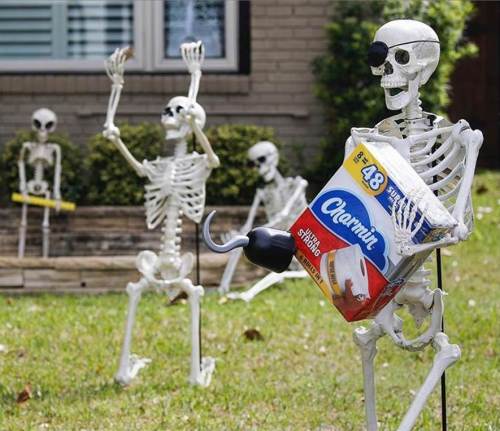
Tweet of the Week – April 10, 2020

A creative take on Queen’s “I Want to Break Free” (1984) – a quick homage for the desire to be quarantine-free amidst the COVID-19 pandemic!

Leave a comment

Filed under News

Worst Quote of the Week – April 10, 2020

“It is being used in Germany as a mist.  Health care workers go through a misting tent going into the hospital and it kills the coronavirus completely dead not only right then, but any time in the next 14 days that the virus touches anything that’s been sprayed it is killed.”

– U.S. Rep. Louie Gohmert, (R-TX), claiming that German scientists had developed a powder that – mixed with water – will kill the COVID-19 virus on contact.

In response, Dr. Jörn Wegner, a spokesman for Deutsche Krankenhausgesellschaft, the German Hospital Association, stated, “What your congressman said is absolute nonsense.  There are no such tents and there’s no powder or magical cure.”

Gohmert continues to embarrass both my home state of Texas and the United States in general by spouting out such idiotic and ridiculous statements as this “misting” cure.  Why the people of his district continue to let Gohmert stay in office is mind-boggling.  Then again, if you knew East Texas, like I do, you’d understand – somewhat.

Leave a comment

Filed under News

Best Quote of the Week – April 10, 2020

“This is a test of our humanity, whether we will put each other’s lives ahead of our own economic self-interest.  I know we’re passing it here in Kentucky.  We need to pass it as a country.”

Andy Beshear, Democratic Governor of Kentucky, on PBS April 6, discussing the personal and professional sacrifices his state’s residents have made during the COVID-19 crisis.

Leave a comment

Filed under News

How the Chief Is Coping with the COVID-19 Quarantine – April 10, 2020

My attempt to make a home-made face mask out of an old jock strap with steel cup protector that I used during my taekwondo days didn’t turn out as planned.  For everyone’s information, yes, it’s still functionable and clean and is a size extra-medium.

Leave a comment

Filed under Wolf Tales

COVID-19 Safe Distance Measures by State

Both the Centers for Disease Control and Prevention and the National Institutes of Health have recommended individuals remain at least 6 feet (1.8 meters) from one another to help prevent the spread of the COVID-19 virus.  The minimum distance is based on the average trajectory of nasal droplets once expelled from the nose, mouth, or whatever infected orifice a person might have.  (If this person can expel nasal droplets from more openings than their mouth and nose, I suggest they be put to death.  They will be a danger to humanity, no matter what contagion is in the air.)

This “social distancing” has caused some consternation among many people.  For introverts, however, it’s called life as we know it.  But, in order to help people understand exactly what the 6-foot minimum is, each state has comprised analogies for their particular citizenry.

Alabama – 2 outhouses

Alaska – 12 salmon or 2 Alaskan King Crab

Arizona – 5 Native American bead necklaces or a blueprint for Donald Trump’s “Wall”

Arkansas – 5 lists of the state’s 3 family trees

California – 1 surfboard or a chest of old Kim Kardashian press-on fingernails

Colorado – 1 miniature horse

Connecticut – 25 recordings of Donald Trump trying to pronounce Connecticut

Delaware – 6 bags of used Joe Biden hair pieces

Florida – 1 adult alligator or 4 motorized wheelchairs

Georgia – 10 DVD sets of “Gone with the Wind”

Hawaii – 5 floral lei wreaths or 1 lost mainland tourist

Idaho – 1 “No Californians Allowed” sign

Illinois – 5 Chicago pizzas (or 10 boxes of .32 caliber bullets if you’re actually in Chicago)

Indiana – 10 lists of the top 10 names indigenous peoples had, before some drunk White people arrived and screwed up everything

Iowa – 10 late-model voting machines

Kansas – 3 sheaths of whole-grain wheat

Kentucky – 5 cases of moonshine

Louisiana – 10 Mardi Grass beads (preferably neon) or 5 indictments of state governors

Maine – 1 lobster (unboiled)

Maryland – 10-15 bricks from a now-dismantled wall built around Washington, D.C.

Massachusetts – 5 cases of Irish whiskey

Michigan – 10 cases of German beer or 1 illegal Canadian immigrant (in Detroit, use anything that’s bullet-proof)

Minnesota – 5 maps of the 10,000+ lakes in the state (complete with detailed explanations why no one has made a concerted attempt to count the exact number)

Mississippi – 50 audio recordings of school children trying spell Mississippi

Missouri – 50 video recordings of school children misspelling Mississippi as Missouri

Montana – 3 taxidermy moose heads

Nebraska – 1 bovine calf or a University of Nebraska cheerleader (whichever is closest and not sleeping at the moment)

Nevada – 500 poker chips or 1 topless showgirl

New Hampshire – 1 10’x 6’ slab of granite or 5 “We Are NOT Vermont!” signs

New México – 1 saguaro cactus frond (unshaven)

New York – 1 life-size inflatable Donald Trump doll, 5 yamakas, or 10 Brooklyn-made calzones

North Carolina – 5 vintage “Missing: Roanoke – Have You Seen Us?” flyers

North Dakota – 25 copies of “Why God Created North Dakota (Because Minnesota Was Too Cold)”

Ohio – 30 unpublished “Best Reasons to Visit Cleveland” pamphlets

Oklahoma – 15 editions of the latest Indian casino directory (also still accepting donations for the “Back to Europe” movement)

Oregon – Any still-living Grateful Dead fan

Pennsylvania – 25 king-size Hershey bars

Rhode Island – Rhode Island

South Carolina – 10 editions of “25 Reasons We Keep Fighting the Civil War and Still Haven’t Won”, © 1964

South Dakota – 3 cases of malt liquor beer or 1 “White People Don’t Let the Sun Set on You!” sign

Tennessee – 1 statue of Elvis Presley, Patsy Cline, or Tammy Wynette

Texas – 1 rifle and a bottle of tequila (preferably José Cuervo)

Utah – 10 Mormon bibles or 25 unused “Romney 2012” posters

Vermont – 10 “Sanders 2020” banners (previously 5 cases of maple syrup) or 5 “We Are NOT New Hampshire!” signs

Virginia – 5 replicas of Cutty Sark clipper ships or 10 bottles of Cutty Sark whiskey

Washington – 5 buckets of rainwater or 200 bongs

West Virginia – 25 “There Is NO East Virginia” bumper stickers

Wisconsin – 5 crates of Gouda cheese

Wyoming – 1 life-size replica of a buffalo (NO live buffaloes permitted, as they’ll kick your ass)

“Don’t move any closer, bitch!”

1 Comment

Filed under Wolf Tales

How the Chief Is Coping with the COVID-19 Quarantine – April 3, 2020

Reading about my family history has always been exhilarating!

Leave a comment

April 3, 2020 · 10:58 PM

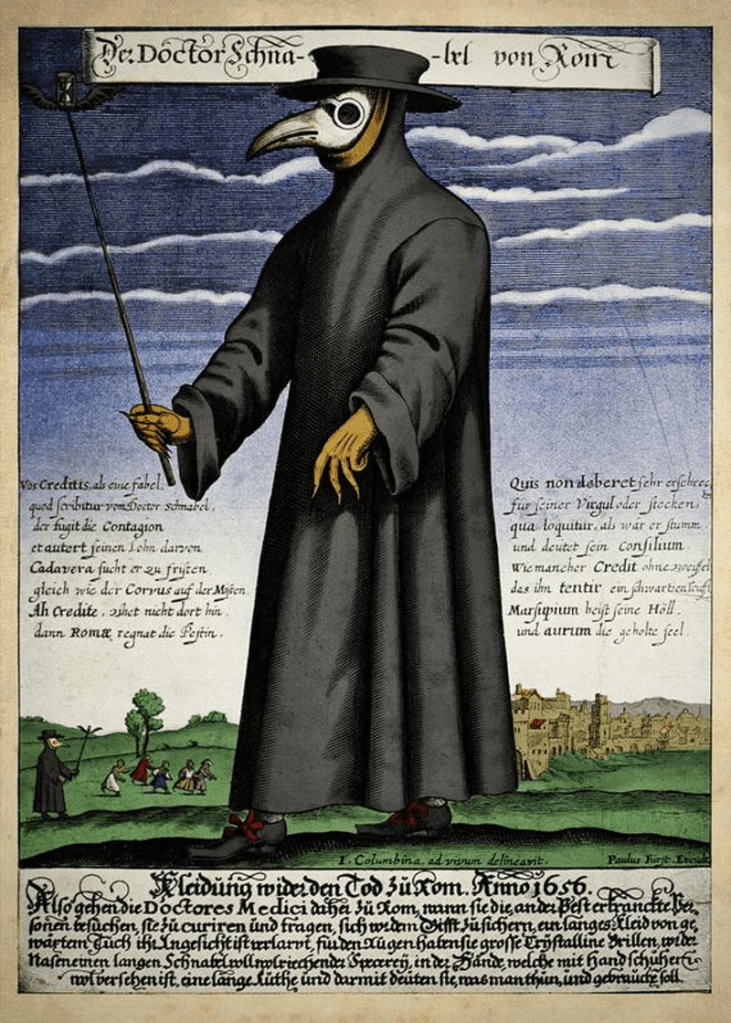
The Earliest Hazmat Suits

Color copper engraving of Doctor Schnabel (Dr. Beak), a plague doctor in seventeenth-century Rome, published by Paul Fürst, (c. 1656).

The sight of various medical personnel clad in head-to-toe coverings to protect themselves from the COVID-19 virus has become common in recent weeks.  It used to be frightening to see something like that; images that were usually relegated to toxic waste dumps and crime scenes.  But such garb is nothing new.

Beginning in the 17th century C.E., as more epidemics of bubonic plague swept Western Europe, doctors often wore a variety of outfits to protect them from the miasma, or “bad air”, then believed to carry disease.  This was still a time when most people believed health scourges were acts of God and not the result of microbes gone awry.  (Some people – even in so-called developed nations – are still stupid enough to believe that!  The AIDS epidemic is a perfect example.)  It was long before people realized the importance of basic health measures: handwashing, sanitation, not listening to politicians or religious leaders.

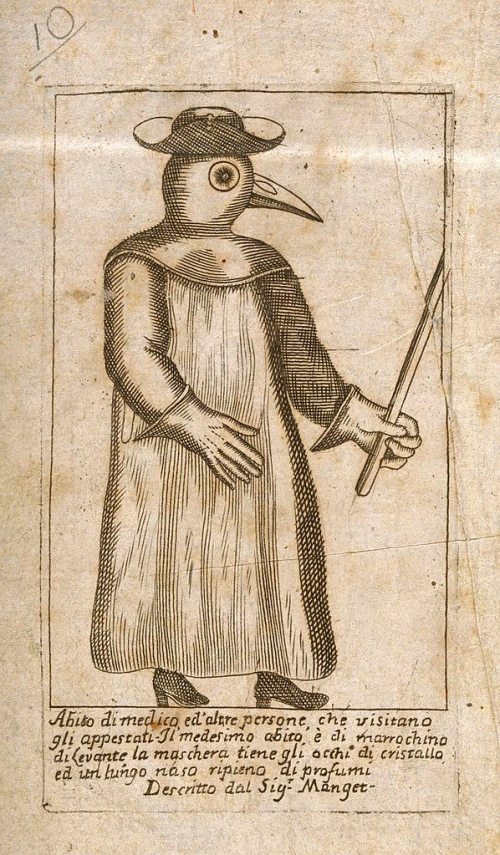
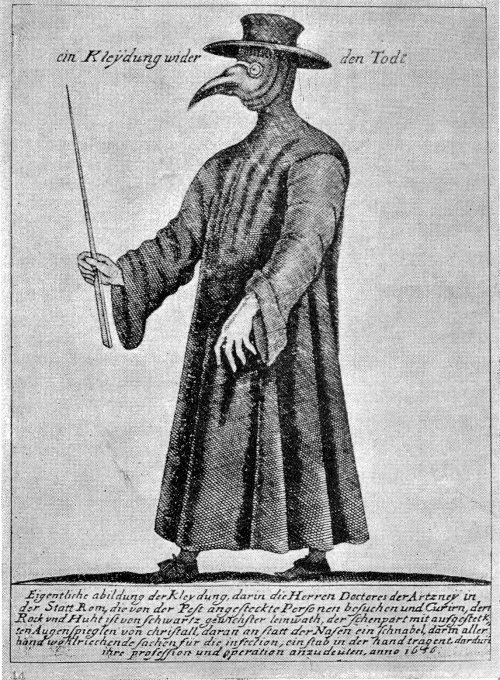
These long-ago costumes look theatrical (almost comical) now, as they typically consisted of a head-to-toe leather or wax-canvas garment; large crystal glasses; and a long snout or bird beak, containing aromatic spices (such as mint and cloves), dried flowers (usually roses or carnations), or a vinegar sponge.  The strong smells of these items — sometimes set aflame for added advantage — were meant to combat the contagious miasma that the costume itself could not protect against.

They attire wasn’t just fanciful.  The ankle-length gowns and beaked masks could offer some protection against germs.  The design of these particular outfits has been credited to French physician Charles de Lorme who may have developed the concept around 1619.  By the time the “Plague of 1656” ravaged Italy (which was then a collection of city-states) and killed an estimated half-million people, the beaked coverings had become mostly mandatory.

Terrifying in centuries past, they make for good Halloween apparel today!

Photograph of 17th-century plague doctor mask from Austria or Germany on display in Berlin’s Deutsches Historisches Museum.

Theodore Zwinger III (1658-1724), coat of arms with portrait.

Man in plague mask on Poveglia, (c. 1899).

Plague doctor, from Jean-Jacques Manget, Traité de la peste, (1721).

Doctor in plague costume during the plague epidemic of 1720 in Marseille. Drawing first published in 1826 in the Guide sanitaire des gouvernemens européens by Louis-Joseph-Marie Robert.

Jan van Grevenbroeck (1731-1807), Venetian doctor during the time of the plague. Museo Correr, Venice.

Copper engraving of Doctor Schnabel, a plague physician in 17th-century Rome, (c. 1656).

IJsbrand van Diemerbroeck, Dutch plague doctor.

Satirical engraving by Johann Melchior Füssli of a doctor of Marseilles clad in cordovan leather equipped with a nose-case packed with plague-repelling smoking material.

Doctor’s outfit at the Lazaret de Marseille, 1720.

A physician wearing a 17th-century plague costume, as imagined in 1910.

A physician wearing a 17th-century plague costume, as imagined in 1910.

Leave a comment

Filed under Classics

Photo of the Week – April 3, 2020

“Prophecy” classes canceled?!  Wow!  Imagine reality smacking head-on into religious ideology!  Happens every time there’s a REAL crisis!

Academy Christian Church

Leave a comment

Filed under News