Category Archives: Essays

No Replacements

The outrage has been palpable.  A recent advertisement by Adidas featuring a man modeling a women’s swimsuit has sparked more controversy than a drag show being staged outside a pre-school.  It’s the latest volley in the ongoing and very contentious debate regarding transgender issues.  In the Adidas ad it’s almost too obvious that the model is a man – squared shoulders, a prominent bulge in the groin and a smattering of chest hair.  I don’t know what idiot thought this would be a good idea, but they need to find another career.  Advertising isn’t working for them.

Women across social and political spectrums are understandably upset.  In an editorial last year, New York Times columnist Pamela Paul wrote: “The noble intent behind omitting the word ‘women’ is to make room for the relatively tiny number of transgender men and people identifying as nonbinary who retain aspects of female biological function and can conceive, give birth or breastfeed.  But despite a spirit of inclusion, the result has been to shove women to the side.”

Also last year actress/singer Bette Midler made headlines when she tweeted: “WOMEN OF THE WORLD! We are being stripped of our rights over our bodies, our lives and even of our name! They don’t call us ‘women’ anymore; they call us ‘birthing people’ or ‘menstruators’, and even ‘people with vaginas’! Don’t let them erase you! Every human on earth owes you!”

Gillian Branstetter, a communications strategist at the ACLU, noted, “The notion that you can’t say the word ‘women’ strikes me as the notion that you can’t say ‘Merry Christmas.’  It’s a panic that is very absent from reality and attempts to position a growing, changing society as a threat.”

I agree with them.  That we are discussing what is female and male is the epitome of ludicrous.  There wouldn’t be an argument if the transgender crowd hadn’t become so vocal and vociferous in recent years.  I don’t understand the transgender matter and I’m not certain I want to understand it.  I do realize that some people may suffer from gender dysphoria.  But I don’t know at what point this matter goes from a medical discussion to a social dispute.

Yet, as the transgender debate ensues, I almost want to laugh.  For years, I’ve heard some women say emphatically that they do not need men; which is overtly cavalier because they need to know that men don’t necessarily need – or want – them.  And I can’t count the number of times I’ve heard women say they don’t even need men to procreate because they have sperm banks – which is like saying we don’t need farms because we have grocery stores.  I’ve also heard others – including some “enlightened” men – declare that males of the species overall are becoming irrelevant; that our Y chromosome has been shrinking over the past several millennia and will eventually vanish into the morass of human refuse.

All-female societies look great in sex videos, but the reality is starkly different.

As far as I can determine now, we can’t replace men and we can’t replace women – no matter how much hardcore feminists and delusional trans activists try.  The transgender movement has become unhinged in its efforts to become relevant and valued.  The anxiety over gender and “appropriate” roles for males and females is manufactured.  Humanity has made it this far without the restrictions bestowed by politically correct culture warriors who – like book censors – think they know what’s right for everyone else.

I don’t know if crap like the Adidas ad is an experiment in shock value; an attempt by media cretins to assert themselves into popular culture.  Despite their best efforts of the trans crowd and their sympathizers, gender is not subjective.

I am male and I’m proud of it.  I have no qualms and make no apologies for it.  Neither should anyone else.

3 Comments

Filed under Essays

Spent

Last November, for my 59th birthday, I met a long-time friend, Preston*, at my gym.  For years I made it a habit to visit my gym on my birthday.  Even though I’ve changed gyms over the years, I hadn’t been to a gym on my birthday since 2019.  So this was a refreshing change.  Preston had turned 55 the previous July and – as we conversed about life and related topics – the subject of retirement arose.  Like me (and millions of others across the globe), Preston has worked most of his adult life.  He did what’s expected of so many people – especially men – in our society: he attended college, found a good job, got married and had kids.  His wife went on maternity leave shortly before giving birth to their daughter some two decades ago and never returned to work.  Thus, Preston – like millions of men – continued working.

Prior to meeting at my gym last November he’d said something that surprised me, yet to which I could relate.  “I’m tired of working so hard.”

It was ironic because the same feelings had been rumbling around in my mind over the previous months.  An uncle told me he’d retired in 2002 at the age of 62 simply because he was tired of working.  Even though he didn’t get the most out of his Social Security, he simply had become weary of the labor grind and therefore, was willing to take the risk of living a more modest life.

My father had essentially been forced to retire at 62 in 1995, but my mother managed to retire at 70 in 2003.  My folks managed to make the most of their golden years – my father dived full-time into genealogical research, and my mother spent hours reading and doing crossword puzzles.  They didn’t travel or go out dancing; they didn’t join any clubs to make a bevy of new friends.  They spent their remaining time on Earth living simply and quietly.

Whenever it’s my turn to retire, I’m certain I’ll spend my time doing what I love to do: reading and writing.  I’d love to travel, but that’s still a dream.

Right now I’m trying desperately to find a job within my chosen profession – technical writing – but I’m not having much luck.  Since the first of this year I have literally applied to more than 100 jobs.  If I actually receive a response, it’s usually a no or the position has been closed.  And even those are rare.  In the state of Texas, the unemployment rate is roughly 4%, lower than most anywhere else in the country.  I’m starting to get the impression my age is a factor.  A friend tells me I’m just being paranoid, but I know age discrimination – though illegal – is a reality in the American work force.

But right now the U.S. government is mired in an impasse over the debt limit.  As usual it’s a battle between political ideologies, and neither side seems willing to concede.  And, as usual, average Americans like The Chief are caught in the mud fight.

I don’t need a palatial beachfront estate with a 6-car garage to be happy.  I don’t need billions in stock or hard cash to feel content.  I just need to make a basic and decent living.  My freelance writing fell flat after the COVID-19 pandemic and hasn’t recovered.  A friend suggested I try to be an Uber driver, but I don’t have a 4-door vehicle and I’m bad at directions.  I think I’m too old for porn, so I won’t even try – again.  Yet I’m not too proud to work and don’t like being idle anyway.

Yet I have to concede I’m tired.  Decades ago I recall my father saying he no longer really cared for being praised for his work; he wanted to be rewarded monetarily.  The bank where I used to work often gave out perfect attendance awards and various other accolades that ultimately weren’t worth the paper on which they were printed.  Now I know what my father meant.

*Name changed.

5 Comments

Filed under Essays

Just Leave It As Is

Last Saturday, May 6, another mass shooting occurred; this one in Allen, Texas, just north of Dallas.  I live relatively close to Allen in another Dallas suburb.  The gunmen, Mauricio Garcia, slaughtered 8 people, including 3 children, before an Allen police officer who just happened to be on the scene responding to another call killed him.  The incident was the 202nd mass shooting in the U.S. so far this year; meaning we’ve experienced more such events than there have been days in the year.

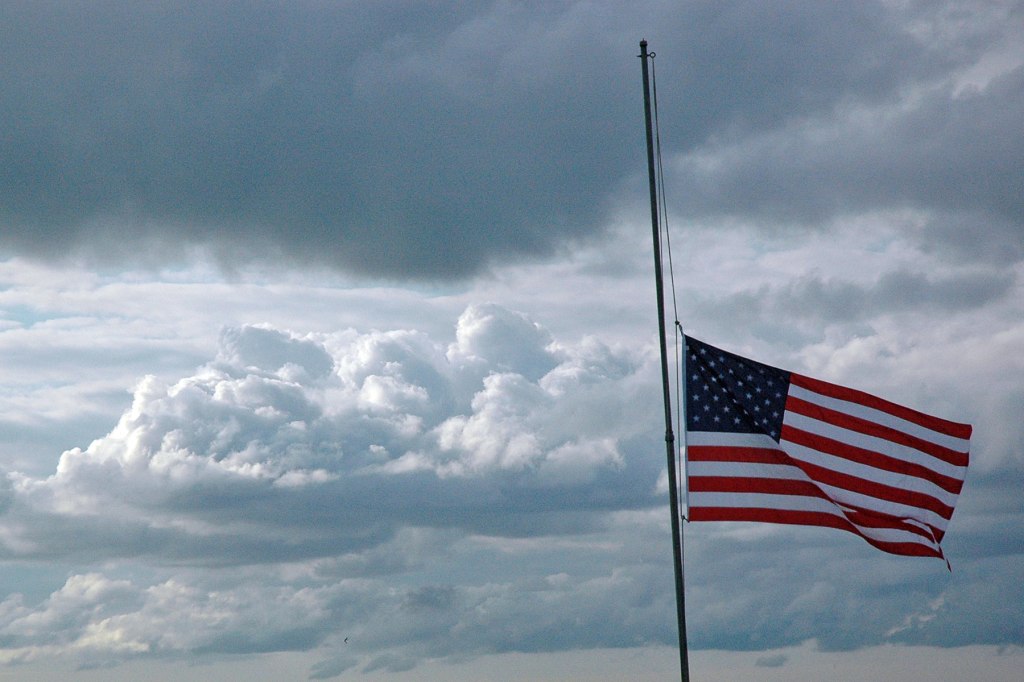
In response President Joe Biden ordered American flags to be flown at half-mast.  I thought to myself – just keep them there.  At the rate we’re going they should never be raised again – certainly not any time soon.

In his own convoluted reaction to the tragedy, Texas Governor Greg Abbott stated he sees no need for any kind of gun control, but emphasized the need for mental health care.  He’s right about the mental health issue.  Part of the problem is right-wing morons like him still maintain that more guns equals a safer society.  Using that “logic”, the U.S. would be the safest country Earth, as we have more firearms than people.  If that type of convoluted thinking doesn’t count as mental illness, I don’t know what does.

In the immediate aftermath of the Allen massacre, however, Texas State Rep. Tracy King proposed a bill in the state legislature to raise the minimum age to purchase semi-automatic weapons from 18 to 21.  (The legislature meets every other year.)  But this year’s session is coming to a close, so the bill won’t make it to a vote.  And I’m sure, even if it could, the gang of far-right extremists that dominate the legislature would smack it down faster than they would a drag show.

The Allen gunman would probably be happy to see that happen.  He’s joined that dubious pantheon of angry White males who – aside from being afflicted with pencil penis syndrome – are obviously too stupid to address serious issues with conversation, so he breaks out his gun.  Garcia turned out to be a White supremacist who had Nazi regalia tattooed onto his torso, as photos he posted to social media prove.  And, like most White supremacists, he zeroed in on the usual targets: Blacks, Jews, Muslims, immigrants and queers.  Enraged about (unable to cope with) an increasingly diverse America, he opted for the Hitleresque solution – just wipe out as many of “those people” as quickly as possible.

I feel that America has become almost jaded in the face of these massacres.  I just know that more of them loom on the dark horizon.  More helpless people will fall victim to the wrath of angry and/or mentally unstable individuals, which will only prompt more of the “thoughts-and-prayers” bullshit regurgitated by conservative officials who place the value of guns over that of human lives.

So just keep that flag at half mast, Mr. President.  I see no real change in the future, except more bodies.

2 Comments

Filed under Essays

Right This

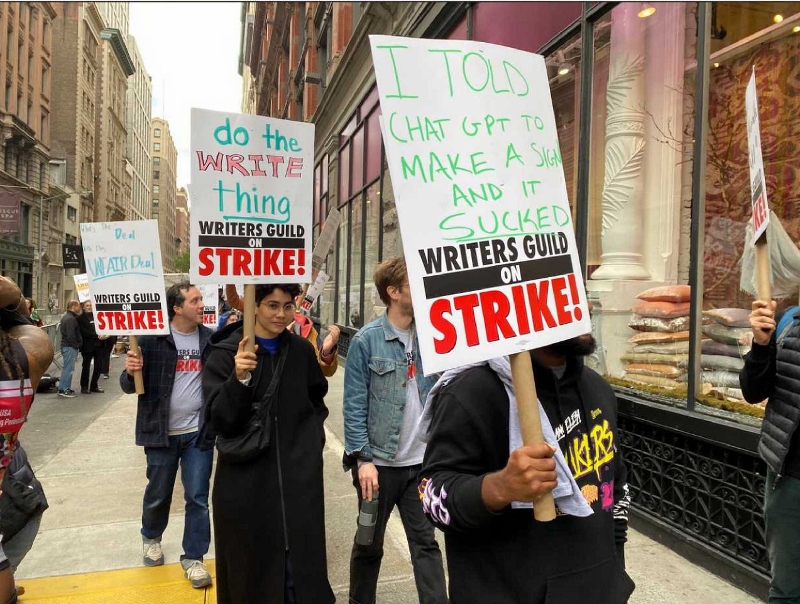
Protesters outside Netflix’s headquarters on May 3 demand better pay and no AI in the writers’ room. Photo: Maya Pontone/Hyperallergic)

On Monday, May 1, the Writers Guild of America went on strike.  It’s the first time professional television and film writers have revolted against the entertainment industry since 2007.  That particular walkout last more than three months and alone cost the state of California $2.1 billion.  Back then the dispute centered on the growing internet market and material being downloaded for very little, if not for free.  The entertainment world’s corporate elites had, of course, remained profitable.

The WGA is still fighting for the usual claims: higher wages, better healthcare benefits and pensions, and – as in 2007 – more compensation when their work shows up on streaming platforms, such as Amazon and Netflix.  According to an industry bulletin, writer pay has fallen, as corporate profits have risen.  Production companies are also hiring fewer writers to do more work.  (Sound familiar?)

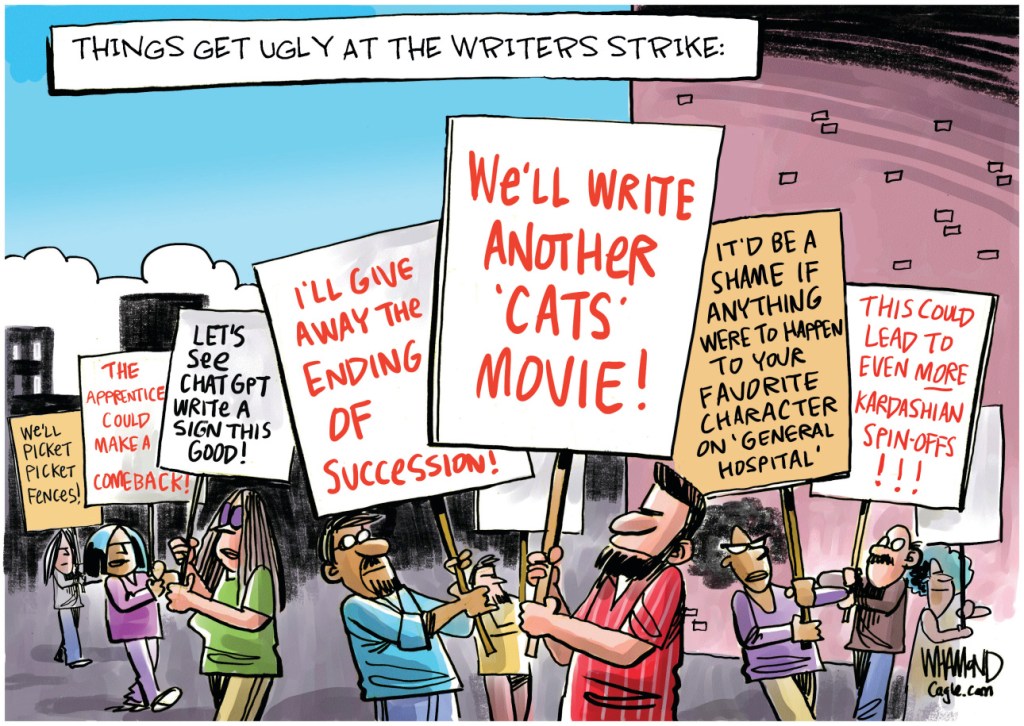
But now the writers are also targeting a new entity: artificial intelligence (AI) and in particular the ChatGPT program, which has emerged as a writing tool.  Launched in November 2022 by OpenAI, ChatGPT is still in its development phase, but has curious (threatening?) implications for writing, computer programming and even every day conversations.  In recent years AI has been used to create realistic fake photos and videos.

Didn’t Isaac Asimov warn about things like this?

Dr. Geoffrey Hinton certainly has.  Considered the ‘Godfather of AI’, Hinton has expressed concerns about AI’s rapid expansion across the globe, dubbing it an “existential risk” to true human intelligence and ingenuity.  A decade ago Google brought Hinton on board to help develop its AI platform, and his endeavors ultimately led to the creation of ChatGPT.  Now, perhaps channeling Victor Frankenstein, Hinton declares, “I’ve come to the conclusion that the kind of intelligence we’re developing is very different from the intelligence we have.  So it’s as if you had 10,000 people and whenever one person learned something, everybody automatically knew it.  And that’s how these chatbots can know so much more than any one person.”

Television and film writers still struggle for respect and profitability.  Britanni Nichols, who writes for the popular ABC show “Abbott Elementary”, noted that she could live comfortably off the residuals she’d receive from the network between seasons, since she’d get half her original writing fee.  But now, when those episodes are sold to streaming services, she earns a paltry 5.5% of that fee.

“You’re getting checks for $3, $7, $10,” she explains.  “It’s not enough to put together any sort of consistent lifestyle.  It can really be a real shock. … sometimes you get a stack of checks for $0.07.”

Music artists experienced similar woes with the Spotify streaming service several years ago.  Singers and songwriters found they were earning, on average, less than one cent per day, as the site’s patronage downloaded a vast array of songs.  The animosity grew so intense that singer Taylor Swift pulled her entire song catalog in 2014.  Other artists followed suit, thus setting the stage for a major overhaul of the music streaming concept and business model.  It was dramatic and controversial, but it had to be done.

Other creatives found themselves expressing similar anxieties.  In 2021 artist Jens Haaning caused a stir when the Kunsten Museum of Modern Art in Aalborg, Denmark paid him the equivalent of USD 84,000 to create a modern art piece.  He responded with two blank canvases collectively titled “Take the Money and Run”.  It was his homage to (and protest of) the poor wages painters often receive for commissioned works.  “The work is that I have taken their money,” he said.  Like writing, painting and sculpting aren’t so easy to do.

Author Amy Joy once stated, “Anyone who says writing is easy isn’t doing it right.”  And I often recollect an old story involving the late actress Anne Bancroft and her husband, writer and filmmaker Mel Brooks.  After landing a movie role, Bancroft allegedly held up the script and lamented the amount of dialogue she had to memorize!” – whereupon Brooks replied by a holding up a blank sheet of paper and asked her to imagine putting all that dialogue down on it.

Several years ago, when LinkedIn was still somewhat relevant, I belonged to various writing and art groups.  In one the issue of financial compensation arose, and a handful of misguided souls had the audacity to question why writers – or any artists, for that matter – felt they had the right to be paid for their work.  “No one asked you to be a writer,” declared one visitor.  I pointed out that no one is asked to enter into any kind of profession, not including family and close friends.  (My parents wanted me to go into computer science, which I did when I started college, and quickly discovered how inept I was at it.)  The public doesn’t ask anyone to go into the creative arts – not directly.  But the average accountant, lawyer, architect, cashier or FedEx driver wants to be entertained in one way or another; try as they may, though, they don’t have the talent or discipline to create their own stories or compose their own songs.  Thus, in a subtle manner, they do ask for someone somewhere to do these things for them.  People like to read stories, listen to music and look at beautiful paintings.  Somebody is always ready to respond and create those pleasures.  Thus, they should be respected and be compensated for their endeavors.

All I can say to the WGA folks is to keep writing and keep fighting!  It’s worth the battle.  You and your work are worth the battle!

Bottom image: Dave Whamond

2 Comments

Filed under Essays

Collapse

The Murdaugh family’s former “Moselle” estate in Colleton County, South Carolina

For nearly two years, many Americans have been fascinated by the various tragedies surrounding the affluent and politically powerful Murdaugh family of South Carolina.  The true-life drama began unfolding in June of 2021, when attorney Alex Murdaugh claims he arrived at his massive estate to find his wife, Maggie, and youngest son, Paul, shot to death alongside some dog kennels.  On March 2, 2023, a jury convicted Murdaugh of murdering Maggie and Paul; supposedly in a perverted effort to conceal his own fiduciary shenanigans, which was amplified by his addiction to opioids.

But Murdaugh’s troubles aren’t over yet.  Local police are now investigating both the 2018 death of the family’s housekeeper at the Murdaugh home and the 2015 death of a young man who supposedly had a connection to Murdaugh’s oldest son, Buster.  At the time of his death, Paul Murdaugh was facing criminal charges for the 2019 boating death of a young woman.  And now, the suspicious death of one of Alex Murdaugh’s ancestors in 1940 has come to light.

If a novice screenwriter had presented this project to a film or television producer, they’d be laughed back into obscurity.

What had once been a prominent legal dynasty now lies in the tatters of arrogance and greed.  Once highly revered in South Carolina, the Murdaugh family name has become synonymous with fraud and murder.  If anything, it’s testament to what happens when people grow too comfortable with their wealth and power and assume nothing and no one can undermine that status.

Alex Murdaugh admitted he lied to investigators about the events of June 7, 2021 – the night his wife and younger son were murdered.  But his admission came only after savvy investigators used technology to confirm his whereabouts.  People seem to keep forgetting cell phones aren’t always their best friend.  And Murdaugh also apparently forgot that paper trails are equally revealing.  Damn, it’s getting so hard for criminals to make a living in the 21st century!

But one curiously tragic element is that at least three strange deaths have been linked to the Murdaugh family.

Stephen Smith

Everyone who knew and loved Stephen Smith had only the best things to say about him.  Openly queer in a bastion of right-wing conservatism, Stephen still maintained a bright outlook on his life.  After graduating high school, he began attending nursing school with the ultimate goal of becoming a doctor.  But his future came to a brutal end when he turned up dead on a remote road in Hampton County, South Carolina on July 8, 2015.  Local police ultimately concluded he was the victim of a hit-and-run – despite that his body displayed no signs of blunt force trauma (although his head showed signs that he had been struck); no shards of vehicle glass or other broken items lay nearby; and Stephen’s wallet and cell phone sat in his car some distance down the road.  Oddly Alex Murdaugh arrived on the scene within hours of the discovery of Stephen’s body.  Understand Murdaugh wasn’t a law enforcement official; he was an attorney with a local law firm that had a long history of handling wrongful death and injury cases.  Why he became involved with the Smith death wouldn’t become obvious until some time later.

Stephen Smith’s parents weren’t satisfied with the results of the investigation, so they contacted the state police agency, the South Carolina Law Enforcement Division (SLED).  SLED’s inquiry didn’t reveal much more, but amidst interviews with anyone and everyone who knew Stephen, one name kept coming up: Murdaugh.  Stephen’s twin sister, Stephanie, states that her brother had suddenly become secretive in the weeks preceding his death and that he was involved with a member of a prominent local family.  Stephen never called out anyone’s name, but Stephanie notes that Alex Murdaugh’s oldest son, Buster, might have had some connection to Stephen.  They all graduated from the same high school in 2014.  Stephen and Stephanie weren’t part of the “cool” crowd during those days, while Buster (mainly because of his family’s wealth) definitely was.  The exact relationship between Stephen Smith and Buster Murdaugh remains unknown, but law enforcement has reopened the investigation into Smith’s death.  It wouldn’t have happened, though, without the murders of Maggie and Paul Murdaugh.

Gloria Satterfield

Gloria Satterfield was a simple, working woman.  Like most people of her stature, she didn’t ask for much beside respect and consideration.  Gloria worked for Alex and Maggie Murdaugh for some 20 years before her untimely death in 2018.  She essentially helped raise Buster and Paul Murdaugh.  It’s such a classic element of the wealthy – they seem to be too busy to raise their own progeny.  In February of 2018, Gloria fell at the Murdaugh home and incurred a serious head injury.  The Murdaughs later claimed she tripped over one of the family’s dogs.  But upon listening to the 911 call, there are no sounds of dogs in the background.  And neither Maggie nor Paul – both of whom spoke to the 911 operator – mentioned dogs during the call.

Five months later Paul was involved in a vehicle wreck, along with his girlfriend, Morgan Doughty.  According to Morgan, Paul – then age 19 – had consumed an excessive amount of beer, and the truck in which they were riding was loaded with empty beer cans and even a number of firearms.  They apparently got into an argument, as Paul sped along a roadway; whereupon he lost control of the vehicle, which landed on the passenger side.  After they both climbed out, Morgan recounts, she attempted to call 911, but she says Paul slapped her phone out of her hand.  He then called his parents who arrived with his Uncle Randy, Alex’s younger brother.  As Morgan watched, the Murdaughs cleared the area and the truck of both the beer cans and the guns before calling emergency services.  She says they ordered her to remain silent.  And she did.  She obviously had no choice.

Mallory Beach

Mallory Beach was 19 in February of 2019 and most certainly didn’t think her life would end any time soon.  No one that age does.  But Mallory’s life came to an especially brutal end on February 24, 2019, when the boat she was riding in slammed into a dock piling.  Paul Murdaugh was driving the vessel, which belonged to his father.  He was also highly intoxicated.  Paul and most everyone else aboard were flung into the dark waters.  Mallory was the only one who didn’t surface.  Her body was discovered several days later; she was the only fatality.

After everyone in the boat was transported to a local hospital, a number of medical staff noted Paul Murdaugh’s behavior changed dramatically; he allegedly became more belligerent and refused to provide blood and urine samples.  While at the hospital, Paul called his paternal grandfather who then arrived with Alex.  The older Murdaugh men refused to allow hospital staff to take the requested blood and urine samples, but their interference in the fiasco didn’t end there.  As the other boat crash survivors recounted later, the duo visited all of them in their respective rooms and suggested they remain quiet about the night’s events.  But Alex went further and asked one of the survivors – a long-time close friend of Paul – to confess to police that he had been driving the boat at the time of the accident.  The young man – who had suffered a broken jaw – refused.

One of the most egregious aspects of the boat crash is that Paul Murdaugh wasn’t brought before a court to face a variety of charges until early 2021.  And, instead of being subjected to the normal protocol of mug shots and fingerprinting, Paul was allowed to stand against a wall in the hallway and have his official mug taken with a cell phone.  Then a fingerprint kit was brought into the courtroom – all done obviously done to accommodate an already pampered young man.  The Beach family sued the Murdaughs for wrongful death, and earlier this year a judge approved a settlement between the two families.

After the murders of Maggie and Paul, Alex Murdaugh loudly claimed it was retribution for the boat crash; that some angry local – perhaps tired of the slow pace of justice – decided to enact justice on their own.  No one seems to believe him.  At his sentencing, Judge Clifton Newman had an interesting response to the defendant’s claims that his opioid addiction led to his erratic behavior.  “And it might not have been you,” Newman stated. “It might have been the monster you become when you take 15, 20, 30, 40, 50, 60 opioid pills, and maybe you become another person. I have seen that before.  The person standing before me was not the person who committed the crime, though it is the same individual.  We’ll leave that at that.”

The drama has not ceased.  Investigations into the deaths of Stephen Smith and Gloria Satterfield continue, as their respective families demand the bodies be exhumed.

Nothing can be made right about all of this, but even a cursory glance at the scope of this case proves that the Murdaugh family name has been sullied – perhaps forever.  Entire empires have crumbled because of their leaders’ arrogance and greed.  So have family dynasties.  The Murdaughs are just the latest.

2 Comments

Filed under Essays

Damnit!  You Died and Didn’t Even Tell Me!

Over Easter weekend I learned that one of my closest long-time friends, David, died on April 4, at the age of 49.  He would have turned 50 on April 17.  I don’t know for certain, but I believe he’d succumbed to esophageal cancer.  I had spoken with him briefly last month when he told me he planned to visit a doctor.  He had trouble swallowing and – mostly shocking – weighed only 114 pounds at the time.  He later informed me that an X-ray showed his esophagus was bent and that his doctor had referred him to a gastroenterologist who referenced cancer.  That’s what I had thought, when he mentioned the initial X-ray findings.  The gastroenterologist wanted to rush him into surgery.  Afterwards I never heard from him again.  I had thought of calling him, when I decided to check that most ubiquitous of sources: Facebook.  That’s when I found out about his demise.

Damn!  And he didn’t have the decency to tell me.  You know…that’s kind of rude.

The news hit me especially hard because Easter weekend marked the first anniversary of the death of another close friend, Paul, who died after a year-long bout with liver cancer at the age of 55.  His death was considerably different in that I had been in constant contact with him and saw the end looming over the horizon.

I also saw the end with another friend, also named David, before his death in 1993.  That was the first time I’d actually lost a close friend to death, and it impacts me to this day.  People have always accused me of being too sensitive; in that I don’t often let things go.  That’s true to an extent.  I had a tendency to hold grudges.  But it’s tough to let go of the death of a close relative or friend.

David went quick, though.  According to one of his friends, the cancer was too advanced for doctors to do anything.  And I got mad again.  That’s just like a man!  Waited until the last fucking minute to take care of himself!  That’s so old school.  Men of my father’s generation did shit like that!  David was almost a whole decade younger than me.

Several years ago I watched a program on the lives of very old people; those who’d lived beyond 90 and how they managed to sustain themselves.  Aside from good genes and a positive outlook on life, they all seemed to have one pertinent thing in common: their ability to deal with the death of others around them.  As sad as it is to lose a loved one, we have to understand that it happens.  Some things may last forever, but no person can – at least not in this world.  Our capacity to accept that helps us move forward with our own lives.

So, as difficult as it’s been these past few weeks, I’ve had to accept David is gone.  My greatest consolation is that he’s not suffering anymore.

Good night, my friend.  I’ll miss you, but I’m glad you have begun your next journey in life.  As with everyone else I’ve lost, I hope to see you on the other side.

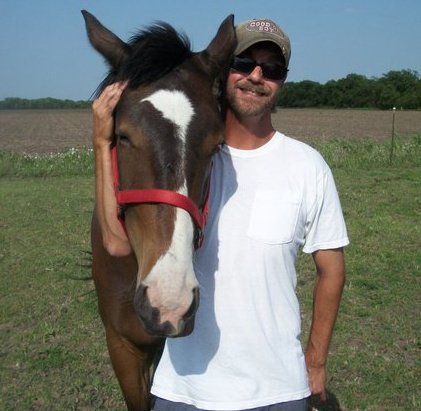
David in his natural element – with an animal

11 Comments

Filed under Essays

Sad

On April 4 New York officials arrested former President Donald Trump for paying a former adult film star $130,000 to keep quiet about an alleged tryst they had in 2006.  It’s actually more complicated than that.  And, in keeping with the appetite Americans have for the salacious antics of public personalities, there are more players in this game than a womanizing, tax-cheating businessman and a glamorized prostitute.

Politicians and porn stars seem to have a lot in common: they have no conscious and don’t care who they screw, as long as they get some kind of money and notoriety in the end.  And, for the record, I actually think more highly of porn stars.  I don’t know what prompted the “actress” known as Stormy Daniels (Stephanie Clifford) to find anything remotely attractive about Donald Trump.  She claims he was just exceptionally charming, which I think a lot of women say when they engage in such behavior.  Monica Lewinsky said the same about Bill Clinton.  Who really know and who really cares?

Trump’s real transgression involving Daniels – the one that landed him in a Manhattan courtroom – isn’t his sexual indiscretion or even the money he supposedly paid out to buy her silence.  It’s that he allegedly processed the payment through his campaign finances, as he desperately sought the Republican Party’s nomination for president in early 2016.  That’s illegal, if it did occur.  According to one of his closest confidants at the time, Michael Cohen, it did.  We know so much about the fiasco because Cohen was a Trump attorney who served as vice-president of the Trump organization.  In 2018 Cohen was found guilty of a number of monetary crimes, including campaign finance violations.  Afterwards he turned on Trump and declared that his former boss, indeed, paid Daniels to remain quiet.  Then news arose that Trump had an affair with another woman, Karen McDougal, an actress and former Playboy model – and that the real estate magnate had paid her to stay silent as well.  But wait!  It gets worst!  Yet another rumor has emerged that Trump had an affair with another, unnamed woman and that she bore a child as a result of their liaison.  This latter story comes from an admittedly dubious source – a doorman at Trump Tower in New York.

Writers for daytime dramas have composed shit like this for decades, and their viewers recognize the absurdity of it all, but still love to watch the shenanigans executed on screen.  When it happens in real life, though, observers react with awe.

Most of us, however, don’t react with shock or surprise – at least not people my age.  I’ve seen this type of histrionic morass play out in public most of my life.  I’m never really surprised when powerful people get caught up in their own personal machinations.  It’s almost laughable.

But, as I look at this mess involving Donald Trump, another word comes to mind: sad.  Trump is the first former U.S. president to be indicted for criminal behavior.  His supporters are screaming that this is all a liberal plot; quickly forgetting that conservatives tried to impeach Bill Clinton for lying about his own dalliance with a woman a quarter century ago.

Regardless this is all an embarrassment and a disgrace for a nation that has always prided itself on being the leader of the free world; a beacon for democracy.  This pathetic drama continues, but it’s truly disheartening.  The cesspool of American politics seemingly has no bottom.

Image: Jane Rosenberg

1 Comment

Filed under Essays

Changing Dahl’s

“The problem with the world is that the intelligent people are full of doubts, while the stupid ones are full of confidence.”

Charles Bukowski

Fragile souls have infected the American conscious.  In ongoing efforts to accommodate every type of human who could possibly exist on Earth, language is being reconstructed and new words are being created.  Thus, a new type of censorship has taken hold.  As a writer, I’m devoutly opposed to any type of literary censorship.  No matter how offensive some writings may be, people should always be allowed to read them and determine whether or not they find it palatable.  No one, but no one has the right to make those decisions for others.

But does this include editing?  Are books written years ago now subject to contemporary sensibilities?  Roald Dahl – author of such legendary children’s tomes as “Charlie and the Chocolate Factory” and “James and the Giant Peach” – has become the latest target of political correctness, as his publisher, Puffin Books, has decided to edit some of those famous works.

For example, in “Charlie and the Chocolate Factory”, the character of Augustus Gloop is no longer “fat” but now “enormous”. In “The Twits”, Mrs. Twit is no longer “ugly and beastly”; she’s just “beastly”.

Other passages have been rewritten.  In the original version of “James and the Giant Peach”, the Centipede sings: “Aunt Sponge was terrifically fat / And tremendously flabby at that,” and, “Aunt Spiker was thin as a wire / And dry as a bone, only drier.”

In the amended interpretation, he sings: “Aunt Sponge was a nasty old brute / And deserved to be squashed by the fruit,” and, “Aunt Spiker was much of the same / And deserves half of the blame.”

Even the mundane term “female” has rendered vile.  The character of Miss Trunchbull in “Matilda” – described as a “most formidable female” – has now metamorphosed into a “most formidable woman”.

In a nod to the burgeoning transgender movement, gender neutral terms are now popular.  The Oompa-Loompas in “Charlie and the Chocolate Factory” are now “small people”, instead of “small men”; while the Cloud-Men in “James and the Giant Peach” are now “Cloud-People”.

Really?

The Roald Dahl Story Company explained the alterations by declaring, “it’s not unusual to review the language” during a new print run and any changes were “small and carefully considered”.

Puffin made the changes in concert with Inclusive Minds, an entity founded in 2013 that – according to their web site – “works with the children’s book world to support them in authentic representation, primarily by connecting those in the industry with those who have lived experience of any or multiple facets of diversity.”  It’s curious that Inclusive Minds emphasizes that they “do not edit or rewrite texts, but provide book creators with valuable insight from people with the relevant lived experience that they can take into consideration in the wider process of writing and editing.”

Okay, great, wonderful!  I have no problem with inclusion.  During high school and even college, I rarely found the Spanish and Indian portions of my heritage included in literature and popular cultural formats, such as television.  I certainly didn’t see any positive representations of queer people.

But, while inclusivity is great from a cultural perspective, it’s ridiculous and personally offensive to me as a writer to see books published long ago rewritten to cater to new levels of awareness.  We can’t go back and change what happened a lifetime ago.  No matter how much someone wishes things had been different way back when, they just can’t alter the past.  They simply can’t.  Dahl was a product of his time; he said and wrote what was commonly acceptable in his day.  If you read his books and don’t like the verbiage, then don’t read them!  It’s the same with a TV show; if you don’t like it, DON’T WATCH IT!

I understand that some things are blatantly offensive.  That’s just how it is.  If we ban every book that someone finds offensive, we wouldn’t have anything to read!  Stop the madness.  It’s not going to help move society forward.

17 Comments

Filed under Essays

What He’s Done

SWAT officers take Solomon Peña into custody in Albuquerque, New México. (Photo: Roberto E. Rosales/Albuquerque Journal)

Earlier this week New México police arrested a failed Republican congressional candidate and charged him with hiring some men to shoot up the homes of Democratic opponents. Solomon Peña allegedly was dissatisfied with the results of his race last year and decided to seek revenge in the worst possible way: through violence. Like his idol, former President Donald Trump, Peña is an election denier and claimed fraud in his own run for a seat in the U.S. House of Representatives. He lost to his Democratic opponent by more than 3,600 votes.

In the U.S. many elected officials – mostly Democrat and liberal – have been the targets of political violence over the past 5 or 6 years; which (not surprisingly) coincides with the rise of Trump.  The animosity reached a feverish crescendo on January 6, 2021, when a mob of Trump loyalists stormed the U.S. Capitol Building in a failed attempt to undermine the 2020 presidential election, as well as democracy itself.  I’m still angry at the sight of hundreds storming into the building and even angrier at those who continue to support Trump and dismiss the severity of that day.  Like most Americans, the rampage reminded me of images of developing countries in the throes of political chaos.  While various groups in the U.S. have threatened to inflict such carnage over previous decades, no one really thought it would happen.

We have Donald Trump to thank for that.

Threatening election officials and taking out opponents with bullets is what used to happen in places like Colombia and the Philippines.  Even as recently as 1995, Israel experienced political violence when Prime Minister Yitzhak Rabin was assassinated.  The act stunned the international community and roiled the only truly democratic state in the Middle East.

Americans have always had a love-hate relationship with their elected officials, whether or not they actually voted for them, or even voted at all.  But I’ve always believed the Watergate fiasco was a major turning point in our nation’s disillusionment with politicians overall.  That a sitting president would seek to gain an advantage over his adversaries by concocting a burglary scheme shocked most people.  They always sort of knew politicians weren’t necessarily the most moral of individuals, but an actual break-in?

A greater sense of partisanship began to take hold in the ensuing decade and became more pronounced in the 1990s, as Republicans did everything they could – and failed – to undermine Bill Clinton’s agenda.  The scandalous (and genuinely corrupt) 2000 presidential election widened the chasm of discontent.  The GOP’s blatant disrespect for President Barack Obama was even more egregious and appalling – but not really unexpected from conservatives, as far as I was concerned.

Then came Donald Trump, and the haters suddenly had a license to lash out with unabashed vigor.  All the social upheavals of the 1960s were the result of tensions that had been brewing for decades; people had grown tired of just waiting for change and hoping for the best.  In a similar, yet twisted manner, the right-wing extremism that exploded under Trump also had been fomenting in the souls of angry (mostly White male) conservatives for years; that is, since…well, since the 1960s.  Ronald Reagan once said he wanted to return America to the time before the 60s screwed up everything.  As a relic of his past, he naturally didn’t understand we can’t go backwards in time.  That’s science fiction.  But that’s why I call most conservatives preservatives – they want to preserve the old ways of life; ways that were good for them, of course, but not everyone else.

Trump revised that futile dream with his “Make America Great Again” mantra; claiming he wanted to “take America back”.  Back to where, those of us with more than half a brain asked, and how far?  Back to the Civil War?  Back to the Gilded Age?

Peña is just one cog in the wheel of America’s political vitriol.  Think of this for a few moments.  Acting like a drug cartel leader, Peña (who already had a felony criminal record) hired some thugs to fire gun shots into the homes of people he thought had snatched victory from him. At least one of those bullets ended up in a child’s bedroom.  Just as with drug cartels, Peña and his henchmen cared nothing about their intended victims and any collateral damage – i.e., innocent bystanders.  Drug lords only care about their profits; everyone and everything else be damned.  Peña only cared about exacting personal revenge over what he perceived to be a corrupt system.  We’re not supposed to do that in civilized societies.

But that is Trump’s legacy.  That is what he’s done to the overall concept of democracy.

4 Comments

Filed under Essays

A House at 50

“Listen,” I said to my father, “you hear that?”

He didn’t know what I meant.

“Nothing.”

It was December 1972, and my 9-year-old self had never heard such quiet in a neighborhood.  This week marks 50 years since my parents and I moved into this home in suburban Dallas.  The area was newly-developed; former farm and ranch territory that comprised the hinterlands of a growing metropolis.  Family and friends wondered how my parents had managed to find the place.

We had been living in a two-bedroom apartment above a garage in the back of a house owned by my father’s oldest sister and her husband.  Located just north of downtown Dallas, it sat very near Harry Hines Boulevard – a lengthy industrial stretch of road that would later become more infamous as a haven for prostitutes and adult book stores.

My mother was in that apartment with a 17-day-old me on November 22, 1963, when she heard a cacophony of sirens and rushed to a window.  She saw the tail of President Kennedy’s motorcade rushing down Harry Hines, unaware of what had just happened moments earlier.

On the day we began moving into our new home, my aunt made herself scarce.  She had grown so accustomed to having us there that she couldn’t bear the sight of us packing up to leave.

It’s hard to imagine now, but not until we moved here did we get our first color television set.  A month later we finally got our phone.  I still have that number connected.  In 1972, Richard Nixon won a second term in the White House; Watergate reared its contemptuous head; violence marred the Summer Olympics in Munich; HBO launched; Polaroid introduced the SX-70 one-step instant camera; and three of my favorite films – “Cabaret”, “The Godfather”, and “The Poseidon Adventure” – came out.

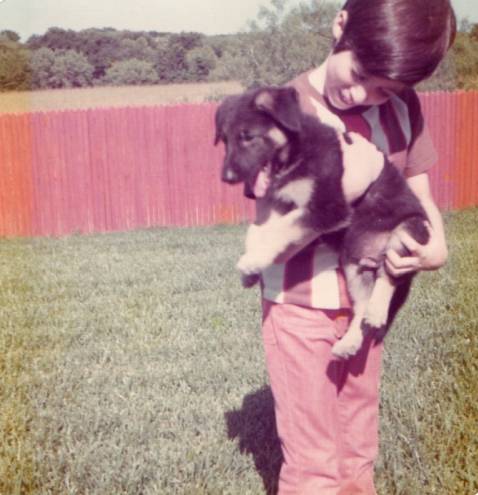
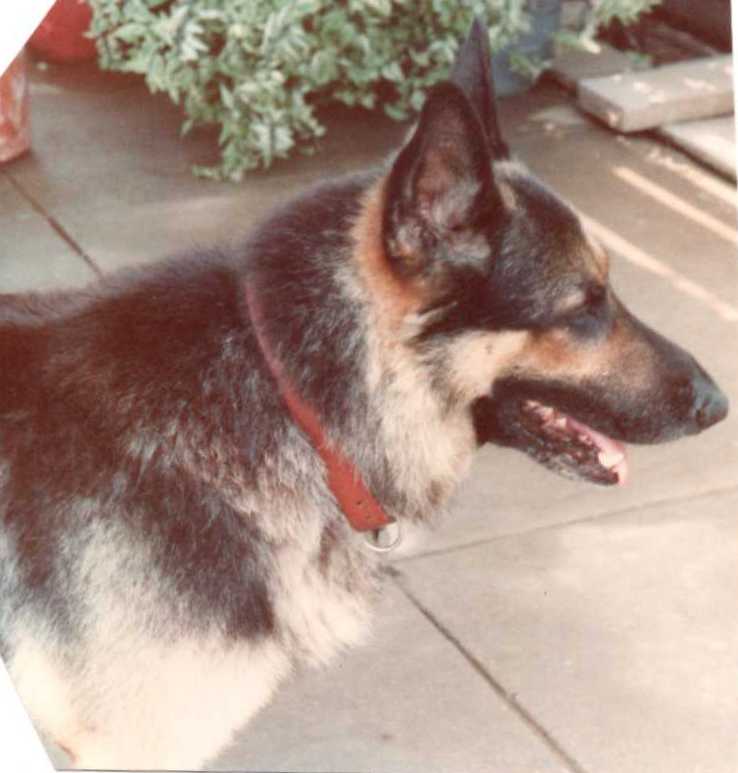
My parents were excited because they were now living the American dream of home ownership.  My father was particularly enthusiastic to follow his mother’s tradition of gardening and quickly found paradise in the front and back yards.  I was thrilled with the prospect of getting a dog.  It was a promise my parents had made to me upon moving into the house.  They fulfilled it the following summer when they bought a German shepherd puppy I named Josh.  My mother had to swallow her phobia of large canines; having witnessed a man ravaged by a Doberman in the late 1930s.

My parents made friends with many of the neighbors, and I maintain a few of those friendships today.  They each had that type of personality, especially my father – they seemed to make friends with most anyone.  I, on the other hand, seemed naturally reticent to meet new people.  Regardless, our home became a refuge for most everyone we knew.  We often held parties and other gatherings; if for no other reason except to have a party or a gathering.  Family, friends and neighbors relished visiting.  This was a place where all good souls were welcome; where people could feel happy and safe.  We had food (real food – not just chips and dips!), music, beverages, laughter and plenty of love.  No one left here sad or dejected.  Drunk and tired, maybe – but never glum.

When my father lay in a hospital bed in May of 2016, he reiterated that he wanted to die here – in this house.  It was a wish I was able to grant him.  My mother also passed away here in 2020.

A few years ago I told an old friend, Paul, that I suspected I will die here, too, albeit alone.

“What’s wrong with that?” he asked.

“Nothing!” I replied.  It was more a statement than an omen.

So I’m alone now.  This house is quiet.  At a half century it’s showing its age.  But it’s mine; it’s where I grew up and where my parents drew their last breath.  It’s where so many people came to enjoy life.

It’s a house at 50, but it’s always been a home.

9 Comments

Filed under Essays