Tag Archives: pandemics

Best Quote of the Week – April 24, 2020

“We live in a country where skin color is hazardous to one’s health and mortality is not determined by one’s genetic code but instead by one’s ZIP code.  We appeal to you to channel treatment and resources to those areas in our body politic that have suffered the most from this national infection that has allowed this virus to spread disproportionately.”

Rev. Frederick Douglass Haynes III, pastor of Friendship West Baptist Church in Dallas.

Haynes signed a letter calling on the Trump Administration to address the racial and economic inequality that is making non-White communities more vulnerable to the COVID-19 pandemic.

Leave a comment

Filed under News

Earth Day at 50

A lion pride naps on a road in Kempiana Contractual Park, South Africa, an area tourists do not see.  The park has been shut down due to COVID-19 concerns.

Alfred Hitchcock’s 1963 film “The Birds” was an innovative horror film.  A small, peaceful town in northern California suddenly finds itself the target of avian rage.  Seemingly unprovoked and without explanation, untold numbers of birds begin assaulting the townsfolk; leading to death and destruction in the most surreal ways.  Some film historians consider “The Birds” to be a call to action for the burgeoning environmental movement.

But I consider a movie that came out nine years later, “Frogs”, to be an even greater homage to environmental action.  It points specifically to environmental degradation caused by irresponsible and reckless human activity.  Whereas “The Birds” deals with one type of animal that suddenly goes insane, “Frogs” gathers an entire gallery of creatures that seek revenge on their human adversaries.  Just about everyone likes birds.  But few truly like spiders, snakes and alligators – the monsters that seem to band together in “Frogs”.  Even snapping turtles and clever geckoes get into the act!  And yes, frogs join in the mayhem with their ominous croaking, as if directing the chaos.

Unlike “The Birds” where both characters and audience are perplexed by the deranged airborne assaults, it becomes clear the frightening swamp creatures inhabiting “Frogs” are colluding to exact their own brand of justice.  As laughable as the antics can be at times, I always find myself gleeful at the sight of upper class people, trapped on an island off the coast of Georgia on Independence Day weekend, suddenly realizing their wealth and luxurious possessions can’t save them from the brewing ecological nightmare.

It’s the same feeling I get when I see bullfighting matadors gored by the massive horned beasts they stab with spears or when a circus elephant decides to bitch slap people dancing on its back.  It’s also the identical sense of euphoria I’ve been getting in recent weeks as I read of vacant cities resulting in clear skies and see pictures of wild animals strolling through urban streets because of the COVID-19 pandemic.

Today marks the 50th anniversary of Earth Day 2020, a movement begun as the realities of an industrialized society became brutally clear.  A number of celebrations and gatherings had been planned for this day.  The COVID-19 pandemic, however, has stifled those activities, and the revelry has been limited to virtual commemorations.  But, as raucous as some festivities have been in the past – with the usual cadre of corporate scions sneering overhead – perhaps there may be no better way to celebrate Earth Day than watching the world go quiet.

Satellite photos of many locations taken before and after mandatory quarantines and lock-downs exhibit how the reduction of human and vehicular traffic has resulted in less-polluted skies.  On clear days, for example, overhead views of Lake Michigan often reveal shipwrecks on the sea bottom.  But recent COVID-19 restrictions have produced many more of these days.

Undoubtedly, the disease has been heartbreaking and tragic.  But as Earth Day 2020 quietly sunsets, I still feel things couldn’t be more glorious with quarantining and social distancing have become common practice.

A fox wanders through a residential street near West Middlesex University Hospital in London, England on April 2, 2020. (Kirsty Wigglesworth/AP)

Jackals howl in Hayarkon Park, in the heart of Tel Aviv, Israel. (Oded Balilty/AP)

A Hindu holy man feeds monkeys at Pashupatinath Temple in Kathmandu, Nepal, the country’s most revered Hindu temple on March 31, 2020. Guards, staff and volunteers are ensuring animals and birds on the temple grounds don’t starve during the country’s lockdown, which halted temple visits and stopped the crowds that used to line up to feed the animals. (Niranjan Shrestha/AP)

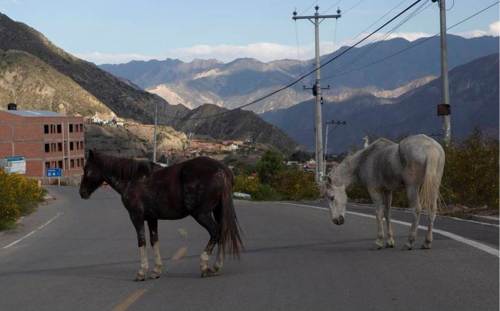
Horses in Huajchilla, Bolivia, on the outskirts of La Paz, wander a deserted highway amid government restrictions that limit residents to essential shopping in an attempt to contain the spread of the new coronavirus on April 15, 2020. (Juan Karita/AP)

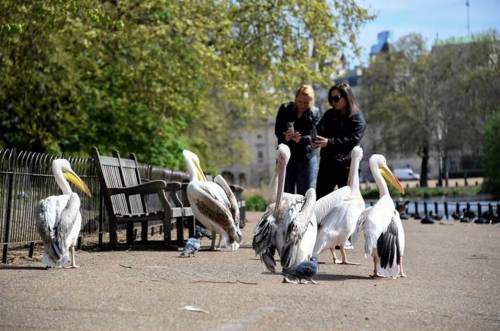
Two women take pictures of the pelicans in a deserted St James’ Park due to the Coronavirus outbreak in London, England on April 14, 2020. (Alberto Pezzali/AP)

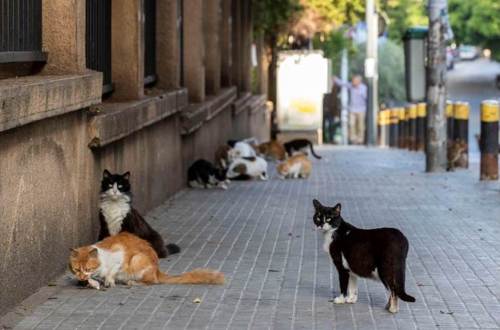
Cats eat food on a street that is almost empty before a nighttime curfew imposed by the government to help stem the spread of the coronavirus in Beirut, Lebanon on April 3, 2020. (Hassan Ammar/AP)

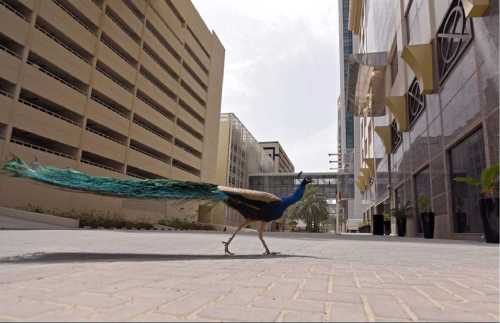
A lone peacock walks along a street in Dubai on April 1, 2020, past shops closed during the pandemic. (Karim Sahib/AFP via Getty Images)

Fallow deer from Dagnam Park in Romford, England rest and graze on the grass outside homes in the Harold Hill community on April 2, 2020. The deer are a regular sight in the area around the park, but as the roads have become quieter due to the nationwide lockdown, the deer have staked a claim on new territories in the vicinity. (León Neal/Getty Images)

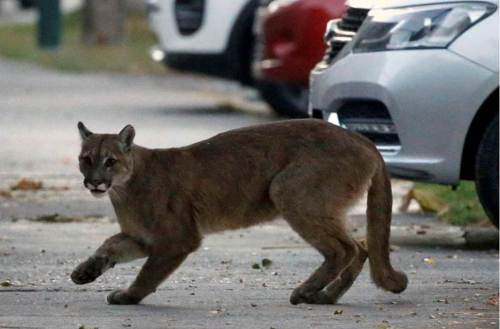
A young puma wanders the streets of Santiago, Chile shows on March 24, 2020. According to Chile’s Agricultural and Livestock Service, the animal arrived from nearby mountains in search for food as fewer people occupy the streets due to COVID-19. (Andres Pina/ATON CHILE/AFP via Getty Images)

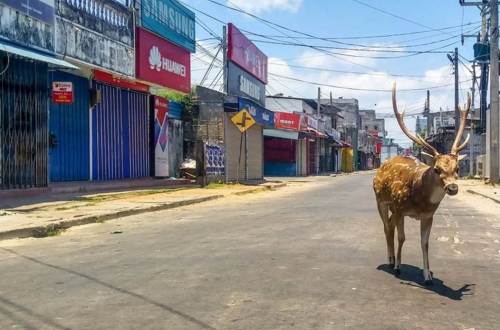
A wild deer, from a herd used to mingling with and be fed by the local population, roams a deserted street during a government-imposed nationwide lockdown, in the port city of Trincomalee, Sri Lanka on March 31, 2020. (STR/AFP Getty Images)

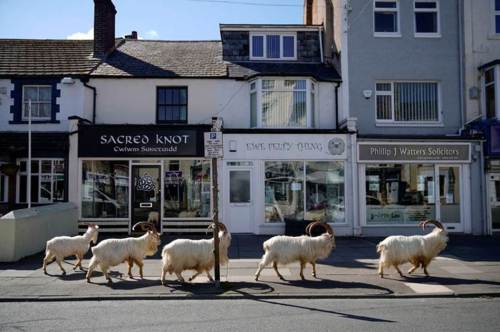
Mountain goats roam the streets of Llandudno, Wales. The goats normally live on the rocky Great Orme but are occasional visitors to the seaside town, but a local councilor told the BBC that the herd was drawn this time by the lack of people and tourists due to the COVID-19 outbreak and quarantine measures. (Christopher Furlong/Getty Images)

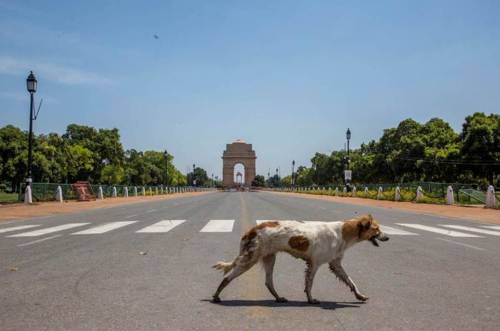
A stray dog walks in front of an empty historic India Gate as a nationwide lockdown continues over the highly contagious coronavirus (COVID-19) on March 30, 2020, in New Delhi, India. (Yawar Nazir)

Stray dogs stand on a deserted square in Pristina, Kosovo on April 1, 2020, during a government-imposed curfew from 5pm to 5am as part of preventive measures against the spread of the COVID-19. (Armend Nimani/AFP)

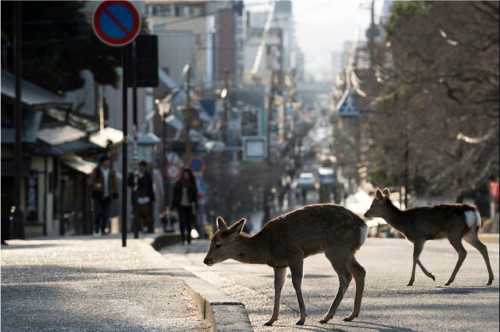
Sika deer cross a road on March 12, 2020, in Nara, Japan. Like a number of tourist hotspots around the country, Nara, a popular ancient city where free-roaming deer are an attraction for tourists, has seen a decline in visitor numbers in recent weeks amid concern over the spread of COVID-19. Some groups of deer have begun roaming in the city’s residential area due to shortage of food partially fed from tourists, according to media reports. (Tomohiro Ohsumi)

A seabird swims across clear waters by a gondola in a Venice canal on March 17, 2020, as a result of the stoppage of motorboat traffic, following Italy’s lockdown within the new coronavirus crisis. (Andrea Pattaro/AFP)

Sea turtle hatchlings scamper towards the water. (Ben Hicks)

The History Channel’s “Life After People” series examined what the world could look like if humanity disappeared.  It didn’t describe what might cause a massive die-off of humans, but a variety of experts discussed how flora and fauna would slowly consume and ultimately destroy human-made creations and induce a chemical- and pollution-free world.

Hm…would that be a bad thing?

7 Comments

Filed under Essays

How the Chief Is Coping with the COVID-19 Quarantine – April 17, 2020

Counting ice cubes is a good way to pass the time.

Sooooooooooooooooooooooooooooooooooooooooooooooooooooooooooooooooooooooooooooooooooooooooooooooooooooooooooooooooooooooooooooooooooooooooooooooooooooooooo

much

tiiiiiiiiiiiiiiiiiiiiiiiiiiiiiiiiiiiiiiiiiiiiiiiiiiiiiiiiiiiiiiiiiiiiiiiiiiiiiiiiiiiiiiiiiiiiiime!

1 Comment

Filed under Wolf Tales

Photo of the Week – April 17, 2020

Help wanted!

Olive Veronesi doesn’t ask for much.  But, on this past Easter Sunday, while many people wanted church, family gatherings and chocolate rabbits, the 93-year-old resident of Seminole, Pennsylvania stood at her front door and held up a sign expressing exactly what she wanted:

“I Need More Beer!!”

Fortunately, some concerned locals responded to her distress call faster than Donald Trump reacting to a porn star in need of anal sex.  They delivered several cases of beer to Olive, so she was saved.  It’s good to know there are still people who will go above and beyond the ordinary to help a senior citizen with anything.

Leave a comment

Filed under News

Tweet of the Week – April 17, 2020

Alexandra Chalupa, founder of the political consulting firm Chalupa & Associates, LLC, is referring to the appointment of Michael Caputo, a long-time Republican strategist, to the U.S. Department of Health and Human Services under the leadership of Alex Azar.  As a Ukrainian-American, Chalupa has a vested interest in anything involving Ukraine.  But she’s right to call out this type of nepotism in an administration that’s as incompetent as it is corrupt

Leave a comment

Filed under News

Stupidest Quote of the Week – April 17, 2020

“This is COVID-19, not COVID-1, folks. You would think that people charged with the World Health Organization facts and figures would be on top of that. This is just a pause right now. So there is an investigation, examination to what happened. But people should know the facts.”

Kelly Anne Conway, Senior Counsel to Donald Trump, regarding the president’s decision to shut down flights to and from China over the COVID-19 pandemic.

There’s a reason why the illness was named COVID-19.  This apparently is another one of Conway’s “alternative facts” charges, but one of the longest-serving members of Trump’s White House obviously hasn’t made herself aware of real facts.  I must concede I have some sympathy for Kelly Anne.  She looks like an aging porn star headed into rehab.

Leave a comment

Filed under News

Worst Quote of the Week – April 17, 2020

“The social scientists are telling us about the economic disaster that is going on. Our (Gross Domestic Product) is supposed to be down 20% alone this quarter.  It is policymakers’ decision to put on our big boy and big girl pants and say it is the lesser of these two evils.  It is not zero evil, but it is the lesser of these two evils and we intend to move forward that direction.  That is our responsibility and to abdicate that is to insult the Americans that voted us into office.”

– U.S. Congressman Trey Hollingsworth, indicating that jump-starting the economy is worth the deaths of people due to COVID-19

Hollingsworth went on to say, “[I]t is always the American government’s position to say, in the choice between the loss of our way of life as Americans and the loss of life, of American lives, we have to always choose the latter.”

Okay then…he can lead by example!  Don’t ask someone to do something that you aren’t willing at least to try yourself!

2 Comments

Filed under News

Best Quote of the Week – April 17, 2020

“We don’t have a king.  We have a president.  That was a big decision.  We ran away from having a king, and George Washington was president, not King Washington.  So the president doesn’t have total authority.”

– New York Gov. Andrew Cuomo, responding to Donald Trump’s claim of “total” authority to reopen the nation’s virus-stalled economy, despite what health experts recommend and what individual state governors want.

Leave a comment

Filed under News

Saltarello by Arte Factum


Miracle of the True Cross at the Bridge of S. Lorenzo, oil painting by Gentile Bellini, 1500; in the Gallerie dell’Accademia, Venice.

The current COVID-19 crisis has been compared to the “Black Plague”, which ravaged much of Eurasia in the middle of the 14th century C.E.  Historians and scientists now believe the scourge first appeared in Western Asia in the 1330s, before storming into India and the Middle East via the legendary “Silk Road” and then into Europe and Northern Africa.  It even reached the Danish outpost of Iceland.  It’s a wonder, I believe, it didn’t make it to North America, as Viking explorers had already reached what is now Newfoundland.  Europe was the hardest hit region, with some 50 million estimated fatalities.  Overall, it killed roughly 350- 375 million people.  But, since they had no accurate population counting system at the time, the death rate very well could have been several times worst.

There are some chilling similarities to the COVID-19 debacle.  It began in Asia and seems to have struck Italy first.  Back then religious leaders convinced their ignorant, illiterate followers that the pestilence was God’s condemnation for whatever sins they’d committed.  On top of that, national commanders initially didn’t realize the severity of the pandemic and concocted whatever excuses sounded plausible.

Politics aside, one other element remains relatively unchanged: the love of music and dance.  We’ve seen people across the globe cope with isolation and mandatory quarantines by singing and dancing; playing music on their doorsteps or balconies for neighbors to hear; connecting with family and friends through cyberspace to share melodies.  Again, there are similarities with the “Black Plague”.

Medieval Europeans also often used music and song to celebrate life’s various events.  I find music from this time and place beautifully intriguing and even somewhat familiar to current musical trends.  As usual, Italians always rose to the occasion; creating a number of songs and dances to express the beauty of life.  The saltarello is a perfect example.  An Italian dance style dating to the 14th century, it involved leaping and skipping and was performed to music done in a triple meter tempo; usually accompanied by tambourines, guitars, and singing.  Saltarello survived into the 18th century and, by then, had become a popular folk dance.  Saltarello rhythm and energy bears similarities to tarantella; another popular Italian folk dance also often performed at weddings and dating to medieval times.  A well-known contemporary model appears in the final movement of Felix Mendelssohn’s ‘Italian’ symphony.

Featured performance: Arte Factum

Image: SCALA/Art Resource, New York

3 Comments

Filed under Classics

Photo of the Week – April 10, 2020

Ryan Michalesko

Leave a comment

Filed under News