Category Archives: Essays

Barrett Block

“It has been 80 years since a Supreme Court vacancy was nominated and confirmed in an election year. There is a long tradition that you don’t do this in an election year.”

Sen. Ted Cruz (R-TX), February 14, 2016, “Meet the Press”

“The court — we are one vote away from losing our fundamental constitutional liberties, and I believe that the president should next week nominate a successor to the court, and I think it is critical that the Senate takes up and confirms that successor before Election Day,” Cruz said. “This nomination is why Donald Trump was elected. This confirmation is why the voters voted for a Republican majority in the Senate.”

Cruz, September 18, 2020, hours after the death of Supreme Court Justice Ruth Bader Ginsburg

If hypocrisy was a virtue, many politicians would be among the most honorable of citizens.  Sadly, political environments seem to have no room for such people.  Hypocrisy reigns, as U.S. Senate Republicans rammed through the nomination of Judge Amy Coney Barrett this week, in order to fill the seat left by the death Justice Ruth Bader Ginsburg last month.  Ginsburg’s failing health and ultimate death had been the subject for years among Supreme Court watchers.  Liberals and even moderates feared her death would come at such a pivotal moment in U.S. history as we’re in now.

Allegations of a double standard aside, my biggest concern with Barrett is her unwillingness to answer questions regarding one particular issue, the most sacred element of democracy: voting.  I’ve always found it odd that conservatives will move mountains to protect gun rights, but unleash similar amounts of energy to thwart voting rights.  It’s obvious this matter is critical because we are on the cusp of a presidential election.  Yet, the right to cast a ballot has come under threat since Barack Obama fairly and legitimately won his first election in 2008.  (Understand there’s never been any question of the validity of Obama’s elections.)  States with predominantly Republican legislatures suddenly became concerned with voter fraud and began implementing measures to combat it.  Similar reactions erupted after passage of the 1965 Voting Rights Act and ratification of the 26th Amendment to the U.S. Constitution in 1971.

My home state of Texas, for example, was among the first to tighten voter identification.  College ids and utility bills were nearly eliminated as proof of one’s existence or residency, but they retain their positions as supplemental forms of identification.  Other measures, such as fingerprints and retina scans were proposed – all in a futile attempt to combat the mystical voter fraud; much the same way Ted Cruz managed to fight off myriad communist sympathizers on the manicured grounds of Princeton University.

In the midst of the current COVID-19 pandemic, the idea of standing in crowded places to cast a ballot made many people shudder.  Generally, senior citizens and the disabled were among the few granted the privilege of mail-in voting.  But, as the novel coronavirus remains highly contagious, mail-in voting became more palatable.  Then, as if on cue, President Donald Trump and other right-wing sycophants raised the ugly specter of voter fraud.  And, of course, mail-in voting – just like the overall right granted by the 1st Amendment to the U.S. Constitution – was in jeopardy.

When voting rights advocates tried to compromise by pushing for drop-off ballot boxes, conservatives again balked.  On October 1, Texas Governor Greg Abbott mandated that only one drop-off box would be acceptable per county.  That works great for tiny Loving County (pop. 169), but not for massive Harris County (pop. 4.7 million).  U.S. District Judge Robert Pitman overruled Abbott; denouncing the governor’s proclamation as “myopically” focused.  But the governor persisted, and the 5th U.S. Circuit Court of Appeals agreed with him.

Earlier this week, however, Judge Barrett couldn’t seem to bring herself to declare the importance and value of voting rights.  Minnesota Sen. Amy Klobuchar asked Barrett about the freedom of the formerly incarcerated to regain their voting rights.  She highlighted one of Barrett’s 2019 dissent in Kanter v. Barr that voting should be granted only to “virtuous citizens.”  In the Kanter case, the U.S. Court of Appeals for the 7th Circuit ruled it reasonable that the litigant, Rickey Kanter, lose his right to own firearms after a felony conviction for mail fraud.  Barrett was the only member of the 3-judge panel to resist and brought up the “virtuous citizens” remark, which subsequently invoked discussions of what constitutes virtuous.  As with any moral declaration, the concept of virtue can be purely subjective.  Yet Barrett didn’t stop there.  In her dissent, she went on to write that the application of virtue should limit the right of citizens to vote and serve on juries.

I can’t count the number of times I’ve heard conservative political figures announce their support for ex-convicts to regain their right to bear arms, if they’ve served their full sentences.  None, however, have expressed similarly ardent advocacy for the same ex-convicts to earn back their right to vote.  I suspect this is because they all realize the significance of the power of voting and the power it gives even to the poor and disenfranchised.  Hence, measures in the past with poll taxes and “grandfather clauses”.

Barrett still wouldn’t clarify what she meant by “virtuous”.  In response to Klobuchar, she said, “Okay. Well, senator, I want to be clear that that is not in the opinion designed to denigrate the right to vote, which is fundamental … The virtuous citizenry idea is a historical and jurisprudential one.  It certainly does not mean that I think that anybody gets a measure of virtue and whether they’re good or not, and whether they’re allowed to vote. That’s not what I said.”

Klobuchar persisted.  In citing Justice Ginsburg’s writing in the landmark voting rights case Shelby County v. Holder, she asked, “Do you agree with Justice Ginsburg’s conclusion that the Constitution clearly empowers Congress to protect the right to vote?”

Shelby County v. Holder was crucial in the contemporary assault on voting rights.  It addressed Section 5 of the 1965 Voting Rights Act, which requires certain states and local governments to obtain federal preclearance before implementing any changes to their voting laws or practices and Section 4(b), which contains the coverage formula that determines which jurisdictions are subjected to preclearance based on their histories of discrimination in voting.  The seminal 1965 act was not-so-subtly aimed at southern states.  When the case arrived at the U.S. Supreme Court in 2013, where a 5-4 ruling declared Section 4(b) unconstitutional because it was based on data over 40 years old.  The high court didn’t strike down Section 5.  Previous research had showed that both sections had led to increases in minority voting since the 1960s.  Contemporary voting advocates, however, claimed that recent efforts – especially after Obama’s 2008 victory and mainly in the South – made it easier for election officials to impose greater restrictions on voting.

Again, Barrett just couldn’t (more likely wouldn’t) bring herself to state her position clearly.  “Well, Senator, that would be eliciting an opinion from me on whether the dissent or the majority was right in Shelby County,” she told Klobuchar, “and I can’t express a view on that, as I’ve said, because it would be inconsistent with the judicial role.”

Klobuchar then brought up alarming news that Atlas Aegis, a Tennessee-based company, was trying to recruit former members of the U.S. military to show up at various polling places while armed; all in a supposed effort to ensure the security of voting.  The image of such activity has become plausible as even President Trump advocates for armed poll-watchers to prevent voter fraud.  Whether these people should be armed with bazookas or cell phones hasn’t been made clear, but the threat is obvious.

“Judge Barrett,” asked Klobuchar, “under federal law, is it illegal to intimidate voters at the polls?”

“Sen. Klobuchar, I can’t characterize the facts in a hypothetical situation and I can’t apply the law to a hypothetical set of facts,” Barrett said.

Well, that’s a nice, safe response.  And I have to concede it’s only proper in such a setting.  A fair jurist can’t logically state a position without knowing the facts.  As the late Justice Antonin Scalia, Barrett’s self-admitted idol, once declared, “I want to hear your argument.”  But that should apply only to specific cases.  There should be no doubt about the concept of voting.

Barrett was also evasive in answers to other questions, such as abortion – the perennially key issue among conservatives – and the Affordable Care Act.  Trump had made it clear from the start of his presidential campaign that he wanted to overturn both the Supreme Court’s 1973 Roe v. Wade decision and the ACA.  While he and social and religious conservatives offer no concessions for Roe, the president often mentioned a replacement for ACA, which has yet to materialize and – as far as I’m concerned – doesn’t exist.  Roe will always remain a thorn in the fragile ribs of conservatives, but the idea of eliminating health care coverage for all citizens – particularly while we remain mired in this pandemic and flu season already underway – is infuriating.  Not-so-ironically the high court is set to review the validity of the ACA next month.  As with the upcoming election, Trump wants to ensure a conservative majority on the court before both events.

Trump has already stated – as he did in 2016 – that he will only accept the results of the election if he wins.  Whatever fool is surprised, please raise your hand now, so we full-brain folks can laugh at you!  Loudly.  Yet it’s clear: Trump realizes this election could end up like 2000, when the Supreme Court ordered the state of Florida to stop its ballot recount and thereby hand the presidency to George W. Bush.  That Bush’s younger brother, Jeb, was governor of Florida in 2000 wasn’t lost on most.  The “good-old-boy” network was alive and well at the turn of the century!

And it thrives in the anti-First Amendment actions of Republican governors across the nation.  I feel that Barrett is basically their puppet; their tool in resolutions to ensure a conservative majority in the Supreme Court.  As with any justice, Barrett’s place on the court could impact generations of people.  As a writer, I’m a strong free speech advocate, which equals the right to vote.  They’re intertwined.  And I feel that many conservatives view the 1st Amendment to the U.S. Constitution as available to only a handful – people like them.  People who share their narrow view of the world and what is appropriate in order to function within it.

Thus, the U.S. Senate’s kangaroo confirmation hearings for Barrett are ominous.

Leave a comment

Filed under Essays

Dialogue

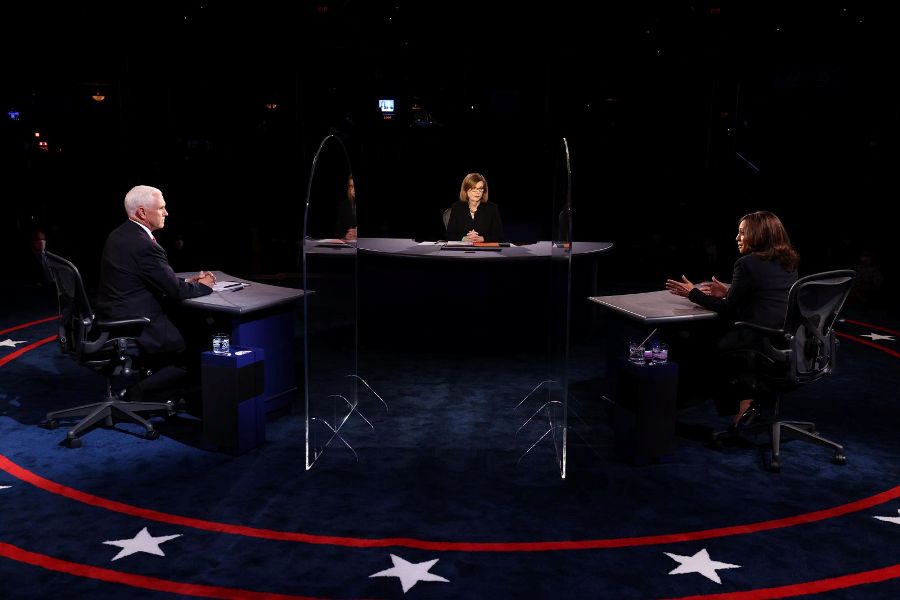
Last Wednesday’s debate between Vice-President Mike Pence and Sen. Kamala Harris was a glaringly stark contrast to the crap-fest between Donald Trump and Joe Biden the previous week.  For the most part, Pence and Harris showed those two other old curmudgeons how to remain relatively calm and focused during discussions about critical national issues.

I say ‘for the most part’ because of Pence’s tendency to interrupt Harris – the same way Trump repeatedly interrupted Biden – and to ramble beyond his slated time limit – again, like Trump.  I feel that both Trump and Pence fit the unpleasantly stereotypical image of the angry White male: men who believe only those exactly like them are qualified to speak out on any concern facing the country and should be allowed to speak adnauseam about it.

Harris, meanwhile, showed restraint and decorum by politely stating, “I’m speaking,” with a bright grin.  Many observers, especially women and non-Whites, viewed this as a typical response for someone like Harris.  Women and non-Whites, it seems, are always expected to maintain a sense of calm in the face of indignity and disrespect.  Otherwise, they’d be viewed as uppity or bitchy.  Harris, in effect, had to stay polite and professional; for if she had done a Joe Biden and yelled, “Shut up!” to Pence, political pundits – particularly those on the conservative end who already hate her for the mere fact she’s a dark-skinned woman daring to campaign for a national office, much like they did with Barack Obama – would have mercilessly slayed her.

Pence never really answered any question from moderator Susan Page who proved as equally powerless as Chris Wallace during the Trump-Biden fiasco.  But, for we independent observers – that is, those of us not satisfied with either Trump or Biden – Pence’s blatant disorientation during the debate signaled how dysfunctional the current White House administration is in the face of dual crises: the failing economy and the expanding COVID-19 pandemic.

To me Trump, Biden and Pence represent America’s past: still fighting the U.S. Civil War; the civil rights movement of the 1960s and 70s; law-and-order mantras; the Cold War; a caste society.  Harris, on the other hand, represents America’s future: attacks on economic inequality and social injustices; ending war; giving ALL citizens the chance to prove their merit and their value in a 21st century world.

Time doesn’t stagnate, except in the minds of conservatives.  Regardless of what one thinks of the vice-presidential debate, the 2020 presidential campaign continues.  It can’t end soon enough.

Leave a comment

Filed under Essays

Melting

President Trump walks to Marine One Friday, October 2, on his way to Walter Reed National Military Medical Center.

“Kennedy deserved to be shot because he was a Catholic!”

My father looked at the old man with the hottest level of anger he could muster in a split second.  All of 30 with a newborn son, my father blurted back at his coworker, “He was our president, you son-of-a-bitch!  No one deserves to get shot!”

It was November 22, 1963, and the news of President John F. Kennedy’s assassination had just spread around the print shop in downtown Dallas where my father worked.  Emotions were already raw, and my father didn’t care that he – a young Hispanic man – was yelling and cursing at a much older White male; in Texas; in 1963.

The antagonism towards Kennedy and the Democratic Party in Dallas and Texas – and throughout much of the Southeastern U.S., for that matter – couldn’t be more palpable on that tragic day.  Even decades later I’ve heard some conservatives say November 22, 1963 was one of the best days in modern American history.  One was a former friend – an openly-gay Jewish man – in 2003.  The rest of us seated with him at a restaurant table after a Toastmasters meeting were stunned.

“Yeah,” I casually responded.  “Just like the day Hitler escorted the first rabbi into a gas oven.”

No one in their right mind celebrates the death or illness of a national leader.  Even as much as I dislike Donald Trump, I’m not happy to know that he’s come down with the dreaded COVID-19 virus.  Late on Thursday night, October 1, news broke here in the U.S. that Trump and his wife have tested positive with the virus.  Earlier this evening, Friday, the 2nd, Trump was escorted to the hospital.  While I’m sure some leftist extremists are thrilled with this development, I see it for the national implication it has.  This poses a serious threat to our national security.

In 1918 President Woodrow Wilson was concerned with the “Great War” (now known as World War I), which was consuming Europe and now involved the U.S., when a mysterious influenza began rampaging across the globe.  Now known simply as the “Spanish flu”, the scourge afflicted some 500 million people and killed an estimated 50 million.  Understand this occurred long before the jet age.  According to historians, Wilson ignored the severity of the health crisis, even as it began taking lives here in the U.S., and vigorously pursued the end of the war.  In April of 1919, he arrived in Paris for peace talks – and left sick with the very flu he never publicly acknowledged.

Once back home, Wilson was quickly sequestered, and White House press reports simply indicated that overworking had caused the president to come down with a cold and a fever.  The Associated Press emphasized Wilson was “not stricken with influenza.”  In the aftermath of the greatest conflict the world had known, the mere thought of the president contracting the dreaded flu surely would have sent the nation into a panic.  So the true nature of his illness was stifled.

Six months later matters worsened for Wilson when he suffered a debilitating stroke.  It’s plausible the flu exacerbated the onset of the stroke.  Wilson never really recovered and would die in 1924.  During the 18 months he had left in his presidential tenure, Vice-President Thomas Marshall should have taken his place.  But, at the time, the vice-president was little more than a figurehead.  In fact, throughout Wilson’s presidency, Marshall later claimed he performed “nameless, unremembered jobs” that had been created solely to prevent him from doing any harm to the nation as a whole.  But, as history eventually revealed, First Lady Edith Wilson served as de facto Commander-in-Chief.  She literally presided over cabinet meetings and other presidential duties; all while hiding her husband’s grave condition.

After Woodrow Wilson’s debilitating stroke in October 1919, First Lady Edith Wilson practically took over his White House duties.

Just less than four years after Wilson endured his stroke, President Warren Harding suffered a similar event – but with fatal consequences.  Harding and his wife, Florence, had just arrived in San Francisco after touring the Alaskan territory when he experienced a heart attack.  Vice-President Calvin Coolidge was at his father’s home in Vermont; a dwelling without electricity or a telephone – not uncommon in rural abodes even by the 1920s.  When word reached Washington of Harding’s death, two Secret Service agents got in a car and drove all night to Vermont to rouse Coolidge.

It’s difficult to imagine that now: a house with no phone and Secret Service agents having to drive to scoop up a sleeping vice-president.  It’s equally unimaginable what allegedly happened in the days following Harding’s demise.  First Lady Florence Harding charged into the Oval Office upon returning to the White House and cleaned out her husband’s desk; apparently removing a number of documents along with personal effects.

Secrecy has always been a part of any presidential administration.  It has to be.  And sometimes it’s mixed with basic respect for an individual’s privacy.  Not until after Franklin D. Roosevelt died, for example, did many Americans learn he had been stricken with polio in the 1920s and was all but bound to a wheelchair.  At the 1940 Democratic National Convention in Chicago, Roosevelt fell as walked to the podium.  Film footage of the event wasn’t released until a few years ago, and most convention-goers remained quiet about the incident.  Footage of Roosevelt being wheeled onto the deck of a military vessel almost remained hidden for decades.

Most Americans weren’t aware of the severity of Dwight D. Eisenhower’s heart attack in the fall of 1955; the White House press initially disguised it as a cardiac event.  As with Roosevelt, the American public bestowed respect for medical privacy upon the president.  But when Eisenhower experienced a mild stroke two years later, some questioned his fitness for office.  By the time he left the White House, he truly looked like the 70-year-old man he was.

Therefore, most Americans were thrilled when John F. Kennedy – the first president born in the 20th century – arrived.  He wasn’t just handsome and charming; he was vibrant and energetic.  Yet not until long after his death did the public learn that Kennedy had become addicted to a variety of pain pills to help him cope with both a back injury he’d suffered in World War II and the effects of Addison’s disease.

Kennedy’s assassination was the first since William McKinley in 1901 and his death the first in nearly 20 years.  It had been a given that the vice-president would succeed the president, if something detrimental happened to the latter.  But, what if something happens to the vice-president?  McKinley’s first vice-president, Garret Hobart, died of heart disease in November 1899.  McKinley didn’t replace him, even though he selected Theodore Roosevelt as his running mate during his 1900 reelection campaign.

The question of succession became urgently relevant on November 22, 1963.  Many people forget that Vice-President Lyndon Johnson was in the same motorcade as Kennedy; a few cars away.  When shots rang out, a Secret Service agent shoved Johnson to the floorboard where the vice-president began complaining of chest pains.  That was kept secret from the public, as a horrified nation needed no further bad news.

Thus, the 25th Amendment to the U.S. Constitution was created.  It established a definite line of succession to the office of the president, beyond just the vice-president.  And it received its first real test on March 30, 1981 when President Ronald Reagan was shot just outside a hotel in Washington, D.C.  Vice-President George H.W. Bush was aboard Air Force Two, returning to the nation’s capital, when a Secret Service agent informed him of the shooting.  Back in Washington chaos rocked the White House, as the country felt the nightmarish echoes of Kennedy’s death.

On March 30, 1981, Vice-President George H.W. Bush sat aboard Air Force Two watching news reports about the shooting of Ronald Reagan.

A junior in high school at the time, I vividly remember the confusion.  While most of my classmates seemed oblivious to the fact the president of the United States had just been shot, I was worried.  The Soviet Union had invaded Afghanistan more than a year earlier and were poised to invade Poland to squelch a labor uprising.  As with rumors about the Kennedy assassination, was this a Soviet plot?  I knew Bush was vice-president, but I didn’t know he’d been in Texas.

I remember Secretary of State Alexander Haig stepping into the White House Press room and announcing, “I’m in control here.”  Haig was criticized later for inserting himself as the interim authoritarian.  But, in a morass of hysteria, someone had to take command!

I also recall my mother sitting before the TV upon returning home from work that evening – and tearing up as news of the shooting spilled out.  It took her back to that tragic autumn day in 1963, as she sat down to watch “As the World Turns” while nursing me, and Walter Cronkite suddenly interrupted to tell of Kennedy’s shooting.

The magnitude of the Reagan shooting didn’t come into full view immediately as news figures couldn’t determine if Reagan had, indeed, been shot.  (It turned out a fragment of a bullet that had hit a car had struck Reagan.)  The White House later concealed the seriousness of Reagan’s health in the aftermath.  Days after the incident, Reagan posed for a photograph; clad in his robe and smiling.  No one knew at the time he was running a high fever and almost collapsed once the picture was taken.

Reports of Donald Trump’s condition continue to flood our news feeds.  We’re now learning that several people within the President’s inner circle have tested positive for the novel coronavirus and that the outdoor ceremony on Saturday, September 26, announcing Judge Amy Coney Barrett to the U.S. Supreme Court, may have been the “super spreader” event.

Trump is now in isolation and being treated for the ailment.  I don’t bemoan that he’s being treated with the most potent medicines available and has a complete medical staff around him.  Whether anyone likes it or not, he IS president of the United States, and his health is extremely important.  I don’t care much for Donald Trump, but I don’t want to see him get sick and die.  I only wish the best for him in this crisis.

2 Comments

Filed under Essays

Health In

This COVID-19 pandemic has taken so much from the average person – no matter where in the world they live.  Here in the U.S. we’re trapped in a nightmarish scenario with a disoriented leader heralding recent gains in the stock market, while millions remain unemployed.  I’m sure those struggling to pay utilities are thrilled to know Fortune 1000 companies are enjoying record stock prices.

One of the most severe – and underrated – effects is the impact the scourge has had on people’s psyches.  Emotional, mental and physical health always become subconscious victims of any national crisis.  People are just trying to survive.

Personally, I’m in a vortex of angst and frustration.  My freelance writing enterprise – as meager as it was – has pretty much collapsed.  I’m fortunate I have some money saved from previous work, but I know that won’t last forever.  Or even much longer.  After my mother’s death this past June, though, I began to feel sick.  Friends and relatives thought I was in a state of grief, which I was for the most part.  But I thought I’d contracted that dreaded novel coronavirus.  I had many of the symptoms.  I had hoped my seasonal allergies had started to hit me early.  Then again, perhaps it was the stress of dealing with my mother’s health.  One friend suggested I was suffering from a lack of iron and Vitamin D.  Still, I finally reconciled, it may be all of the above.  Fighting so many battles at once takes a toll on the body.  And mind.

Because of the pandemic, health clubs were among those businesses shuttered across the nation in an effort to contain the spread.  I last visited my gym in mid-May; shortly before the rehabilitation center where my mother had been staying shoved her out because her Medicare benefits had been exhausted.  (That’s another story!)

But even after my gym reopened in June, I still haven’t visited.  Again it was that awful sickness.  I didn’t know what was wrong.  I’ve taken to doing basic calisthenics and walking along an exercise trail behind my home in recent weeks in the middle of the day.  I used to go running, but I don’t have the strength right now.  Key words: right now.  Once you take off a long time without doing any kind of exercise besides laundry and loading and unloading the dishwasher, it’s a tad bit difficult to get back to normal.  But even that little bit still makes me feel good.

Seven years ago I wrote about my tendency to visit my local gym on Saturday nights, when hardly anyone was present.  I commented that only lonely fools like me did such a thing.  At the turn of the century, working out on a Saturday night was unmanageable.  But the gym I had at the time was open 24 hours.  It was a perfect time to jog on a treadmill and lift weights, I realized, with such a sparse crowd.  No one was there to be “seen”.  That quiet time – with various types of music blaring from the myriad speakers lingering overhead – allowed me to think of every aspect of my life.

I left that gym in 2017 to join another local gym that closed unexpectedly a year later.  After a lengthy hiatus, I joined my current gym last year.  This is an old-school gym with no fancy juice bars or chic workout gear.  Loud rock and rap music bounces around the concrete walls.  It boasts an outside area with non-traditional workout gear, like tractor tires and tree stumps.  Men can go shirtless.  People there sweat – they don’t perspire!  It’s not for suburban soccer moms or GQ cover models.  (No offense to soccer moms!)  I feel more than comfortable in such an environment.

I know it’s tough to take one’s mental and physical health into consideration if you’re unemployed or underemployed.  But I also know you don’t have to belong to any kind of health club to care for your own health.  Mental health experts are concerned about the severity this pandemic is having on people’s well-being.  Quarantines are literally driving people crazy.  And to drink too much alcohol and/or consume illegal drugs.  Or contemplate hurting themselves.  A bad economy helps none of that.  I can identify with all of that.  I really do feel that kind of pain.

Just walking the other day, carrying a water bottle and letting the sun emblazon my bare torso, helped me mentally.  It didn’t make everything magically disappear once I returned home.  I knew it wouldn’t.  But maintaining one’s health – as best as possible, even in the worst of times – is vital.  It can’t be overemphasized.

2 Comments

Filed under Essays

Sacred Burn

“You want to do what?”

I knew my father wouldn’t like the idea of me joining the military, but the look in his eyes shivered my soul.  That was easy for many people to do to me in the late 1980s, when I had little self-esteem and little self-respect.  I had hoped joining the U.S. Marine Corps could cure me of that.  Along with my alcoholic and same-sex tendencies.  Besides, life was not going well for me at the age of 24.  I had changed majors in college three years earlier and was nowhere near graduating.  Both my parents were upset that I’d decided to study filmmaking instead of computer science.  But, after 3 ½ years of pretending both to know what I was doing and enjoying it, I had cracked in the spring of 1985 and made the bold switch.  As high school-only graduates, my parents had imbued me – their only child – with grand ambitions.  Their ambitions.  Their dreams.  They thought my writing was just a hobby to pass the time.  They never realized I’d considered it seriously in my private cogitations.  But filmmaking?  I might as well have said I wanted to be a professional gambler.

Then came the military idea.  By 1988, I was truly at a loss of where I was going.   Still, my father insisted I finish college and earn a degree – any degree.  Especially one he and my mother found acceptable.  They had reluctantly come to accept my detour into film studies.

But the military?

After the debacle of Vietnam, the concept of military service fell out of favor with many young Americans.  It was fine if dad and granddad had done it.  But not the new generation.  Things had changed considerably by the 1980s.  It was not socially fashionable.  The thing to do was to get a good job – establish a career, rather – and make lots of money and live in a nice house with plenty of beautiful clothes and a new vehicle every year or two.  That’s what my parents had wanted when they began pushing me to study computer science as I neared high school graduation.  I felt I had no choice then.  And, even by 1988, I still felt I had no real choice.  I gave into my father’s wishes (demands) and decided to continue college.

Sadly, though, I dropped out and entered the corporate world in 1990 – always with the thought that I’d return to compete that higher education.  Which I did.  In 2008.

I loved my father, but I wished I’d actually rebelled against his insistence and joined the military anyway.  I feel now that my life would have gone much more smoothly overall.

All of that began coming back to me nearly 20 years ago, as the U.S. plunged itself into two new conflicts: Afghanistan and Iraq.  The scorn I once felt for the military had metamorphosed into respect and awe.

And it’s become even more apparent since the election (via Russia) of Donald Trump.  This week Trump has found himself embroiled in more controversy regarding the U.S. military.  Most of us remember that moment in 2015, when then-candidate Trump disparaged U.S. Senator John McCain by stating, “I like people who weren’t captured.”  It was a direct smack-down of McCain’s brutal tenure as a war prisoner during Vietnam.  Under normal political circumstances, that would have ended most political campaigns.  But Trump persevered and, despite that comment and the fact he garnered a medical deferment during the same period because of some mysterious bone spurs, he went on to win the Republican Party’s nomination and eventually the presidency.  Could the nation have picked a more disrespectful dumbass to be our leader?

Now come reports that Trump disparaged the U.S. war dead during a visit to France in November of 2018 to mark the end of World War I.  Allegedly, he denounced the long-dead servicemen as “losers” and “suckers”.  Of course, these are just accusations.  But, while some high-ranking officials have come forward to state they don’t recall Trump ever making those statements, others have declared our Commander-in-Chief did say those things.

And that’s the irony of this entire debate, isn’t it?  The President of the United States is the literal head of all branches of the U.S. military.  Any national leader holds that role.  Thus, for the President of the United States to denigrate war dead as “losers” and “suckers” just sort of undermines his credibility – presuming, of course, that he had any in the first place.

But Trump doesn’t.  He’s already been proven a draft dodger (something conservatives so easily lobbed at Bill Clinton nearly 30 years ago), a tax cheat, a womanizer (another conservative slam against Clinton) and a failed businessman.

It was obvious to me more than five years ago Trump wasn’t fit to be the leader of the proverbial free world.  His actions and his verbiage have proven that to many others since.  While it amazes me that so many go into orgasmic-like frenzies at the mere mention of his name, I find him beyond appalling.  He’s just downright disgusting.

Our people in uniform can’t legally criticize their Commander-in-Chief in a public setting, but I certainly have no problems with it.  Trump’s words fail to surprise me anymore.  It’s just more proof of his mental instability and blatant incompetence.  All of that is bad enough.  But blatant disrespect for the millions of Americans who have served in uniform – including my father, other relatives and friends – is one of the most despicable things anyone can do.  Whether or not they are President of the United States.

Image: Spreadsheet

Leave a comment

Filed under Essays

So This Is Who We Have?

“I don’t make jokes.  I just watch the government and report the facts.”

Will Rogers

Both the 2020 Democratic and Republican National Conventions have come to an end, and I couldn’t be happier.  Last week former Vice-President Joe Biden accepted the Democrat’s nomination for president, while Sen. Kamala Harris accepted the vice-presidential role.  And, over the last few days, incumbent President Donald Trump and Vice-President Mike Pence accepted their respective nominations from the GOP.  Aside from watching these political love fests conclude, the only thing that excites me more about this entire process is that the demise of the 2020 presidential race is in sight.  I feel even more disenfranchised than I did four years ago.

Okay, one other thing that truly excites me is the prospect that Donald Trump will be voted out of office in November.  But I have to concede that I’m not too thrilled with the idea of a Biden presidency.  Joe Biden was good as vice-president, but I feel less secure with him in the role of Chief Executive.  I’m certain, though, he’ll be much better than Trump.  Hell, a stray dog would be better than Trump!

In 2016 I voted for Green Party candidate Jill Stein.  A physician, Stein had been the Green Party’s candidate four years earlier.  I knew Iceland would see 80-degree temperatures on Christmas Day before Stein would win the U.S. presidency.  But I didn’t like either Trump or the Democratic choice of Hillary Clinton.  Clinton supporters blamed people like me for Clinton’s loss in 2016.  But we didn’t cause Hillary Clinton to lose the 2016 presidential election.  Hillary Clinton caused Hillary Clinton to lose the 2016 presidential election.  Her and the Russians.  As we now know, Russia essentially elected Trump; just like the U.S. Supreme Court elected George W. Bush in 2000.  America’s role as the beacon of democracy seems to have been shredded over the past 20 years.

I just never liked Hillary Clinton.  I loved Bill (Whose Your Daddy?) Clinton, but I never took a liking to Hillary.  By 2016, she had acquired top much baggage; more baggage than a Samsonite warehouse or a Lufthansa flight fresh in from Berlin.

And I definitely didn’t like Trump.  Donald Trump had been running for president for some 30 years by the time he made it official in 2015.  The idea had arisen back in the 1980s, when his name and persona first became public, and much of the nation had grown enamored with the concept of rapid-fire wealth and public prestige.  As AIDS and cocaine rampaged, many in the U.S. found the likes of Trump appealing.  He survived the collapse of the financial industry related to the savings-and-loan crisis and the string of high-profile prosecutions that ensued.  It seemed there was a price to pay for fiduciary recklessness.  No one knew at the time, though, that Trump was actually a womanizing failed businessman and tax cheat.  We know that well enough now.  But he’s president.  And, as another massive health crisis grips the nation and the world, we see how incompetent and ineffective Donald Trump really is.

I’m sure Joe Biden can do better.  But I keep thinking Biden should have called it a political life after his vice-presidency ended in January of 2017.  He should have retired to his estate in Delaware to consult on other political campaigns, give speeches and write books.  He’d served his time in office; he’d done his duty.

For the Democratic Party, the 2020 presidential campaign had started with high promises and an extraordinarily bright future.  The field of candidates was the most diverse that had ever existed among any political party.  But, by March, we’d ended up with two old White guys: Biden and Sen. Bernie Sanders.  Kind of like the Republican Party.  And I say this with all due respect to old White men.  I mean, I’m a mostly White man myself – in the golden days of middle age.  And, as I’ve declared before, White men aren’t the nexus of evil in America they’re often portrayed to be.  But I personally had hoped Sen. Elizabeth Warren would be the Democrats’ choice.  I would definitely be more excited with her at the head of the ticket.

As usual, there has been no real mention of either the Green or Libertarian Parties.  They’ve essentially been locked out of the convention hall – again.  And Americans are overwhelmed by the demagoguery of the Democratic and Republican Parties – again.  Indeed, the U.S. is becoming less and less like a democracy and more like an oligarchy.  Does my vote – or the vote of any individual – truly count?  Throughout the year the U.S. has seen covert attempts by the Trump Administration to thwart the right to vote – one of the foundational pillars of any free society.  That’s typical of social and political conservatives.  While the Republican Party of the 19th century pushed for the 13th Amendment to the U.S. Constitution, it was the passage of the 1965 Voting Rights Act that propelled many conservatives into the arms of the GOP.  Recent efforts to enforce voter identifications, calls for limiting early voting days and ongoing battles to undermine mail-in voting prove that conservatives – the ones who will move Heaven and Earth to protect their sacred gun rights – will do anything possible to circumvent the voting process.

And here we are: stuck with two old men who represent more of America’s past than its future.  I was enthralled with Bill Clinton and I liked Barack Obama.  Yet, I just can’t bring myself to get excited with the current campaign.

My two biggest fears?  If Trump is reelected, the nation will descend further into social chaos and economic madness.  If Biden is elected, he may die in office, which will send the nation into equally unending chaos.

I know I will vote nonetheless.  People have fought and died for this right – even within the past 100 years.  There are literally millions of people across the globe who would relish the chance to choose between the lesser of two or three evils.  The people of Belarus certainly wish they had that opportunity now.  Amidst the current COVID-19 pandemic and a rash of voter suppression tactics, I will stand in line to select a candidate for the U.S. presidency.  It’s my right and my obligation.  Besides, I have nothing else to do two days before my 57th birthday.

1 Comment

Filed under Essays

This Is Why I Write

“I loved words. I love to sing them and speak them and even now, I must admit, I have fallen into the joy of writing them.”

Anne Rice

So far, 2020 has been one of the roughest years in the lives of many people.  Not just here in the United States, but across the globe.  For me, it’s been extraordinarily tough.  Even before the COVID-19 pandemic hit, I became leery as my savings dwindled.  My freelance writing career hasn’t proven as successful as I’d hoped, so writing gigs have dried up.  My mother’s stroke at the end of January sent me into an emotional tailspin.  I felt incredibly guilty sending her to a rehabilitation center.  But, as her own health failed, I realized she was entering the final stages of her life.  She finally passed away June 22.

My mother worked in the insurance industry her entire adult life, retiring in 2003 at the age of 70.  She was earning pensions from the last two companies where she worked.  One has already informed me there was no final beneficiary payout, and I’m waiting to hear from the other.  They have to (snail) mail me some documentation that I have to complete and sign and return to them with a copy of her death certificate.  Okay, I’m thinking, this is the 21st century.  Did they not get the memo?  It’s like much of the Southeastern U.S. with the Civil War.  But it’s not financial; it’s an issue I have to resolve from a legal perspective in order to probate the will and get this house transferred into my name.

Still, I remain unemployed, with little financial backup.  I’ve had to delay utility payments – something I’ve never done in my entire life.  Now my truck is showing its age.  Like a dog, 14 is old for a vehicle.

Moreover, I thought briefly I had contracted the dreaded novel coronavirus.  Symptoms like fever and a persistently runny nose alarmed me.  The lethargy overwhelmed me.  I kept thinking (hoping) these were the effects of allergies – a constant plague in my life.  Or perhaps I’m simply recovering from the stress of caring for both my parents.  Maybe it’s male menopause.  (I’ll be 57 in November.)  I didn’t know.  But a friend recently suggested another problem: a lack of exercise (which I’d already admitted) and/or an iron deficiency (which I’d already suspected.)  Thus, I purchased some iron supplements and have become determined to reinvigorate my various exercise regimens.  I’ve been out walking along an exercise trail behind my home these past couple of weeks.  During one of those I actually made an attempt to jog – and promptly stopped.  You just can’t go months without running and then expect to break into an Olympic-style sprint!  I’m watching middle age gently fade from my soul in real time.

That same friend, however, said something to me last week that offended me more than anything else he – or most anyone else – has ever said.  We’ve always had a sometimes-contentious, yet brutally honest friendship.  But he coyly criticized me for spending so much time on my writing – and this blog; that I’m wasting that time and energy on my creative pursuits instead of trying to find a full-time job.

His comments stunned me.  I promptly reminded him of my previous years of employment; where I slaved away over hot computer keyboards during weekdays, before turning to my creative writing endeavors in the evenings and on weekends.  I’ve always felt a greater sense of responsibility to myself and my community than to suffer for my art and live off the grid and on the edge.

I write because I enjoy it.  I feel I’m good at it.  It’s the one thing about myself in which I’m 100% confident.  Writing is mostly all I’ve ever wanted to do with my life.  It’s therapeutic.  It’s kept me from hurting myself and others.  I understood long ago that my chances at becoming a famous author were slim.  But I don’t write stories in the hopes of becoming wealthy and renowned.  I fully realize the odds of that are incredibly rare.  I’m not naïve – or irresponsible.

I continue to search for full-time, even contract or part-time, work.  And I continue to write – on this blog and my stories.  I’m not writing now just to piss off my friend, which would suck up too much of my energy.

Once more, I write because I love it.  It’s who I am and who I always will be.

There are some parts of our souls upon which we can never give up.

Image: Fernando Doglio

2 Comments

Filed under Essays

Respect in Motion

It’s finally happening!  The Washington Redskins national football team has decided to change their name by eliminating the term “redskins”.  This is a moment for which the Indigenous American community has been striving for years.  It comes at a time of national soul-searching for the United States – a period nearly a quarter of the way into the 21st century where we are at long last coming to terms with a lifetime of racial injustice and inequality.

The alteration didn’t come from a moment of sudden spiritual enlightenment from team owner Dan Snyder who had said many years ago that a name change was out of the question; adding: “NEVER – you can use caps.”

Never say never, Danny boy!

Snyder bowed to social and economic pressures.  Several major corporations that have sponsored a variety of professional sports teams in the U.S. for years had vowed to pull their support if Washington didn’t change its name.  When you grab someone by the financial gonads, they’ll follow you with hearts and minds.

But society is also changing.  Despite the old guard claims that it’s “just a game”, American consciousness has seen that proverbial light in the darkness and gone towards it.  NASCAR, for example, recently banned Confederate flags from its events; a move that has upset many White southerners.  Again, the old guard is losing its grip on cultural relevance.

The word “redskin” is equivalent to slurs like nigger, gook, spic, fag, or politician.  It’s seriously debasing and relegates the Western Hemisphere’s native peoples to a skin tone (which many don’t actually have) as well as to a sub-human category.  In all fairness, some people of Native American ancestry don’t care either way.  They don’t view the term as derogatory or racist.  It’s just a word.  Of course, it is!  So is genocide.

Washington is now at a moniker crossroads.  Obviously, they’ll keep the name Washington.  But what to add to it?  Some have suggested “Warriors” or “Red Tails”; the latter a reference to the legendary Tuskegee Airmen, a group of African-American United States Army Air Forces (USAAF) servicemen during World War II who went disregarded and underappreciated for decades.

I recommend the term “Monuments”.  It’s a direct recognition of the Washington Monument, but it’s also a reference to the structure’s form and size.  You know – a large, tall, long, hard, phallic-shaped emblem.  Since football is such a macho sport, I feel it’s appropriate.

Regardless of whatever name Washington adopts, the time is way past due.  And there’s simply no turning back.  Time doesn’t stop and it doesn’t retract.  It always moves forward.  So should we all.

“A Matter of Respect” (2012)

Leave a comment

Filed under Essays

It’s Still a Matter of Respect

Yesterday, July 3, the Washington Redskins football team made the stunning announcement that they would actually consider changing their name; at least change the “Redskins” part of it.  If there’s a true case of better late than never, this is it.  For decades, the nation’s Native American population and their supporters have demanded Washington remove the “Redskins” feature of their moniker.  As recently as 2013, team owner Dan Snyder scoffed at the possibility of such a move.  Many have expressed surprise that Snyder would be opposed to the alteration because he is of Jewish-American extraction.  But I say it’s because he is Jewish-American that he remained reticent to a change.  From what I’ve seen, many people of Jewish faith and ethnicity feel they are not only the “Chosen Ones” of humanity, but they are the ONLY ones who have ever suffered the horror of genocide.  So much so that the term ‘holocaust’ has metamorphosed into ‘Holocaust’ as a direct reference to Nazi Germany’s attempt to obliterate the Jewish people.  Snyder had spat out the usual Caucasian rhetoric of venerating Native Americans as fierce warriors with the word “redskin”.

In his formal statement, he declared, in part, “This process allows the team to take into account not only the proud tradition and history of the franchise, but also input from our alumni, the organization, sponsors, the National Football League and the local community it is proud to represent on and off the field.”

Not once did Snyder mention the derogatory nature of the word “redskin”.  In the spirit of thick-skin football, I presume Snyder wouldn’t mind me recounting a couple of old Jewish jokes someone told me more than 30 years ago.

“Hear about the new German microwave oven?

Seats 500.”

Or…

“What’s a Jewish woman’s favorite sex position?

Bent over the checkbook.”

In the spirit of racial unity, I wanted to refer to one of my earliest essays, “A Matter of Respect,” in which I address this very issue.  Because, like love and hope, respect never dies.

Leave a comment

Filed under Essays

Coloring In

We’ve heard it so many times before.  History has always been written by the victors.  It’s a sad reality, yet very true.  It means that much of the history of Africa and the Western Hemisphere has been recounted with a decidedly European viewpoint.  As someone of mixed European and Indigenous American extraction, I always felt conflicted about this disparity.  While trying to find information about Native American Texans in an encyclopedia during my grade school years, for example, I noticed that references to pre-Columbian peoples were treated dismissively.  It wasn’t just archaic history in standard academic circles.  It was irrelevant.  Even mention of the state’s Spanish colonizers – the first permanent European settlers – was dubbed “pre-history.”  It seemed Texas history didn’t actually begin until the likes of Stephen F. Austin and Sam Houston arrived.  And it didn’t matter that these men weren’t even born and raised in the state.

Only within the past half-century has the truth about various indigenous societies been revealed with advances in archaeological research and detailed forensic analysis.  Lidar, for example, has taken the concept of neon lighting from the banal presence of liquor store signs to the jungles of Central America where long-abandoned Mayan structures remain shrouded by the foliage.  As a devotee of Archeology magazine, I’m constantly amazed by discoveries of ancient settlements across the globe.  Areas once thought to be occupied by nomadic hunter-gatherer types at best are revealing the ghosts of thriving population centers.

Yes, history has always been dictated and composed by those who somehow managed to overcome the locals – usually through the casualties of disease and pestilence or the sanguineous nature of war and violence.  But the blood of history’s victims seeps into the ground and eventually fertilizes the crops that feed the newly-minted empires.  That blood eventually metabolizes into the truth of what really happened – albeit many centuries or millennia later.  Still at that point, it can no longer be ignored.

Here in the U.S. we’re now seeing statues and other emblems of the American Civil War come down by government decree.  Supporters of that conflict have maintained its genesis was the battle for states’ rights, while truth-tellers insist it was a battle over slavery.  They’re both correct, in some ways.  It was a battle over the right of some states to keep an entire race of people enslaved.  I certainly feel removal of these statues is appropriate.  Those who fought for the Confederacy wanted to rip the nation in half over that slavery issue and therefore, should not be venerated as military heroes.  They’re traitors.

The debate has now shifted to renaming many U.S. military bases.  In my native Texas, one military base is named after John Bell Hood, a Confederate general who – like so many other Texas “heroes” – wasn’t even born and raised in the state.  Hood also wasn’t an especially adept military commander; having lost a number of individual conflicts.  And yet, a military base is named after this treasonous fool?

The U.S. Pentagon has expressed some willingness to rename military bases that reference those ill-fated Civil War characters.  Naturally, it’s upset many White southerners who annually reenact various Civil War conflicts; not realizing how ridiculous they look in their antebellum garb.  I can’t help but laugh at them.  They’ve been fighting the war for over 150 years and STILL haven’t won!

In his usual brusque and toddler-esque manner, President Trump announced last month he would veto a USD 740 billion defense bill if it included an amendment that would rename many of those military bases.  He declared, “These Monumental and very Powerful Bases have become part of a Great American Heritage, and a history of Winning, Victory, and Freedom.”

Remember, the Confederacy lost that war.  A million reenactments won’t change that reality.

Some 30 years ago my father discovered that Spain’s Queen Isabella (who funded Christopher Columbus’ voyage) was an ancestor of his mother.  According to documentation my father found, Isabella learned of the atrocities Spain’s military officials were committing against the indigenous peoples of the “New World” and ordered them to stop.  That’s one reason why Latin America has a stronger connection to its native peoples than the United States and even Canada.

It should be worth noting that, while Italians celebrate Columbus as a national hero, he probably wasn’t even a native son.  For centuries he was considered a Genoese sailor with grand visions of finding a westward route to India and subsequently gain an edge in the then-contentious spice trade.  Contemporary research, however, has declared he was actually the son of Polish King Władysław III; often dubbed the twelve-toed king because allegedly had 6 toes on each foot.  And I have to emphasize that Columbus couldn’t get Italian leaders to finance his ventures, so he turned to Spain.  In the 15th century C.E., Italy was actually a conglomeration of city-states.

In one of my earliest essays on this blog, I lamented the term “redskin”; a derogatory moniker for Native Americans that has figured prominently into the names of many sports teams, from grade school to professional.  Just this week the Washington Redskins football team announced what many previously considered unthinkable: they might change their name.  Team owner Daniel Snyder conceded he’s bowing to pressure from its largest corporate sponsors (big money always has the loudest voice in the corporate world), as well a growing cacophony of socially-conscious voices demanding change.  Snyder said the team has begun a “review” of both the name and the team’s mascot.  Detractors, of course, moan this is political correctness at its worst.  But, just like Civil War reenactors still haven’t won, Eurocentrics still won’t admit they didn’t obliterate North America’s indigenous populations.

Change on such a grand scale is always slow and painful.  But, as with time itself, change will happen; it can’t be stopped.

We can never correct or fix what happened in the past.  Nothing can ever atone for the loss of millions of people and the destruction of the societies they built.  But we can acknowledge the truth that is buried.  It’s not rewriting history; it’s writing the actual history that remained entombed in that bloodied soil for so long.  It’s adding the needed and long-absent color to reality.

4 Comments

Filed under Essays