Category Archives: Essays

Earth Day at 50

A lion pride naps on a road in Kempiana Contractual Park, South Africa, an area tourists do not see.  The park has been shut down due to COVID-19 concerns.

Alfred Hitchcock’s 1963 film “The Birds” was an innovative horror film.  A small, peaceful town in northern California suddenly finds itself the target of avian rage.  Seemingly unprovoked and without explanation, untold numbers of birds begin assaulting the townsfolk; leading to death and destruction in the most surreal ways.  Some film historians consider “The Birds” to be a call to action for the burgeoning environmental movement.

But I consider a movie that came out nine years later, “Frogs”, to be an even greater homage to environmental action.  It points specifically to environmental degradation caused by irresponsible and reckless human activity.  Whereas “The Birds” deals with one type of animal that suddenly goes insane, “Frogs” gathers an entire gallery of creatures that seek revenge on their human adversaries.  Just about everyone likes birds.  But few truly like spiders, snakes and alligators – the monsters that seem to band together in “Frogs”.  Even snapping turtles and clever geckoes get into the act!  And yes, frogs join in the mayhem with their ominous croaking, as if directing the chaos.

Unlike “The Birds” where both characters and audience are perplexed by the deranged airborne assaults, it becomes clear the frightening swamp creatures inhabiting “Frogs” are colluding to exact their own brand of justice.  As laughable as the antics can be at times, I always find myself gleeful at the sight of upper class people, trapped on an island off the coast of Georgia on Independence Day weekend, suddenly realizing their wealth and luxurious possessions can’t save them from the brewing ecological nightmare.

It’s the same feeling I get when I see bullfighting matadors gored by the massive horned beasts they stab with spears or when a circus elephant decides to bitch slap people dancing on its back.  It’s also the identical sense of euphoria I’ve been getting in recent weeks as I read of vacant cities resulting in clear skies and see pictures of wild animals strolling through urban streets because of the COVID-19 pandemic.

Today marks the 50th anniversary of Earth Day 2020, a movement begun as the realities of an industrialized society became brutally clear.  A number of celebrations and gatherings had been planned for this day.  The COVID-19 pandemic, however, has stifled those activities, and the revelry has been limited to virtual commemorations.  But, as raucous as some festivities have been in the past – with the usual cadre of corporate scions sneering overhead – perhaps there may be no better way to celebrate Earth Day than watching the world go quiet.

Satellite photos of many locations taken before and after mandatory quarantines and lock-downs exhibit how the reduction of human and vehicular traffic has resulted in less-polluted skies.  On clear days, for example, overhead views of Lake Michigan often reveal shipwrecks on the sea bottom.  But recent COVID-19 restrictions have produced many more of these days.

Undoubtedly, the disease has been heartbreaking and tragic.  But as Earth Day 2020 quietly sunsets, I still feel things couldn’t be more glorious with quarantining and social distancing have become common practice.

A fox wanders through a residential street near West Middlesex University Hospital in London, England on April 2, 2020. (Kirsty Wigglesworth/AP)

Jackals howl in Hayarkon Park, in the heart of Tel Aviv, Israel. (Oded Balilty/AP)

A Hindu holy man feeds monkeys at Pashupatinath Temple in Kathmandu, Nepal, the country’s most revered Hindu temple on March 31, 2020. Guards, staff and volunteers are ensuring animals and birds on the temple grounds don’t starve during the country’s lockdown, which halted temple visits and stopped the crowds that used to line up to feed the animals. (Niranjan Shrestha/AP)

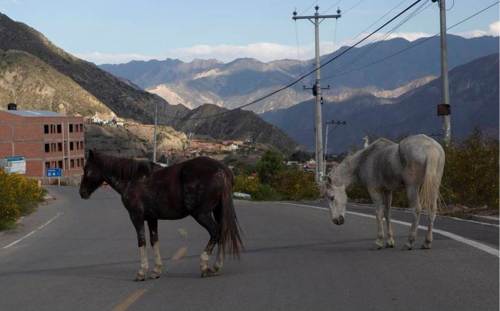
Horses in Huajchilla, Bolivia, on the outskirts of La Paz, wander a deserted highway amid government restrictions that limit residents to essential shopping in an attempt to contain the spread of the new coronavirus on April 15, 2020. (Juan Karita/AP)

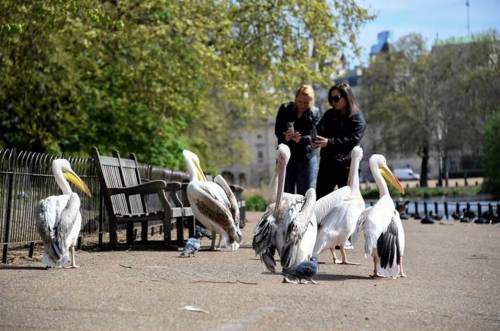
Two women take pictures of the pelicans in a deserted St James’ Park due to the Coronavirus outbreak in London, England on April 14, 2020. (Alberto Pezzali/AP)

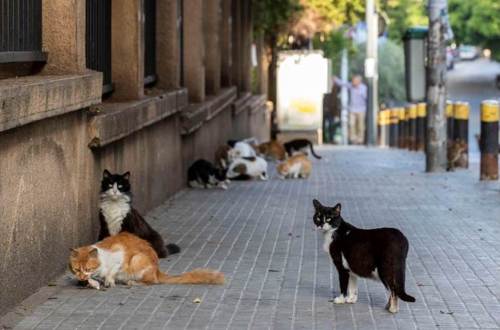
Cats eat food on a street that is almost empty before a nighttime curfew imposed by the government to help stem the spread of the coronavirus in Beirut, Lebanon on April 3, 2020. (Hassan Ammar/AP)

A lone peacock walks along a street in Dubai on April 1, 2020, past shops closed during the pandemic. (Karim Sahib/AFP via Getty Images)

Fallow deer from Dagnam Park in Romford, England rest and graze on the grass outside homes in the Harold Hill community on April 2, 2020. The deer are a regular sight in the area around the park, but as the roads have become quieter due to the nationwide lockdown, the deer have staked a claim on new territories in the vicinity. (León Neal/Getty Images)

A young puma wanders the streets of Santiago, Chile shows on March 24, 2020. According to Chile’s Agricultural and Livestock Service, the animal arrived from nearby mountains in search for food as fewer people occupy the streets due to COVID-19. (Andres Pina/ATON CHILE/AFP via Getty Images)

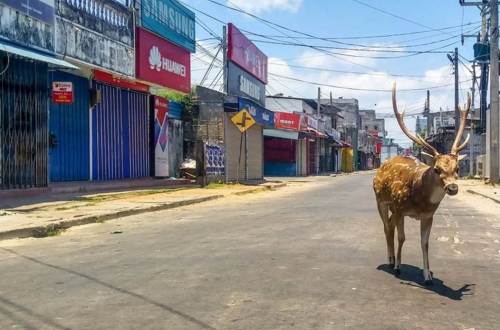
A wild deer, from a herd used to mingling with and be fed by the local population, roams a deserted street during a government-imposed nationwide lockdown, in the port city of Trincomalee, Sri Lanka on March 31, 2020. (STR/AFP Getty Images)

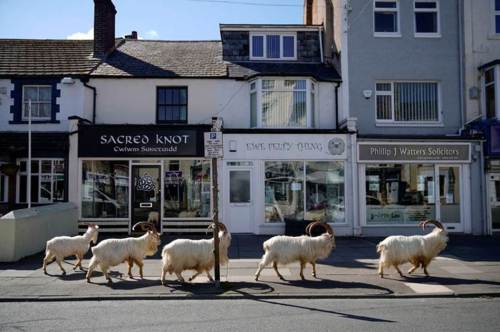
Mountain goats roam the streets of Llandudno, Wales. The goats normally live on the rocky Great Orme but are occasional visitors to the seaside town, but a local councilor told the BBC that the herd was drawn this time by the lack of people and tourists due to the COVID-19 outbreak and quarantine measures. (Christopher Furlong/Getty Images)

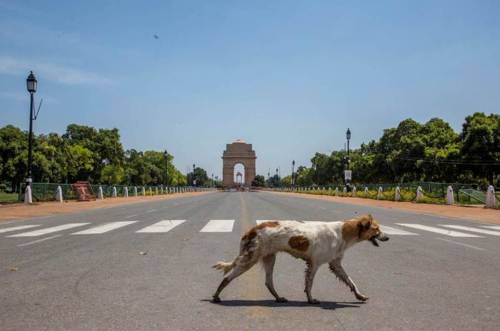
A stray dog walks in front of an empty historic India Gate as a nationwide lockdown continues over the highly contagious coronavirus (COVID-19) on March 30, 2020, in New Delhi, India. (Yawar Nazir)

Stray dogs stand on a deserted square in Pristina, Kosovo on April 1, 2020, during a government-imposed curfew from 5pm to 5am as part of preventive measures against the spread of the COVID-19. (Armend Nimani/AFP)

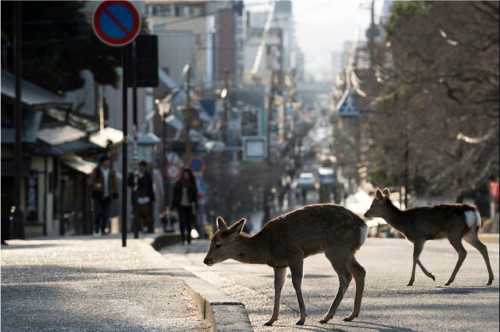
Sika deer cross a road on March 12, 2020, in Nara, Japan. Like a number of tourist hotspots around the country, Nara, a popular ancient city where free-roaming deer are an attraction for tourists, has seen a decline in visitor numbers in recent weeks amid concern over the spread of COVID-19. Some groups of deer have begun roaming in the city’s residential area due to shortage of food partially fed from tourists, according to media reports. (Tomohiro Ohsumi)

A seabird swims across clear waters by a gondola in a Venice canal on March 17, 2020, as a result of the stoppage of motorboat traffic, following Italy’s lockdown within the new coronavirus crisis. (Andrea Pattaro/AFP)

Sea turtle hatchlings scamper towards the water. (Ben Hicks)

The History Channel’s “Life After People” series examined what the world could look like if humanity disappeared.  It didn’t describe what might cause a massive die-off of humans, but a variety of experts discussed how flora and fauna would slowly consume and ultimately destroy human-made creations and induce a chemical- and pollution-free world.

Hm…would that be a bad thing?

7 Comments

Filed under Essays

Truth Amid the Obstruction


No time is right for a health pandemic, but COVID-19 couldn’t have arisen at a more inconvenient period for Americans: at the start of the 2020 presidential election race.  Things had been proceeding somewhat normally until March, when concerns about the “novel coronavirus” began altering the social landscape.  When I saw that this summer’s Olympics in Tokyo had been postponed – possibly to next year – I knew our world had been capsized by this invisible biological menace.  Viruses, like facts, always have a way of sneaking into our lives and making us rethink everything we’ve ever learned.  Facts, however, are good things.  But, while a crisis of any kind can bring out the best humanity has to offer, it can also bring out the worst.

Right now political conservatives in the U.S. are trying to finagle the COVID-19 miasma into an obstructionist nightmare for the voting populace.  Last week thousands of voters in Wisconsin were forced to leave their homes and venture out to designated polling places to cast their votes for a candidate in the Democratic primary.  On April 6, the U.S. Supreme Court, in a 5-4 decision, refused to allow an extension of absentee voting in Wisconsin; thus, forcing the primary to go on as planned on April 7.  On April 2, a federal judge had ruled that absentee voting can be extended.  But unsurprisingly, the Republican National Committee appealed the ruling, which landed on the docket of the High Court.

In her dissent, Justice Ruth Bader Ginsburg wrote that “the court’s order, I fear, will result in massive disenfranchisement.”  She went on: “Because gathering at the polling place now poses dire health risks, an unprecedented number of Wisconsin voters – at the encouragement of public officials – have turned to voting absentee.  About one million more voters have requested absentee ballots in this election than in 2016.  Accommodating the surge of absentee ballot requests has heavily burdened election officials, resulting in a severe backlog of ballots requested but not promptly mailed to voters.”

Political conservatives don’t like it when people they consider insignificant actually have the audacity to practice their right to vote.  For a good part of American history, they’ve done just about everything they could – including intimidation and violence – to stifle voting rights; which, they’ve obviously forgotten, is one of the fundamentals of a democratic society.  The right to vote is clearly mentioned in the 1st Amendment of the U.S. Constitution!  Then again, they may not necessarily forget about it, as they just ignore it.  And they always seem to skip over to focus attention on the 2nd Amendment, which addresses firearms.

Conservatives established and enforced such obstructionist tactics as “grandfather clauses”, literacy tests, and poll taxes.  Voting advocates had to fight for confidential voting.  Early feminists had to do the same to get the 19th Amendment ratified.  When President Lyndon Johnson signed the 1965 Voting Rights Act into law, he conceded that he and his fellow Democrats had probably handed the South to the Republican Party.  And he was right!  Slowly, but surely, over the ensuing decade, many White southerners began switching to the GOP.  A number of well-known U.S. politicians, such as Strom Thurmond and Jesse Helms, also changed their allegiances to the Republican Party.

The election of Barack Obama solidified in the minds of many conservatives the horrors of expanded voting.  They then launched a number of efforts – both at the national and state levels – to ensure that would never happen again.  A slew of voter identification rules were suddenly enacted.

The COVID-19 scourge has prompted calls across the nation for expanded absentee voting, such as mail-ins, which has been rebuffed by conservatives who holler voter fraud could result.  This week Texas Attorney General Ken Paxton opined that fear of catching the virus does not qualify voters to vote by mail

But State Judge Tim Sulak ruled that Texans afraid of catching COVID-19 should be allowed to vote by mail during the pandemic, using the state’s disability clause in the state’s election code, and said he will issue a temporary injunction.  The Texas Democratic Party and several had filed a lawsuit over concerns that voters in this July’s elections, including the primary runoffs, could come in contact with infected people when voting in person.

“Based on the plain language of the relevant statutory text, fear of contracting COVID-19 unaccompanied by a qualifying sickness or physical condition does not constitute a disability under the Election Code,” Deputy Attorney General Ryan M. Vassar wrote in a letter to Fort Worth State Rep. Stephanie Klick, a fellow Republican.

And, of course, Paxton was “disappointed” that Sulak had “ignored the plain text of the Texas election code to allow perfectly healthy voters to take advantage of special protections made available to Texans with actual illness or disabilities.”

The voter fraud claim is the default mantra of right-wing politicians every time they enact legislation that impacts the voting process.  Texas Republicans have long opposed the expansion of mail-in voting.  In 2017 the GOP-dominated state legislature stiffened penalties for election fraud.

“Our state is better off when more Texans participate in our democracy,” said Gilberto Hinojosa, chair of the Texas Democratic Party.  “Voting by mail is safe, secure and accessible.  It allows more voters to participate in our democracy, and it’s a common sense way to run an election, especially during a public health crisis.”

Like the Texas Innocence Project, you know the Texas Democratic Party has their work cut out for them!

Currently, residents over age 65, military members, those who will be away from their residence during voting and people with disabilities can request mail-in ballots.  Democrats argue that a disability, defined as a “sickness or physical condition that prevents the voter from appearing at the polling place on election day without a likelihood of needing personal assistance or of injuring voters’ health,” covers all Texas voters under the age of 65, including those who are afraid to catch the COVID-19 virus.

In his letter to Klick, Vassar naturally disagreed, stating that fears of catching the virus is neither a sickness nor a physical condition, but an emotional reaction to the pandemic is not “sufficient to meet the definition of disability”.

It’s ironic that Vassar regards concerns of contracting COVID-19 as emotional.  Throughout Obama’s presidency, conservatives screamed that his administration would ban all firearms, abandon Israel, and force churches to conduct same-sex weddings.  None of that happened.  It never has and most likely it never will.  Yet, liberals are always justifiably concerned that voter suppression is a real possibility when conservatives are elected to office.  Justifiably concerned because many state legislatures, such as Texas, actually have moved to enact legislation to combat the ubiquitous pandemic of voter fraud.

During Black civil rights movement of the 1950s and 60s, news cameras captured horrific scenes of police physically assaulting individuals or using water hoses to attack groups of African-Americans.  I’ve seen some of that footage – startling black-and-white images of mostly peaceful citizens wanting to vote or be able to enter a restaurant and have a meal.  We don’t see that now.  Instead, we see elected officials use the power of their position to suppress voting.  Firearms have metamorphosed into pens – but they pose no less of a risk.

While I have my own doubts about the effectiveness of the voting process – the fraud-ridden elections of George W. Bush and Donald Trump being the most recent examples – people in any truly democratic society have the right to cast a ballot.  And eventually, the obstructionist tactics of those elected (not ordained) politicians will reveal the truth behind their dubious motives.

2 Comments

Filed under Essays

Gang of Imbeciles

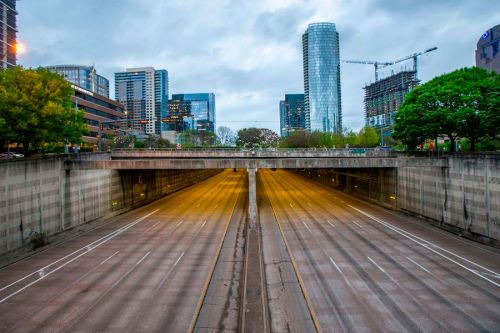
Woodall Rodgers Freeway, heading into downtown Dallas, sat nearly empty at 7:26 am on Tuesday, March 24, 2020 – the first morning after Dallas County’s “shelter in place”. This stretch of highway is normally packed with vehicles during morning rush hour. Photo by Lynda M. Gonzalez, Dallas Morning News).

“Greatness in the last analysis is largely bravery – courage in escaping from old ideas and old standards and respectable ways of doing things.”

James Robinson

Crises can make or break a leader.  The 1979-81 Iran Hostage fiasco decimated Jimmy Carter’s final year in office and assuredly caused him to lose his 1980 reelection bid.  The 1995 Oklahoma City Bombing helped secure Bill Clinton’s image as a stalwart president.  The Hurricane Katrina debacle, on the other hand, proved George W. Bush was incompetent and ineffective as Commander-in-Chief.

The current COVID-19 scourge is Donald Trump’s national crisis.  It could be the savior of his presidency; the one element that ensures his place in the pantheon of great world leaders.  Or it could be his death knell; the catastrophic event which will equate him with failure, except his most devoted followers.  As things appear now, it’s turning into the latter.

Yesterday, March 26, Trump signed a roughly USD 2.2 trillion stimulus package unanimously passed by the U.S. Congress.  Because the COVID-19 mess has created a new set of “social distancing” protocols aimed at subverting the virus’ spread, a large number of Americans have suddenly found themselves jobless.  Restaurants, nightclubs, gyms, and tattoo parlors have been forced to shut down.  History will determine if that achieved its intended goals.  But, as of March 26, the number of jobless claims set a record at 3.3 million.  Who would’ve thought an invisible microbe could wreak such havoc?

Amidst this cataclysm, our dear leader, Donald Trump, has openly considered easing restrictions to the practices of social distancing.  Earlier this week, he suggested the U.S. could return to normal by Easter.  “I would love to have the country opened up and just raring to go by Easter,” he said.  That’s akin to the captain of the Titanic shouting, “Pool party!”

It’s almost painful to watch Trump and his band of clueless minions pretend this crisis will obey a presidential command.  Many conservatives tried to explain George W. Bush’s pathetic handling of the Hurricane Katrina fiasco by claiming his adversaries wanted him to stop the storm from terrorizing the Gulf Coast.  I heard a few actually say that aloud!  And I had the pleasure of telling them, ‘No.  The issue was RESPONDING to the hurricane!’  Bush and the Republican Party were quick to declare war on Iraq in 2003.  But, when a REAL threat emerges, they failed miserably.

If anything, the start of the AIDS epidemic in the U.S. some forty years ago proved how dangerous social conservatism can be to a health crisis.  Admittedly, thousands of people didn’t come down with HIV in a matter of days, as with the COVID-19 virus.  But the reality is that national policy should never be based on individual predilections or religious ideology.  Every time people make health-based decisions on their own personal religious beliefs, people die.  Every single time!

But the AIDS epidemic showed that a slow federal response to a health concern can be lethal.  I’m watching the COVID-19 pandemic unfold here in the U.S. in stark realism.  As of March 27, the U.S. has achieved the dubious distinction of the most number of COVID-19 cases in the world.  Meaning we’ve now surpassed China and Italy.  Trump always declared America is #1 – and what do you know?!  The old bastard has finally been proven right!

I really don’t want to see Donald Trump fail in this entire imbroglio.  It’s not good to wish your national leader stumble and falter as a national crisis of any kind grips the nation.  But, thus far, Trump has shown no real leadership, with the exception of the aforementioned stimulus package.

It doesn’t need to be this way for him – or for anyone.  This could be his golden moment to prove he’s an authentic leader, not the failed businessman / tax cheat others claim he really is.  Every country’s leader is forced to confront a national emergency of some kind or another.  It just comes with the territory.  The U.S. presidency, in this case, is not school a crossing guard-type of position.  It requires more fortitude and clarity than most jobs, when in fact, the presidency is not a standard job.  It’s more of a calling – kind of like human rights work, or teaching.

As I view it in this moment of national surrealism, Donald Trump is not listening to the tragic sounds of that call.

Leave a comment

Filed under Essays

I Don’t Care About…

A few nights ago, amidst extensive coverage of the ongoing COVID-19 crisis, a national news network abruptly mentioned that Tom Brady recently signed a contract to join the Tampa Bay Buccaneers.  I guess it was supposed to be a bright spot in yet another tension-filled day in the U.S. and the world.  And who wouldn’t want to take a break from this madness?  But it startled me, as it came even before news about a massive storm system that had swept in from the Pacific and was approaching the middle of the country; bringing heavy rain and strong winds – some possibly tornadic – upon tens of millions of people.  I’m well aware Americans love their football and that sports usually brings people together – excluding stupidly angry parents at kids’ softball games.

In the midst of this pandemic, I could care less about Tom Brady or any other professional athlete – especially the overpaid, over-celebrated types.  Like Tom Brady.  The COVID-19 death toll is rising rapidly in the U.S.; gradually becoming more real and more frightening.  Just as a mudslide creeps down a rain-slogged hill, picking up rocks and vegetation, the virus has been gathering unsuspecting victims – slow, but unstoppable.  Here in my native northeast Texas, the Dallas / Fort Worth metropolitan area’s nearly 8 million residents have found themselves in an unexpected lockdown capsule.  Not much scares Texans, native or transplant.  But COVID-19 is more terrifying than the thought of the federal government snatching up our firearms, or bars and restaurants running out of beer and tequila.

With my elderly mother’s fragile health in even more jeopardy and my gym forced to shut down, I wonder if I’m fatally mistaking my usual spring allergy symptoms for that wicked Wuhan menace.  And, as matters intensify, there are some aspects of American society I don’t care about right now.  I don’t care …

If another wedding or funeral in either Afghanistan or Iraq is interrupted by an ISIS bomb.  U.S. troops have been embedded in Afghanistan for nearly two decades, and we still haven’t been able to tame the bearded and burqa-covered savages who occupy the nation’s rocky environs.  I’ve long championed the complete removal of American troops from Afghanistan; whether or not the energy titans who have insisted they remain like it or not.

If Israel and its venomous neighbors let yet another peace pact collapse.  There never has been peace in the Middle East and – at the current rate – there never will be.  For one thing the U.S. has been kissing Israel’s kosher ass for as long as I can remember.  We’ve bequeathed literally billions of American dollars in aid to Israel, and they’ve reciprocated with little more than self-righteous angst.

To hear more about the British royal family.  As I’ve noted previously, the American media harbors a fascination with the Windsors that the majority of American citizens do not.  To put it in more common vernacular, we mostly don’t a shit what the British royals do.  That Prince Harry and his wife, Meghan, won’t adhere to some ancient, traditional Buckingham duties is about as important to the American populace as a grasshopper binging on a blade of Augustine grass.

About the plight of illegal immigrants lined up along the Mexican border.  Yes, I know many of them are desperate for a new life; free of poverty and crime.  But, right now, we can’t help them.  I’m genuinely more concerned about the health of my mother (who was born in México in 1932) and myself than some illiterate wetback who’s either too stupid or too lazy to follow established rules and laws to enter the U.S. legally.  If they can afford to pay several thousand American dollars to a coyote, or smuggler, to help them cross the Rio Grande, they can use that money to acquire the proper documentation.

About the anxiety of the transgendered.  Personally, I’m almost sick of hearing gender-confused folks clamor for equal treatment, then publicly lament that no one understands their “struggles”.  No, I don’t comprehend that you have trouble figuring out whether you should have indoor or outdoor genital plumbing and I don’t want to take the time and energy to do so.  For years the TG community demanded to be included within the overall queer community; now they want to piggyback on the rest of us and still have their own revolving closet.

About Confederate monuments.  Throughout the southeastern U.S., generations of redneck assholes have been fighting the American Civil War and – goddammit – they STILL haven’t won!  They keep hollering that the conflict that took some 800,000 lives was about states’ rights, when in fact, it was about the right of said states to keep millions of Negroes enslaved like wild animals.  The conservative morons who approve school text books have tried to dance around the issue by making such asinine claims that African slaves were “immigrant workers” or that slavery was actually “work for food and shelter.”  If anything, these are the people I’d love to see infected with COVID-19 and die.  When education and information fail to enlighten people, I view death as the only viable alternative.

About the Kardashian clan.  As with the British royal family, I’m about as concerned with the Kardashian gang as I am with a bug’s ass.  In fact, like with professional athletes, I don’t give a shit for the antics of overpaid, over-hyped celebrities; people who live in gilded mansions and consider limited bandwidth a problem.

Whether or not Oprah Winfrey can eat bread.  For more than thirty years I’ve heard the former talk show host bemoan her struggles with weight and body imagery.  Here’s some body imagery for you: I have an uncircumcised penis and hair covering my butt and my chest.  Does anyone genuinely care?  No!  And I don’t give a flying fuck if Oprah can eat an entire loaf of unleavened bread in one sitting without feeling guilty.  Her wagon loads of chicken fat (emblematic of her butt cheeks) failed to impress me; instead, just making me laugh.  I recall, during her 2009 visit to the Dallas area, Oprah waddled onto a stage at the Texas State Fair clad in jeans and a cowboy hat (trying to look so…you know, Texan).  My mother glared at the TV screen and uttered, “God, I didn’t realize how fat she is until now…seeing her in those jeans.  You know, fat gals have no business wearing jeans.”  Thus remember, despite her self-aggrandizing proclamations, Oprah doesn’t really care if you like bread, or if you can distinguish real mashed potatoes from processed cauliflower.  She just cares if you buy her magazines.  Which might not be a bad idea right now.  Toilet paper has been in short supply lately.

Now, dear readers, please tell us what you care about most (or least) in these critical times.  I fully believe in the power of the pen and the keyboard, and as bloggers and writers, we are obliged to keep the unbridled truth – and the hand sanitizer – in motion.

Leave a comment

Filed under Essays

Getting Viral

“If a severe pandemic materializes, all of society could pay a heavy price for decades of failing to create a rational system of health care that works for all of us.”

Irwin Redlener

We Texans like to consider ourselves a hardy lot.  Not much scares us – not communists, Islamic terrorists, hurricanes, triple-digit temperatures, or even gingivitis.  When the 2014 Ebola scare hit Dallas, locals rumbled through their daily routines without any real concern that a fatal microbe – one with a roughly 90% death rate – lurked in the air.  Actually, it was in the bloodstream…of a handful of individuals.  Ebola, like HIV and bad attitudes, is a blood-borne pathogen and therefore, not transmittable via the air.  Thus, I thought it odd that the South by Southwest Festival (SXSW), an annual gathering of film, music and media artists in Austin, had been canceled this time because of the current, ongoing coronavirus outbreak.  I still can’t believe that Austin – a city that prides itself on being “weird” – has been humbled by a viral intruder.  But it has.  Sadly, thousands of weirdos from across the globe will not be able to descend upon the capital of one of the most conservative dominions in the United States and find kindred souls through their mutual love of art and music.  And humanity’s mutual love of going to work and to school, shopping and taking vacations also has been undermined by a wicked little microbe.

For COVID-19 – the critter formerly known as a coronavirus – the mystery continues unabated.  I haven’t seen this much hysteria over a disease since AIDS popped up nearly four decades ago.  With the death toll now exceeding 3,000 and the confirmed number of infections pushing 100,000, COVID-19 is proving to be a formidable bacterial opponent.  The flu-like virus has reached every continent except Antarctica and (as many of these things tend to do) shows no signs of slowing.  What are we bipedals on the third rock from the sun supposed to do?

A century ago the world was recovering from two cataclysms: the Great War (World War I) and the “Spanish flu”.  It seems the latter followed the former.  Millions of people displaced across Europe by the ravages of conflict – sickened and hungry – inadvertently created a cesspool of illness.  To this day, no one really knows where exactly the Spanish flu evolved (some say the Midwestern U.S. was the point of germination), what made it so lethal, or why it spread so quickly and so far.  In the ensuing decades, some virologists declared that the closest analogy is the 14th century “Black Plague”, a scourge that managed to ravage much of the known world – from Western Asia to Northern Africa to Iceland.  The “known world”, of course, being what European scholars thought existed, circa 1300 C.E.

The “Black Plague” was a Eurasian pandemic; a merciless spread of the bubonic plague across regions that hadn’t yet realized the beauty of handwashing and Kleenex.  From roughly 1347 C.E. to 1352 C.E., the ailment took approximately 20 million lives.  It impacted commerce and trade and terrified ignorant souls into comprehending the fragility of their existence.  It shaped the entire region; one of the birth places of modern humanity; a womb of agriculture and farming.

The 1918-19 Spanish flu remains the most severe pandemic in recent virological history.  Doctors in both Europe and the U.S. first identified the virus in military camps in the spring of 1918.  Within two years the virus, now identified as a strain of avian H1N1, had directly affected roughly 500 million people and killed an estimated 50 million.  And much like the 14th century “Black Death”, the “Spanish flu” retreated into the annals of medicine, once it appeared to have inflicted enough agony upon a vulnerable populace.  In a time before antibiotics, contemporaries of the “Black Death” and “Spanish flu” resorted to isolation, quarantine, prayer and general hysteria.  So what’s new?

In the century since the “Spanish flu” quagmire, the planet has experienced two similar microbial outbursts: the 1956-58 “Shanghai flu” and the 1968-70 “Hong Kong flu”.  The Shanghai menace was an H2N2 avian virus first reported in China in early 1956.  It had originated from a mutation in wild ducks and combined with a pre-existing human strain.  A vaccine was introduced in 1957, and the pandemic slowed down.  A second wave developed in 1958, however, and went on to become part of the regular wave of seasonal flu.  Overall, the “Shanghai flu” killed about 5 million people across the globe.  By 1968, the H2N2 Asian flu had disappeared from the human population and is believed to have gone extinct in the wild.

Then, in 1968, the “Hong Kong flu” arose.  Developing from an H3N2 avian virus, it first appeared in Hong Kong in July of 1968.  Within two months, the virus had spread across Asia and into Europe.  By autumn, it reached the Western Hemisphere.  As with the Spanish flu, the Hong Kong flu appears to have come to the United States along with military troops arriving home from battle.  In this case, it was the Vietnam War, which had begun to impact all of Southeastern Asia by 1968.  In total, the Hong Kong flu killed approximately 1 million people.

AIDS bears some similarities to all of the aforementioned influenzas disasters, in that it appeared unexpectedly and incited mass hysteria.  But HIV germinates within blood and blood-related elements.  Despite warnings from religious zealots and other uneducated morons, it cannot be transmitted via sneezing and coughing.

The most recent influenza-style epidemic was the 2002-03 SARS (Severe Acute Respiratory Syndrome) virus.  Officially dubbed SARS-CoV, it is thought to be an animal-borne microbe – perhaps bats, which spread to other mammals, such as wild felines.  It somehow spread to humans and was first identified in southern China in November of 2002.  It infected about 1,800 people and killed less than 300.  No known SARS cases have been documented since 2004.

The contemporary COVID-19 has sparked the usual rash of histrionics.  The sight of people clad in hazmat attire scrubbing walls and airline seats is matched only by the plethora of wary citizens navigating the streets of the world’s metropolises while wearing face masks.  Aside from the SXSW event, Chinese New Year events saw dramatic shifts in travel and attendance, and the latest installment of the James Bond franchise, “No Time to Die”, has had its worldwide premier delayed from April 10 to November 25.  Italy, which has experienced the greatest number of COVID-19 infections outside of Asia, has seen an overwhelming drop in tourism to some of its most famed landmarks.  Saudi Arabian authorities have suspended the year-round “umrah” pilgrimage to Islam’s holiest place, in a bid to stop the spread of the virus.  The usual masses of people circling the granite Kaaba at Mecca’s Grand Mosque has been reduced to a handful of brave souls.

Here in the U.S. we’ve seen a run on hand sanitizer, face masks, generators, non-perishable food items, and even hazmat suits.  People are refusing to shake hands and will touch elevator buttons and door handles only if there’s a latex glove or a paper towel between them.  I can only suspect that the same has occurred in other countries.  These precautions are not unwarranted.  In a world with a population rapidly approaching 7 billion, it’s not illogical to envision millions of people literally dropping dead on the streets.

While the epidemic seems to have slowed in Wuhan, China (the place of its birth), it continues across the planet.  We’re far from the death toll of even the Hong Kong flu.  And most of the fatalities have occurred in individuals over the age of 65 and / or in people with underlying health conditions, such as diabetes and heart disease.  This should be expected of any viral scourge.

My greatest concern, however, is that the real biological menace – the one that could wipe out literally millions, if not billions of people – has yet to emerge.  Such a pandemic would be unprecedented in human history.  And it would impact everyone, much like the 1918 Spanish flu, which affected even strong, healthy people.  The very young, the very old and the very sick are always the first victims of any airborne disease.  Epidemiologists will continue to march across the globe in search of the next viral threat, and the rest of us will continue to wonder if our time will end in the depths of elderly sleep or swaddled in the confines of plastic.

1 Comment

Filed under Essays

Still Can’t Get into the Dance!

“I checked my watch. Yep, it was 2020. We were supposed to have flying cars by now. Instead, gay Republicans can’t even get a booth at their own convention.”

Marco Roberts, secretary of the Texas Log Cabin Republicans, lamenting how the Texas Republican Party has – once again – refused to grant the Texas LCR (an openly GLBT group) a booth at this year’s state convention.

Damnit!  They paid for their tickets, but they still can’t get in through those steel doors!  They wear the red, white and blue; display their guns; mock affirmative action; and say they hate immigrants.  But, the ballroom guards just won’t let them get beyond the entrance threshold.  What’s a queer Republican have to do to get noticed in the state of Texas?

Apparently, nothing.  Once again, the Texas GOP has locked out their smidgen of homosexual brethren; refusing to acknowledge they even exist, much less grant them any speaking privileges.  As the Texas Republican Party continues along its rightward path, that’s not surprising.  Recently they rejected – yet again – the Log Cabin Republicans’ request for a booth at the state convention, denouncing the group as “perverted”.  LCR is a political organization that advocates equality for the queer community; essentially a political home for conservative gays and lesbians.  They admire Ronald Reagan and oppose the usual “liberal agenda”: big government, taxes, affirmative action, abortion, Mexicans, Muslims and Bill Clinton.  One aspect of the liberal agenda they can’t bring themselves to oppose is…well, themselves!  Homos, queers, fags, dikes…you know – perverted folks.  It’s the oddest of all symbiotic relationships.  From the national level on down, the Republican Party has not hidden its animosity towards the queer community.  They despise homosexuals more than agnostics and uppity (meaning educated) Latinos and Negroes.

Conservative queers often mirror the general conservative population: mostly White and male.  I’ve known a few conservative queers – emphasis on “few”.  Literally just one woman and a handful of men.  Queer conservatives are a little like snow leopards – rare and practically endangered.  The major difference of course is that snow leopards are stunningly beautiful and more deserving of their niche in the world.

Two queer conservatives I knew had been good friends of mine nearly 20 years ago.  One was Jewish and a native Texan; the other was Native American from Arkansas and an Army veteran with cheek bones high enough to set Jell-O shots.  Together they owned a chain of men’s clothing stores throughout Texas and were, therefore, staunchly pro-business.  They eagerly supported Republican Party ideology of low business taxes and few regulations.  They didn’t care very much about the environment and – more astonishingly – they didn’t worry how fellow conservatives viewed them.  The Jewish guy literally told me that one day!  “I don’t really care how they look at me,” he stated nonchalantly.  He and his partner were more concerned about the overall welfare of the nation; they stood alongside the party’s general message without hesitation or regret.  Their business acumen was so intense that the Jewish guy once dismissed my unemployment status around 2002 in that “you only represent about 6% of the population.”  In an interview with the “Dallas Voice” several years later, the Jewish guy openly declared his opposition to diversity in the workplace; admitting he believed businesses should have the right NOT to hire people of a certain race, ethnicity or religion simply because they didn’t like the people within that group.  I noticed he didn’t include sexuality in that group of undesirables.  I remember thinking, ‘How could someone hate themselves THAT much?’

Indeed, how could anyone with at least half a brain and some semblance of a conscious willingly accept the bigoted philosophy of others among them?  Of course, some Republicans didn’t mind if queers loiter among them; as long as they kept quiet and vocalize their support for the party’s agenda.  After all, there were some Native Americans in the ranks of the U.S. Army and Jews among the Nazi guard.  My two aforementioned friends noted change often comes from within.   But, I realized after listening to them, so does support.

Among the many items on the Texas GOP agenda, one in particular has gained national notoriety: support of “reparative therapy” for gays and lesbians.  Reparative or conversion therapy is a concerted psychological attempt to change someone’s sexuality from homosexual to heterosexual.  (There’s no such thing as reverse therapy, unless you count visiting a gay bar.)   Doctors, clerics and various others have tried to “cure” queer people of their “affliction” for centuries, usually through religious means.  But, in its present form, conversion therapy has existed since the 1960s.  Early attempts often used electroshock therapy; the same kind previously used on the mentally ill.  And, of course, queer folks have always been considered mentally ill by many in both the general population and the medical community.  Some in both camps still hold that assessment.  But, contemporary reparative therapy is generally more psychological in its approach, with a good dose of theological rigor thrown into the cocktail.

Response to the inclusion of conversion therapy has been met with the usual vitriol from gay rights groups and medical professionals.  No concrete proof exists that such methods actually succeed, even though there are plenty of people willing to testify otherwise.  If anything, the process can be deadly.  People who undergo such treatments usually don’t notice a change in their same-gender attractions and – feeling like utter failures – sometimes hurt themselves, often fatally.  I don’t think it bothers the likes of Texas Governor Greg Abbott or Senator Ted Cruz that a depressed queer kills themselves.  To them, that’s one less degenerate off the streets.

That the Texas GOP should include this mess in their agenda shouldn’t surprise anyone familiar with the party, or with the antagonism queer folks feel when confronted by them.  But, what of gay Republicans?  How exactly do they regard this mess?  Well, for starters, Log Cain Republicans has officially denounced the reparative therapy.  In that regard, they’re in line with the general queer community.

LCR’s battle with their Republican brethren in Texas is not new.  They’ve tried unsuccessfully to become part of the mainstream Republican dialogue.  In 1996, when Bob Dole ran for president on the Republican ticket, the national GOP created ruckus within its own ranks when it initially refused to accept a $1,000 donation from LCR.  Then, it changed course and asked LCR to resubmit the money, which LCR did.  But, responding to internal pressure, the GOP returned the donation.  After the very public squabble, LCR officially declared itself neutral in that year’s presidential campaign.  They damn well couldn’t support incumbent Bill Clinton.  That would – as one LCR official declared – “undermine our credibility.”  But, it still couldn’t bring itself to support Dole.  It was left holding that $1,000 check and its support, like a teenage boy left holding a pair of tickets and box of Trojans outside the prom venue.  And, it’s been that way ever since.

Change may come from within a particular group, but at what point do you finally get it that some folks within that group just won’t change?  Steven Hotze, the leader of an anti-LGBTQ religious organization and Republican kingmaker, sent emails to board members decrying the “immoral and perverted sexual proclivities” of gay people.

State Sen. Rob Hall (R) accused the group’s members of promoting “unnatural sex.”  Speaking of Log Cabin Republicans, he added, “They don’t have the basic belief in the God of the Bible that we are founded on.  I could not find anywhere on their website an expression of their faith in God like you will find on a Republican website.”

Not to be defeated or deterred, a representative from LCR tried to remake the vitriolic rhetoric by saying the number of people who spoke in support of accepting the group’s money to buy booth space was encouraging.  Relatively speaking, it was a huge win.

Yes, a win for the party at a state and even a national level.  But when will the queers in the trenches finally get it that they’re really not wanted?  When will they understand that, no matter how much they try, they still won’t be allowed into the dance hall?

Leave a comment

Filed under Essays

Morass

Ronald Reagan and Tip O’Neill conceded they didn’t get along personally.  O’Neill would go so far as to say Reagan was one of the laziest presidents he’d ever known.  It was ironic that two old Irish-Americans would have such disparate viewpoints, as they each reached the apex of their careers.  Yet, despite their differences in how government should function and what policies were best for the nation, they did try to work together.  Those differences fell into the background in March of 1981, when Reagan almost fell victim to a would-be assassin’s bullet.  O’Neill visited Reagan in the hospital and the two even read biblical passages together.

Flash forward nearly four decades and try to imagine such comingling in Washington now.  On Tuesday, Donald Trump gave his State of the Union address.  As required, he provided copies of his speech to Vice-President Mike Pence and House Speaker Nancy Pelosi.  Despite intense animosity between Trump and Pelosi, the latter extended her hand to the president – which he deliberately ignored.  After Trump concluded speaking, Pelosi ripped up her copy of the speech, explaining later that Trump had “shredded the truth,” so she saw fit to shred the speech.  Then, on Wednesday, the U.S. Senate voted to acquit Trump of both articles of impeachment the House had brought up at the end of last year.  Over these past couple of days, Trump has gloated over his acquittal; proudly displaying various newspapers announcing the trial verdict and – in a live press conference – condemned the entire fiasco; ultimately calling it “bullshit”.  Yes, he really did utter that word on live television.  Then again, it’s Donald Trump.  Nothing he says or does should surprise anyone by now.

I have NEVER seen anything like this in my lifetime.  In my own 40-plus years of studying American politics, these past four have been surreal and almost otherworldly.  Donald Trump is the stress test of all stress tests.  And I thought George W. Bush was disoriented!  Trump is one block away from full-fledged derangement!  Bush’s actions in office embarrassed me more than once.  But Trump has stained the U.S. presidency with a new level of disgrace and shame.

It’s disillusioned me to the point where I’ve begun deleting all incoming emails of a political nature – even from Democratic and Green Party candidates.  I disliked Bush, but I absolutely loathe Trump.  I don’t like to say I hate someone I don’t know personally.  However, Trump has come as close to it for me as have only a few others – animal abusers, neo-Nazis, Caitlyn Jenner.  Just to name a few.

And none of that gives me pleasure.  It’s easy to hate and demonize.  It’s harder to dismiss bad behavior, especially from our political leaders.  I’ve been watching this circus and cringe at the thought of foreign opinions.  The United States is the self-claimed beacon of democracy and national dignity.  We’re supposed to be far above these kinds of third-world antics.  Now we’ve dropped into the abyss of antagonism and mockery.  People in Somalia must be laughing.

After Bush ascended to the presidency in 2001, some outspoken liberals announced they would actually flee the country.  Even with the current political diorama, I’m not ready to update my passport.  Well…not yet.  I just don’t know when this somnambulistic nightmare will end.  But the dénouement can’t arrive soon enough.

Thanks goodness all bad things – like blind dates and ptomaine poisoning – must come to an end!

Leave a comment

Filed under Essays

Equalizing

Recently, Virginia became the 38th of the United States to ratify the Equal Rights Amendment.  It’s been a long-fought battle for proponents of dismantling all barriers to women achieving full and complete equality with males.  Earlier this month supporters became ecstatic when both chambers of the Virginia state house approved the amendment.

“We must begin to see a world without discrimination of any kind,” declared Virginia State Senator Mamie Locke.  “Equality based on sex is not just good for women, it is good for society.”

Ratification of the ERA reached a critical flashpoint in the 1970s, as more women entered the workforce and began seeking higher levels of education than at any time in U.S. history.  When Congress submitted the ERA to the states for ratification in 1972, it gave it a March 1979 deadline for 38 states to ratify it.  They didn’t make it.  In 1979, however, the U.S. Congress gave the ERA three more years to get ratified.  Again, it didn’t succeed.  By then, most judicial and legislative experts declared the amendment dead.  Even the U.S. Supreme Court, the only court to review it, acknowledged that.

Proponents remained undeterred.  The slew of legal machinations born of this ongoing effort is astounding, which is understandable.  Our education system often discusses our founding fathers, but – outside of Betsy Ross – says little about our founding mothers.  Yes, men devised and built much of the infrastructure and technology that has helped the United States become a wealthy, powerful nation.  The same is true for most other developed countries.  But women have been at the forefront of change and progress as well.  To deny their impact is essentially telling only half of the story.

Still, ERA critics state the ratification process has been unnecessarily complicated and even unconstitutional.  Others point to the 14th Amendment to the U.S. Constitution, which includes the term “equal protection of the laws,” and often refers to citizenship matters.  Supreme Court Justice Ruth Bader Ginsberg (undoubtedly the most progressive of all the Court’s judges) opined that any attempt to ratify the ERA would mean starting over again.

But, as the old saying goes, be careful what you wish for; you might just get it.  Full gender equality doesn’t just mean equal pay for equal work – which has been the crux of the argument.  It could also mean certain employment standards would have to be adjusted or eliminated.  For example, one could argue that physical fitness requirements for firefighters could be declared illegal based strictly on gender.  Some women may be able to meet those particular goals, while a number of men couldn’t.

A new argument that has arisen is that the ERA will prevent pro-life advocates and groups from protesting abortion, which is generally aimed at women.  It’s a dubious claim at best.  Perhaps some birth control methods could come under greater scrutiny.  Since birth control pills and IUD’s are consumed primarily by women, does that mean they will have to be deregulated and sold over-the-counter like condoms?  Or will condoms become available only by prescription?  That’s a disaster waiting to happen!

I personally want to see how ERA advocates react to women being compelled to abide by Selective Service.  Currently, all able-bodied, able-minded males in the U.S. are required to register for Selective Service within 30 days of their 18th birthday.  There’s no penalty for late registration, but there are a slew for non-registration.  Men who don’t register usually can’t enter college or get financial aid.  In some places, they can’t even graduate from high school, or could have their diploma rescinded.  They can’t obtain federal job training, or get jobs within the federal government.  All men who immigrate to the U.S. before their 26th birthday must register in order to garner full citizenship.  Failure to register is a felonious offense and punishable by up to 5 years in prison and a $250,000 fine.

Selective Service is the most blatant and deliberate form of gender discrimination.  The education penalties alone are violations of Title IX, an act passed by Congress in 1972 and directed towards ending gender imbalances in the education system (mainly college).  Contemporary feminists had argued that all-male schools, for example, are unconstitutional if they receive federal funding.  But, as I see it, Title IX means nothing, since Selective Service permits discrimination against males.

The Selective Service system refers, of course, to a military draft, which has not been in place in the U.S. since 1973.  While it basically means all young men must be available for compulsory military service, it actually means that group is expendable.  When the concept of women serving in combat positions in military conflicts arose, many people expressed horror at the thought of women coming home critically disabled or in body bags – as if we’ve made our peace with men returning in the same conditions.  Selective Service, therefore, makes young males cannon fodder.  Even some disabled men have to register for the draft; that is, if they can leave their dwelling under their own power.  If disabled men have to register, why shouldn’t able-bodied women be required to do the same?

How will the ERA affect family leave policies in the American workplace?  Most health insurance policies require coverage for pregnancy, and most companies allow for X amount of time off to care for a newborn.  But very few companies maintain paternity leave, and I don’t believe any insurance policies plans consider such time a medical issue.  Will pregnancy no longer be considered a unique medical condition, but rather, something chronic like diabetes?

Will the Violence Against Women Act have to be restructured to include men, or will it be eliminated altogether?  First enacted in 1994, the VAWA seeks to improve criminal justice and community responses to domestic violence, dating violence, sexual assault and stalking in the United States.  In effect, it’s also a highly sexist piece of legislation because it assumes either that only adult females are the victims of violence or that adult females are the only victims of violence who matter.  The law has been amended in recent years to include lesbian and transgender women – as if men, again, aren’t worth the trouble or should just be left to fend for themselves with laws and processes that don’t really help.

Currently in the U.S. vehicle insurance rates are slanted against males.  Most companies will lower insurance rates for females when they reach the age of 21, but only for males when they reach 25.  Men can earn lower insurance rates if they marry or have children.  Years ago women often couldn’t enter into a contractual agreement without a man as cosigner.  That’s now illegal, but will the ERA render the insurance rates’ gender disparities invalid?

Aside from forcing women into the military alongside men, one bloodcurdling fear among social conservatives is that the ERA will compel society to establish unisex public lavatories.  Early opponents seemed to focus on this in particular.  If that happens, will locker rooms fall to gender equality next?  Will doctors be forbidden from letting prospective parents know the gender of their baby after a sonogram?

As a writer, I wonder what the ERA might do to language.  It’s more common now to use the term humanity instead of mankind.  Will gender-specific pronouns fall out of favor or – worst – be outlawed?

How will the transgendered be impacted by the ERA?  Growing up there were only two genders: female and male.  Now we have such classifications as non-binary and cisgender.  Excuse me?

I know some of these issues seem almost comical, but we really have to think about what gender equality means.  I fully believe women are just as capable as men, when it comes to professional matters, such as business and law enforcement.  But men and women each possess qualities that are generally unique to our respective gender.  Neither set of attributes is superior to the other; they’re meant to work in concert with one another.  I’ve always said that, if gender and racial oppression hadn’t been in place for so long, we might have made it to the moon 200 or more years ago.  Telephones, motor vehicles and television could be ancient equipment by now.

But alas, our world hadn’t become that progressive until recently.  Still, aside from restroom signs and military deployments, gender is not always fluid and malleable.

What does gender equality mean to you?

Leave a comment

Filed under Essays

How Did We End Up Here?

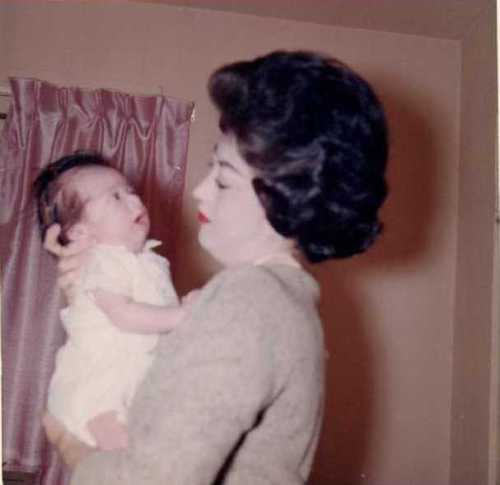
My mother with me in December 1963, a month after I was born.

I stood alone in the darkness of the den last night and wondered how it got to this point.  My mother had a mild stroke one week ago today; paralyzing her entire left side and essentially rendering her immobile.   She is now in a rehabilitation facility.  With dementia clouding her judgment and comprehension, I almost felt like I was abandoning her to a bedridden life.

Both of my parents were among the roughly 100% of the population declaring they would never end up in a nursing home.  In the months before he died, my father insisted on returning to this modest suburban home to pass away.  He did not want to be in a hospital or any other facility hooked up to machinery, barely surviving off IV drips.  I was able to grant him that wish.  Who wants to die in a hospital anyway?  I believe only a workplace is the least desirable place to expire.

But here my mother is in a place filled with elderly and disabled people.  I got a bad feeling from the moment I stepped into the building.  The representative I had spoken to on the phone earlier on Friday told me the structure was older.  Indeed, it is!  With severely off-white walls and ceiling light fixtures the color of Neosporin, the place looks like it’s witnessed every national event since the Vietnam War.  I didn’t expect the rooms to be equivalent to 5-star Bahamian resorts.  But they’re Spartan appearance is just one step above a prison cell.

Aging building features aside, I have to concede the staff seems nice – at least the ones I’ve met so far.  That, of course, is far more important than cosmetics.  The facility has a high rating from business and health associations.  I’m concerned mainly because the state of Texas has become a critical focal point in elder abuse within nursing home facilities.

I’m also worried because I’ve never been put in this situation before.  I had promised my parents I’d never let this happen – being placed in a…facility.  But how does one prepare for such an event?

Life takes such a strangely circuitous route.  When we’re born, we’re totally helpless; dependent on others to ensure our survival.  As we reach the end of our lives – hopefully many years later – we enter another stage of fragility.  The human body winds down and shows its age.  Like a building.

So how did we end up here?  It’s just what happens to many people.  My primary hope right now is that my mother can endure proper physical therapy to get her ambulatory enough to return home.  If she could walk – even with an aid – that would make a world of difference.  Besides, I’d promised my father years ago that – should he die first – I’d take care of my mother.  And I feel if I violate that oath, he’ll return to cripple my hands where I can’t tap on a keyboard to write my stories and make snarky comments on this blog.

Shortly after moving here in December of 1972, I stopped my father amidst the unpacking and asked if he’d noticed something unique: silence.  We’d moved from a garage apartment near downtown Dallas to this newly-developed area.  It had been mostly ranchland and, for years, a large pasture stretched out behind our house.  We’d often see cows grazing, along with the occasional bull.  But relocating from a heavily-trafficked urban neighborhood to here was utopian.

I kept asking myself last night – having downed plenty of vodka and orange juice – how we got to this point.  Things happen, I finally realized, and people get old and disabled.  The alternative is not too pleasant.  But this is the way it is.  And it’s not infinite.  It’s this anomaly called life.

Leave a comment

Filed under Essays

Flush Royal

The announcement of the summit alarmed everyone.  They didn’t know what to make of it.  What would happen?  So, as the key players gathered, many held their collective breath.  Others dismissed it as the usual pomp and circumstance.  Again, interested parties wondered, what would come of this?

Was it another meeting between Donald Trump and Vladimir Putin?  Had the World Court convened to mediate yet another dispute between Israel and Palestine?  Did México’s president finally agree to pay for that border wall?

No, it wasn’t anything that dramatic – except for the tabloids.  Queen Elizabeth II had summoned members of her immediate family to discuss their royal duties.  More specifically if Prince Harry and his wife, Meghan, really did plan to step back from their title-bound obligations.  And, once again, the American press focused so much of their time and energy on this sudden turn of events.

Yet, amidst the chaos, I have to make a very simple inquiry: WHO CARES?!

Seriously!  With all due respect to my British friends, acquaintances and fellow writers and bloggers, the average American citizen doesn’t give a damn what happens with the British royal family!  And I suspect many average Britons don’t care either.

But here we are – AGAIN – with several American media outlets wasting more of their – and our – time telling us what that group of entitled bluebloods are doing.  A while back they spent a great deal of time revealing that Prince Philip had decided to retire from his royal duties and remain at Buckingham Palace, the Windsor family’s primary abode; an 800-room monstrosity that dates to the 18th century.  How does one retire from duties that really aren’t a job?

My mother retired from the insurance industry at age 70.  She gets two pensions, plus social security.  She literally worked for half a century – dealing with gender and racial harassment; gossipy coworkers; rude customers; and unsavory managers.  I recall her bringing work home sometimes, just so she could get caught up – although she didn’t get overtime.  That was on top of helping my father raise me and tending to the house.  She also had to deal with migraine headaches, which often struck in the midst of meetings and conference calls.  Gosh, did Prince Philip have to deal with that shit?

Ever since Prince Charles and Lady Diana Spencer wed in 1981, the American press has held an incredible fascination with the British monarchy.  I have to concede that Diana had more class, grace and style than the entire Windsor family combined.  I’m actually glad that her sons, William and Harry, inherited both her looks and her sense of generosity.

But, if you take away all of their regal extravagance, the Windsors would qualify as little more than trailer park trash here in the U.S.  And, in all fairness, I’ve known people who lived in trailer parks and had more class than the Windsor clan.

Since the United States has such a close relationship with Great Britain – it’s from their tight grasp that we were born – I suppose it’s natural many of my fellow citizens would be enamored with British royalty.  After all, we aren’t similarly obsessed with the royal families of India, Japan, the Netherlands, or Spain.

But, as an average American whose taxes help fund the livelihood of the First Family (in this case, the Trumps, already among the wealthiest families in the world), I have to point out that it is average Britons whose tax money funds the livelihoods of the Windsor family.  While Great Britain suffered through severe economic downturns in the immediate aftermath of World War II and through subsequent national events – such as IRA bombings and coal miner strikes – money was still being sucked out of the paychecks of working people so the Windsors could move from one grand home to another and gallop across the globe.  It’s British taxpayers who finance those extravagant state dinners at Buckingham Palace where only the rich and powerful can partake of exquisite meals.

Twenty years ago Prime Minister Tony Blair made a concerted attempt to tackle child poverty in the U.K.  At the time officials estimated approximately 34% of children in Great Britain lived in households impacted by poverty.  Blair’s goal was eliminate poverty – or at least severely reduce it – within a generation.  Sadly, results have been mixed.  But at least he tried.

The U.S. president is more intent on spending billions of American dollars (tax-payer money) to build a wall along our southern border to keep all those varmint Mexicans out.  Never mind that my Indian and Spanish ancestors had dominated the region long before there was a United States or a Trump family.  That, of course, is a different history.

I suspect much of the child poverty in England could be resolved by pulling money out of the coffers of the Windsors and inserting into health and education programs specifically aimed at children and working families.  The U.S. could do something similar with taxes levied against the largest corporations and wealthiest families who already don’t pay much in taxes.  Families who – much like the Trump clan – feel they’re somehow entitled to their luxurious lifestyles; an existence for them that comes at the expense of we lowly peons who struggle with increasing costs of living on a daily basis.

I don’t know what will come of the aforementioned “royal summit” and, of course, I DON’T CARE!  Plenty of English citizens are opposed to the Windsors and to the general concept of a royal family.  We certainly know what France and Russia did to their monarchies.  I don’t wish a similar fate to befall the Windsors.  But it wouldn’t hurt them to relinquish Buckingham Palace to the city of London to be transformed into a museum.  Their plethora of jewels possibly could fund complete renovations of every single school building in the U.K.  Elizabeth and Philip could sell off the bulk of their homes, and the entire clan could settle quietly into a single multi-room estate and write books about their privileged lives as a source of income.

See!  If we average people ruled the world, there would be no war, poverty, sick and hungry children or overpriced state dinners.  And everyone would have a place at the table!

Leave a comment

Filed under Essays