Category Archives: Essays

Look!  No Handshakes!

U.S. Capitol Hill police officer Brian Sicknick received a posthumous Congressional Gold Medal on December 6.

This past Tuesday, December 6, the Capitol Hill Police officers who battled enraged mobs on January 6, 2021 received Congressional Gold Medals – the highest honor bestowed by the U.S. Congress to individuals and institutions for distinguished achievements and contributions.  They certainly deserve them.

Among the recipients was the late Brian Sicknick, an Air Force veteran whose family accepted on his behalf.  Sicknick suffered a stroke amidst the chaos of January 6 and died the next day.  But something curious happened on Tuesday.

Sicknick’s family refused to shake hands with leaders of the Republican Party – Sen. Mitch McConnell and Rep. Kevin McCarthy.  It wasn’t because they’re die-hard Democrats (what are often called “yellow dog” Democrats in Texas; meaning someone would rather vote for a yellow dog than a Republican) and certainly not merely to cause a ruckus.  To them it was a matter of “integrity”.

Integrity is an attribute that has been lacking in American politics for decades.  What little of it remained in Washington in January of 2017 was obliterated by Donald Trump and his supporters.  Like many Americans Sicknick’s family is disgusted with the GOP leadership as a whole; particularly their failure (unwillingness) to stand up to Trump and call out his repulsive behavior.  Trump’s disrespect for entire groups of people, discombobulated verbiage and other incendiary acts culminated in the horror of January 6 – a truly unprecedented event in American history.

While it may seem petty, even childish, on their part, I’m glad the Sicknicks decided not to be painfully polite and shake the hands of McConnell and McCarthy.  Craig Sicknick, one of Brian’s brothers, expressed no qualms about his family’s decision.  “I really do not hold respect for people who have no integrity,” he said.  “Which is what – this is not a partisan issue, this is an integrity issue. They took an oath to defend and uphold the Constitution.  And when somebody challenges it, like Trump, they do nothing.  Their silence is deafening.  Or worse they keep perpetrating the same policies and lies that caused the insurrection to happen.”

Previously McConnell has condemned Trump’s actions, but McCarthy has visited the former president at his Mar-a-Lago estate several times over the past year.  Conservatives frequently criticized former President Bill Clinton for his varied sexual indiscretions and even tried to remove him from office for one such liaison.  But, when Trump arrived on the scene with his third wife and a slew of even more reprehensible follies, they suddenly seemed to enter a forgiving state of mind.  Moreover, they let Trump reconfigure the entire Republican Party into a circus of hate and violence.

It’s also worth noting that 21 Republicans voted against granting any of those officers Congressional Gold Medals last year.  One, Rep. Thomas Massie of Kentucky, explained that he was bothered by the use of the term “insurrectionists” to describe the rioters.

“I think if we call that an insurrection, it could have a bearing on their case that I don’t think would be good,” Massie said, later adding, “If they just wanted to give the police recognition, they could have done it without trying to make it partisan, without sticking that in there.”

Partisan?  Really?  Hearing Republicans complain about partisanship is like hearing a drug addict complain about a friend’s alcoholism.

Integrity does matter.  The Capitol Hill police officers displayed it unrelentingly on January 6.  We need more of it across the world.

Leave a comment

Filed under Essays

When Three Losers Meet for Dinner

What do a failed president, a disoriented rapper and a White separatist have in common?  They’re all losers!  And, as news reports have revealed, they all met for dinner just before Thanksgiving.  Former President Donald Trump hosted hip-hop singer Kanye West (now known as Ye) and right-wing extremist media personality Nick Fuentes at his Mar-a-Lago estate in Florida a few weeks ago.

If I ever host a dinner party with some of the most interesting and intellectual people in the world, the three aforementioned clowns wouldn’t get past my front door.  (Disclaimer: no offense meant to professional clowns.)

We’ve all had those ‘what-were-they-thinking’ reactions to certain people’s bizarre behavior.  But Trump, West and Fuentes bring a new level of absurdity into the public forum.  It shouldn’t surprise anyone that a walking embodiment of incompetence (Trump) would invite two other dopers to his estate.

I’ve never been a fan of Trump.  When he announced his bid for the U.S. presidency in 2015, I pointed out that he’d technically been running for president for some 30 years.  In a 1980s interview with Barbara Walters, she queried Trump about whether or not he would seek the Oval Office.  Many scoffed at the notion that a New York real estate tycoon should run for the presidency simply because he was incredibly wealthy and well-known.

Those of us old enough to remember the excesses of the 1980s – especially here in the U.S. – know that wealth and fame suddenly became requisites for political office or any kind of leadership position.

Regardless of his status, Trump isn’t a realist.  Consider his relentless – and undeniably refuted – claims that the 2020 elections were fraudulent.  He still refuses to accept defeat; thus proving he’s the proverbial sore loser.  In my own analysis, the 2000 and 2016 presidential elections were blatantly fraudulent, but that’s an entirely different discussion.

But West and Fuentes are also denialists.  West denies observations that he has no real talent, and Fuentes denies the Nazi Holocaust occurred.  I’m certain they all deny other realities, but I don’t want to spend that much time on them.

Trump, West and Fuentes are perfect companions for each other.  While Trump made a name for himself in the 1980s as a successful real estate magnate, West made a name for himself in the violence-prone world of hip-hop.  I have to admit I can’t identify any of his “songs” and I wouldn’t care to either.

Fuentes’ arrival in the public arena is recent.  At barely 24 years old, he’s become an icon of right-wing extremists; a youthful vial of hate and bigotry.  He represents a new generation of Christo-fascist warriors who believe, for example, that Christopher Columbus discovered America and African slaves were actually indentured servants.

Further proving his detachment from reality, Trump denied knowing who Fuentes is.  He’d allegedly invited only West for dinner, and West invited Fuentes.  Of course that’s what happened!

No matter who invited who for dinner, Trump brought out the worst in humanity: the hatred, the putrid, the disgusting and the violent.  Along with West and Fuentes, he represents everything that’s wrong with this nation – and everything a civilized society shouldn’t be.

But let them dine together!  They deserve one another.

The rest of us deserve better.

Image: Kelli R. Grant/Yahoo News; photos: Jean-Baptiste Lacroix/AFP via Getty Images, Joe Raedle/Getty Images, Rainmaker Photos/MediaPunch /IPX via AP)

5 Comments

Filed under Essays

Still Fighting, Living and Writing!

Today, Saturday November 5, marks my 59th birthday, and I have to gloat on myself!  For the first time in a long while, I feel better than I have…in a long while!  For one thing I don’t feel a day older than 57!  And, even as I rapidly approach the seventh decade of my life, I’m determined never to get “old”.

I’ve had so much going on lately.  The COVID-19 pandemic decimated both my burgeoning freelance writing career and what savings I’d amassed over the previous years.  I’ve had trouble finding work, which I attribute in part to my age.  Other stuff has gone awry.  My truck is showing its age; the overhead garage door needs to be repaired; I need a new PC, CD player and DVD player.  I’ve had ongoing plumbing problems.  A job that was contract-to-hire (and that looked very promising) was pulled unexpectedly from me on Friday.

But my hair is still black; my face and body are in relatively good shape; I still enjoy writing and blogging; and – most importantly – I’m still alive!  I woke up this morning…well, more like this afternoon.

I’m also happy to say I’ve achieved that coveted status of “Dirty Old Man”!  Now I can emulate my dad and pretty much do and say whatever I want and not give a shit what people say about it!  What a glorious state of being!

As someone who has suffered from chronic depression most of my life and alcoholism most of my adult years, I’m glad to know I’ve made it to another year of life.  I haven’t given up on myself and neither should any of you!  If someone as deranged as me can live this long, just about anything can happen!

6 Comments

Filed under Essays

The Queen Died…So?

I can only imagine many Britons are still in mourning over the death of Queen Elizabeth II on September 8.  But, like many Americans, I don’t really care.  While much of the American media still treats the British royal family as iconic figures, the overwhelming majority of us couldn’t care less what they do or say.

The only member of that tribe I liked was the late Princess Diana.  I always felt she had more class in her little finger than the entire gang put together.  When she and Prince Charles wed in 1981, many Britons had begun questioning the purpose of a royal family.  Their political power had officially been stripped decades earlier.  They’re figurative leaders, and Elizabeth was considered a “Sovereign Head of State”.  But there’s no question the Windsors remain deeply influential.  They were among the few European royal families to survive the carnage of World War II.

Regardless of their heritage, I consider Elizabeth and the entire Windsor clan representative of the legacy of colonial repression and European superiority complex.  What purpose do they – or any of the other royal families around the globe – truly serve?  The Windsors own a multitude of properties in the British Isles and cost local taxpayers billions every year.  England is currently in an economic crisis.  The Windsors pay some taxes, but – like the wealthiest citizens of most every society on Earth – the actual percentage is questionable and unknown.  That’s by design.

If you want to get an idea of what many in the British Commonwealth think about Elizabeth, watch this piece on Jamaican reaction to her death.  Like the peoples of many former British colonies, Jamaicans were forced to give their lives to enrich the “Crown”.  England, like France and other European powers, slaughtered millions of Indigenous Americans and then snatched millions of Indigenous Africans to replace them.  After World War II, the British Empire was compelled to relinquish two of its biggest colonial prizes: Canada and India.  The fought bitterly to hold onto the Falkland Islands in 1982, but eventually gave up Hong Kong in 1997.

I have to commend the British for doing something positive overall to make some kind of amends for their activities in many parts of the globe, especially Africa.

Years ago many conservative Americans criticized President Obama and his wife, Michelle, for not bowing or curtsying to Queen Elizabeth and Prince Phillip.  I reminded many that our president doesn’t bow or curtsy to the British monarchy or any royal family.  While the U.S. and England are historically and inexorably bonded, the American Revolution was about divorcing ourselves from the power and influence of British royalty.  We represent a true democracy – not a monarchial federation.

The world knows what the French and Russians did to their royal families.  I don’t suggest the same fate befall the Windsors or any other regal clan.  But no one can seem to answer – what purpose do these people serve in a modern world?

I have a tenuous connection to the Windsor clan – emphasis on tenuous.  Elizabeth’s father, King George VI, was a chronic smoker.  So was my paternal grandfather, Epigmenio De La Garza, who was born in 1893.  In February 1952, both George and my grandfather had surgeries to remove part of one lung.  Both the surgeons who worked on King George and the ones who worked on my grandfather attended the same medical school.  King George died.  My grandfather survived and lived for another 17 years.

Fate, like irony, makes for strange outcomes in life.

5 Comments

Filed under Essays

Missing This

In 1995, the British pop duo Everything But the Girl released “Missing”, a song that would become their greatest hit.  Tracey Thorn and Ben Watt paired up 40 years ago to create EBTG.  They found their title in the slogan of a store in their home town of Hull that promised to sell shoppers “everything but the girl”.  I feel they’re one of the most underrated musical acts of recent decades.  There was once a time – before the internet – when people could vanish from our lives and we relied on music like this to fill the void.  Music always seems to fill the void of whatever or whomever we’re missing.

My old friend, Paul Landin, had discovered EBTG in the late 1980s and became instantly fascinated with them.  He was especially enamored with Thorn.  I know he traveled to England at least twice in the 1980s, but I don’t know if he ever saw EBTG in concert there or anywhere.  Paul died in April after a year-long battle with liver cancer.  Shortly after his death, a mutual friend, Mike*, sent a Tweet to Tracey Thorn advising her that “one of her biggest fans” had passed away.  Paul and Mike had met at New York University in the early 1990s where they both studied filmmaking and found they had a mutual love of EBTG.  They couldn’t have been more different: Paul, a Mexican-American born and raised in Texas and Mike, a traditional “WASP” from upstate New York.

A few days after Paul’s death Mike told me he’d dreamed of our old friend.  “It might have been the edible I had last night,” he said via text, “but I felt his presence sitting across from me in the living room.  He was smiling and he said don’t worry, everything is going to be okay.”  Still, Mike lamented, he feels Paul had been cheated out of fulfilling his dreams of being a successful filmmaker/screenwriter.

Paul and I had a strange friendship; almost a love/hate type of interaction.  I supposed that was because we were so much alike in many respects.  Our fathers grew up together in East Dallas.  Paul and I even attended the same parochial grade school in the 1970s (I vaguely remember him) and were altar boys at the accompanying Catholic church.  We shared a love of good food and good cinema.  As fraught as our friendship could be at times, I still miss him and his quirky nature.

Tracey Thorn’s reply to Mike* back in April

I miss a lot of aspects of my life.  But isn’t that what happens to us as we get older?  With more years behind than ahead of us, we sort through the intricacies and chaos of our lives and wonder how we managed to make it this far.

I miss the gatherings my parents and I used to have at this house.  There often wasn’t a particular reason.  Third Saturday of the month?  Good enough!  Family, friends and neighbors would convene upon this simple home and have the best time imaginable.  We had food – real food!  Not just chips and dips.  People often brought dishes out of courtesy, but everyone knew they could actually have a meal.  Ours became the fun house; where people could gather and always feel they were loved and appreciated.

I miss Sunday lunches with my parents.  It was always a special occasion – even when I moved back here in 2007.  We talked about anything and everything.  Like music, food helps people bond.

I miss the 1990s and the excitement of heading into a new century and a new millennium.  In some ways I miss the apartment I moved into in May of 1991; a relatively small one bedroom/one bath abode.  For the first time in my life, I was truly on my own.  I miss happy hours with colleagues at the bank where I worked in Dallas at the time.  I still relish the period from 1996 to the spring of 2001, when most everything in my life seemed to go right.  I know I can never go back (past perfect is only possible in grammar), but I wish I could recapture that feeling of freedom and happiness.  I miss my blue and white lava lamp.

I miss the German shepherd, Josh, my parents and I had from 1973 to 1985.  When we moved to this house in suburban Dallas in 1972, my parents had promised they’d get me a dog.  Somehow I’d become enamored with German shepherds.  My mother had a phobia of big dogs.  As a child in México City, she’d seen a man attacked by a Doberman.  But she swallowed her fears for my sake.  Early on I noticed his eyes seemed to be tri-colored: mostly yellow-gold, but also green and blue.  We didn’t realize how big he was, until we brought him inside the house.  We would bring him in during the torrid Texas summers and (in his later years) during the occasional harsh winters.  Putting him to sleep on Easter Saturday 1985 was one of the most traumatic experiences we ever endured.  It’s not that we expected him to live forever, of course; we just never prepared ourselves for the end.

I miss my last dog, a miniature schnauzer I adopted from a former friend and roommate and named Wolfgang.  I loved the sound of his breathing at night, as he slept.  It remains one of the most soothing sounds I’ve ever heard in my life.  My parents also fell in love with him, after I moved back here in 2007.  My father especially developed a deeply personal relationship with Wolfgang.  I realized how strong that connection was on the day my father died in June of 2016, when the lights flickered, and Wolfgang ambled down the hall.  He stood before my parents’ closed bedroom door and turned to me.  I knew my father was gone.  Wolfgang died less than five months after my father did.  I still maintain my father returned and got him.

I miss my father, George De La Garza, Sr.  I love and miss my mother and everyone I’ve ever known and lost, but I miss my father the most.  We had a unique bond that couldn’t be matched by anything or anyone.  In my worst moments, I often wish he’d come back to get me.  But then, all the plans I’ve made for myself wouldn’t come to fruition.  And when I call to him and get no response, I realize it’s just not my time.  I know.  We could communicate without words.

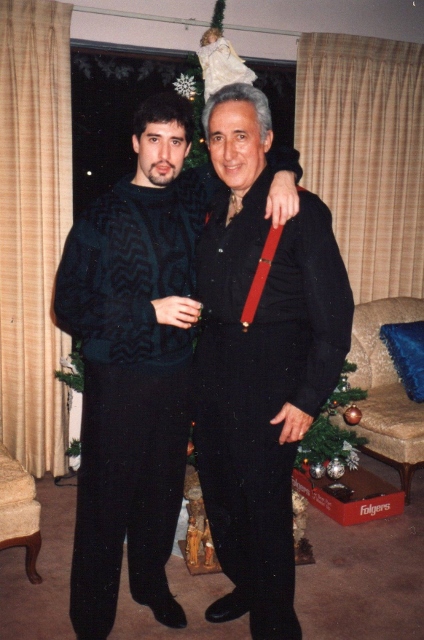
My father and me, Christmas Eve 1992

So I continue and recollect the best moments of my past years and look forward to what I have left.  Still, I’m always missing someone or something.

We all miss someone or something from our lives.  Who or what do you miss?

*Name changed.

Image: Aeviternitas

3 Comments

Filed under Essays

Next!

“First they came for the Communists
And I did not speak out
Because I was not a Communist

Then they came for the Socialists
And I did not speak out
Because I was not a Socialist

Then they came for the trade unionists
And I did not speak out
Because I was not a trade unionist

Then they came for the Jews
And I did not speak out
Because I was not a Jew

Then they came for me
And there was no one left
To speak out for me.”

Martin Niemöller

We’re still in shock here in the U.S.  In just a matter of weeks, the conservative majority on the U.S. Supreme Court undid decade’s worth of progressive social reforms.  The reversal of Roe vs. Wade last month garnered the most attention, but they didn’t stop with that.

In Vega vs. Tekoh, the High Court ruled that a violation of Miranda rights doesn’t provide a basis for civil damages.  The original Miranda vs. Arizona decision ensured people accused of criminal behavior have the right to legal counsel and to remain silent in the face of police interrogation.  Miranda was decided in line with the U.S. Constitution’s Fifth Amendment, which had already established certain guidelines for addressing criminal procedures.  The Vega ruling now ensures that law enforcement can act with impunity.  I suspect it’s a response to the vitriolic reactions to high-profile police killings over the past…well, several decades; the ‘Black Lives Matter’ protests and all that.  In Vega, the SCOTUS majority noted that, if the original Miranda court intended to create a constitutional right versus a prophylactic rule, it would have definitively declared that immediately upon deciding Miranda.  The 1966 Court knew how to use its words, the current Court essentially declared, and those words used were not “constitutional right.”  See how verbiage can be twisted so easily by academics?

In West Virginia vs. the U.S. Environmental Protection Agency, the Court undercut the latter’s efforts to regulate greenhouse gases.  SCOTUS agreed with Republican-led states and energy companies that the 1970 Clean Air Act gave the EPA too much power over carbon emissions.  The decision was also a strike back against the 2015 Clean Power Plan – an Obama-era policy that targeted adverse climate change.  To environmentalists, it wasn’t surprising that energy conglomerates were adamant in reversing the CPP, as well as the CAA.  But the West Virginia ruling falls in line with the belief of conservatives that climate change is a hoax.  That’s why energy companies overwhelmingly support Republican candidates.  I have to note West Virginia is a top coal producer.  It also ranks as one of the poorest states in the union.

In his statement regarding the Dobbs ruling, Justice Clarence Thomas suggested the Court should revisit other high-profile rulings, including Griswold vs. Connecticut, which declared the legal usage of contraceptives; Lawrence vs. Texas, which struck down anti-sodomy laws; and Obergefell vs. Hodges, which legalized same-sex marriage.  Curiously, he didn’t call for a review of Brown vs. Topeka Board of Education, which declared that racial segregation in schools was unconstitutional or Loving vs. Virginia, which legalized interracial marriage.  I guess this is because overturning these decisions would impact Thomas, a Negro married to a White chick.  It’s amazing how some people have no problems enacting laws that wouldn’t affect them personally.

In the 1983 film “The Star Chamber”, Michael Douglas portrays a relatively young judge who becomes engaged with a group of other jurists who find the legal system has gone awry in favor of criminals and decide to enact vigilante justice to right those perceived wrongs.  They hire assassins to kill certain criminals who have escaped incarceration.  The movie is replete with scenes where highly articulate lawyers help defendants get out of trouble.  In one early scene, Hal Holbrook’s character tells Douglas, “Someone has hidden justice inside the law.”  It’s an attempt to justify the group’s brutal actions.

That’s how I often view the legal system.  Charismatic lawyers prancing around even the most heinous of crimes with carefully-crafted verbiage; a kind of Tolkien-style language only they understand, but something the rest of us have to deal with toiling away in the trenches of reality.  I certainly don’t recommend assassination as a viable resolution to our nation’s political ills.  That’s where the treasured right of voting comes into play.  People need to take their voting rights seriously and understand the significance of not voting.  We’ve seen the fruits of voter apathy in my home state of Texas.  In recent years, the right to vote has come under fire from conservatives.  As with many other rights, this isn’t a surprise.  Conservatives have always tried to suppress voting.  You know…the way totalitarian regimes like Russia have.  I’ve noted more than once that the (fair and legitimate) elections of Barack Obama prompted (mostly White) conservatives to launch their assault on the First Amendment to the U.S. Constitution.  During their convention last month, the Texas Republican Party called for repeal of the 1965 Voting Rights Act, which guarantees the right to vote regardless of race.  They did this because…well, because that’s what conservatives do – at least here in the U.S.  They were quick to abolish fascism in Europe during World War II, but weren’t so eager to do the same at home.

With this in mind, I wonder if many conservative queers who voted for the likes of George W. Bush and Ted Cruz are satisfied with their decisions.  Along with many mainstream right-wingers, some are ecstatic that Roe was overturned.  But now, I hate to see their reactions at the thought of reversing Lawrence or Obergefell.  But the neo-Nazi clowns who have targeted the so-called “liberal agenda” for years are coming for their faggot asses next!  I just hope they’ll be happy sitting in their designer closets polishing their Ronald Reagan Glee Club pins.

If anyone in the U.S. believes democracy is functioning just perfectly and nothing is wrong, they need to consider this: five of the current justices on the Supreme Court were chosen by presidents who did NOT win the popular vote.  George W. Bush didn’t really win the 2000 presidential election and he barely won the 2004 election; yet he was able to appoint two justices – Samuel Alito and John Roberts.  Donald Trump certainly didn’t win the 2016 presidential election (perhaps the most corrupt in U.S. history), but he was able to appoint three justices to the Court: Neil Gorsuch, Brett Kavanaugh and Amy Coney-Barrett.  Gorsuch’s selection came because Republicans refused to grant President Obama’s nominee, Merrick Garland, the decency of a hearing upon the death of Antonin Scalia in 2016; claiming it was an election year and the next president should choose the nominee.  However, Barrett’s nomination came after the death of Ruth Bader Ginsberg in 2020.  The same band of Republicans who denied Garland a hearing rammed through Barrett’s confirmation without hesitation.

I don’t know if most Americans fully comprehend the significance of the Dobbs decision that overturned Roe.  It could lead to much worse.  But this is what happens when people don’t bother to vote in even the most mundane of elections.  Liberals seem especially reticent to take local races seriously.  I can only recommend everyone concerned about our democracy to make that concerted effort to vote.  I understand how many people feel their votes don’t count, particularly after the 2000 and 2016 presidential elections and all the corruption involved in both.

Yet, democracy is not a natural form of governing.  Humanity is more likely to construct an oligarchy-style system.  In worse case settings, totalitarianism can take root, as it almost did with Donald Trump in the White House.  People need to be wary of the current U.S. Supreme Court and its fascist leanings, disguised as social conservatism.  (Then again, fascism and conservatism are pretty much the same ideology.)

It’s starting with the Roe reversal.  Unless we place more moderates into public office, it will only get worse.

Bottom image: Michael de Adder

3 Comments

Filed under Essays

Roe Back

“Fight for the things you care about, but do it in a way that will lead others to join you.”

Ruth Bader Ginsburg

Abortion-rights and anti-abortion demonstrators gather outside of the Supreme Court in Washington, Friday, June 24, 2022. The Supreme Court has ended constitutional protections for abortion that had been in place nearly 50 years, a decision by its conservative majority to overturn the court’s landmark abortion cases. (AP Photo/Gemunu Amarasinghe)

It has been one dream of conservatives for decades: overturning Roe vs. Wade.  The landmark 1973 U.S. Supreme Court decision guaranteed women the right to abortion, in accordance with the 9th and 14th Amendments to the U.S. Constitution.  Now that goal has been achieved: earlier today, June 24, the Court has overturned Roe; thus gutting nearly a half century of reproductive freedom for women in the U.S.

It’s a stunning move and it’s left abortion supporters shell-shocked.  It doesn’t seem to matter that the majority of Americans support abortion to some extent.  Six justices on the Supreme Court have decided they don’t like the concept of abortion, so no woman should have access to it and no one should help a woman burdened with a crisis pregnancy.  It is the first time in U.S. history that a constitutional right has been granted and then rescinded.

Social and religious conservatives are ecstatic about this decision.  Although the Roe decision startled many people in 1973, the ruling didn’t really become an issue until the 1980s; when the evangelical Christian movement started to make its intrusive presence known.  They saw the election of Ronald Reagan as assurance that abortion would be outlawed in the U.S.

At least 26 states were ready to outlaw abortion under most circumstances, should Roe be overturned.  Now that it has, they are moving towards the annihilation.  Last year the legislature in my home state of Texas passed the so-called “Heartbeat Act”, which bans abortion after 6 weeks (before many women know they’re pregnant) and only allows it in cases where the mother’s life is endangered.  That means rape and incest victims will be forced to carry their pregnancies to term.  Any woman (or girl) who obtains an abortion and/or anyone who assists in that procedure could face up to $10,000 in statutory damages and face prison time.  Noticeably it doesn’t say anything about prosecuting men who rape women or girls.

The overturning of Roe perhaps will be one of Donald Trump’s greatest legacies, aside from his dismal handling of the COVID-19 pandemic and the violent insurrection at the U.S. Capitol on January 6, 2021.  But it won’t so much be his legacy as it will be that of right-wing extremists – the people who loudly proclaim to cherish personal liberty and freedom, but in practice, mean it only for themselves.  Everyone else’s personal liberty – that is, people who aren’t exactly like them – is somehow subjective.

Abortion opponents are now presenting – as they always have – what they consider viable solutions to the dilemma of unplanned and unwanted pregnancies; quick fixes that are ridiculously quaint and utopian.  They recommend creating a society where every child comes into the world loved and respected; that women always have a safe and effective way to carry out their undesired pregnancies.  It’s tantamount to beauty pageant contestants expressing their wish for the blind to see and the lame to walk.  It’s wonderfully idealistic, yet extraordinarily delusional.  Such answers to some of life’s most complex issues are typical of the conservative mindset: simple and unencumbered.  That’s why I always say my brain is too big to be conservative.

In the 49 years since Roe was passed, it’s estimated that some 60 million abortions have taken place in the United States.  Abortion adversaries groan that it means some 60 million children never got a chance to grow up and have fulfilling lives.  But millions of children have come into the world under the best of circumstances and have never lived fulfilling lives.  The future is always uncertain, and occasionally things go awry in families.

It’s also possible that those estimated 60 million children could have been subjected to abuse and neglect.  Children who come into the world unwanted often end up being unloved.  I have to wonder if abortion opponents are going to dish out any additional cash to help support all those children.  It’s easy for them to lounge in their ivory towers – the way religious leaders often do – and bestow well wishes upon troubled souls.  Good intentions don’t pay diaper and formula bills; they don’t provide housing and education; they don’t deal with the daily angst of raising children.  They’re glossy words that lack substance, unless solid and concrete action is taken to make those lives better.

Liberals and moderates are already concerned that other Supreme Court decisions are at risk, such as Griswold and Lawrence.  Even Brown and Loving may come under similar attack.  As part of his decision to overturn Roe, Associate Justice Clarence Thomas wrote, “In future cases, we should reconsider all of this Court’s substantive due process precedents, including Griswold, Lawrence, and Obergefell,” referring to decisions on contraception, sodomy and same-sex marriage respectively.

Remember, the original Roe decision developed under the auspices of the right to privacy and equal protection under the law.  Those are essential and undeniable features of a truly democratic society.  Stripping any particular group of basic human rights isn’t a sign of a moral culture, as many social conservatives would have us believe.  It’s more emblematic of a totalitarian world; a universe where a handful of people have blessed themselves with the power to decide what is and what is not appropriate for everyone else.

If abortion opponents think this Dobbs decision will end abortion in the United States once and forever, they are mistaken.  After the initial shock has worn off (which is already happening), people will begin to fight back and find ways around it.  Whether right-wing extremists like it or not, abortion will happen.  There will always be women who find themselves in very difficult situations and feel they must end a pregnancy.  It’s been happening for centuries and it will continue happening, even though a band of self-righteous elitists demand otherwise.

Just wait for it.  They’ve awoken a giant.

Leave a comment

Filed under Essays

No Change

I could tell just from my parents’ facial expressions this was bad.  The gallery of people (mostly older men) in similar-looking attire reeked of authority.  For me, all of 9- and 10-years-old, the joy of our first color TV set in this newly-built suburban Dallas home dampened with the drone of voices in that crowd on the screen.  Coupled with my parents’ own head-shaking, I got the sense something was very wrong.  I had no idea.  This was my first exposure to the American political system.  They were the Watergate hearings.

This week marks 50 years since the notorious break-in at the Watergate Office Complex in Washington, D.C., by a gang of misfits operating under the orders of the president of the United States.  Richard Nixon had become so emboldened by his 1968 win that he dared to envision a world where he either had no enemies or enemies that were easily squashed.  He had narrowly lost the 1960 presidential race to John F. Kennedy and then lost a 1962 bid for the California governorship.  Thus, winning the presidency created an authoritarian desire in him to hold onto power at any cost.  He would do anything to ensure he won a second term – which he did, in one of the biggest election landslides in U.S. history.

As recollections of those events abound, the nation is currently encased in more political intrigue.  The January 6 hearings have been underway for a week now, and there’s no telling how long they will last.

In some ways, the events of January 6, 2021 are similar to Watergate.  Both were set off by presidents who wanted desperately to hold onto power and ended up disgracing themselves.  History is still building Donald Trump’s legacy, but at least Nixon legitimately won both of his terms in office.

Trump’s 2016 “win”, on the other hand, was a fluke – a blatant act of fraud in a profession where character often doesn’t really matter.  And, like Nixon, he would do anything to ensure he would serve a second term as U.S. president; the leader of a nation that has long held itself as a beacon of true democracy and freedom.  When the results of the 2020 presidential election began arriving, it became clear Trump was not the winner.  But, as now know, he and his equally maniacal supporters would not accept the results.  Trump had stated months earlier that he would only acknowledged the outcome if he won.  That was the egoist in him talking.  It was also the oligarch in him; a reality TV star who gleefully terminated people in front of cameras, just as he’d surely done during his own professional life.

For decades, many have said we need a businessman in the White House.  Well…we got on with Trump – although we’re now aware he’s not as successful as he claimed to be.  But, with his extreme wealth, he could afford to be brutally honest – a virtue that appealed to the angry (mostly White) masses; a group that had tired of diversity and inclusion and suddenly wanted to claim the victim mantel in the 21st century.

The businessman model failed with the Trump presidency.  In at least one other manner, Nixon resembles Trump.  He never truly admitted wrongdoing.  Just a few years after he left office, Nixon gave a series of carefully-crafted interviews with journalist David Frost, in which he defended his actions; reiterating that, “when the president does it, that means that it is not illegal”.

Trump sees nothing wrong with the events of January 6, 2021.  From his pathetic vantage point, he did nothing wrong.  Even as the hearings proceed, he still insists he’s a victim of a rigged election system.  I’m sure Al Gore and Hillary Clinton would love to have a word with him about rigged elections.

Facing certain impeachment in the U.S. House of Representatives, Nixon resigned the presidency in August of 1974 – the first and (to date) only American president ever to achieve that ignominious feat.  After an impassioned speech to his staff, he boarded the Marine 1 helicopter and left the White House grounds.  There was no gunfire; no bombings; no bloodshed.  The Nixons were dragged from their home and strung up in public, like Nicolae and Elena Ceaușescu.  It wasn’t a Castro-type coup we’ve often seen in developing nations.

The events of January 6, 2021 were calamitous – and bloody.  Never has the U.S. Capitol been invaded and overrun by angry citizens.  That’s something that shouldn’t happen here; again, that’s a developing nation type of fiasco.  I’ve seen it on television and read about it in print – an oppressed people storming their national capitol to demand regime change.  We’ve seen it occur in Central America and the Philippines.  It happened across Eastern Europe, as the Soviet Union collapsed.

As the Watergate hearings proceeded throughout 1973 and ’74, more and more information came to light pointing to Nixon as the instigator of the entire mess.  The break-in wasn’t – as one individual dubbed it – a “third-rate burglary”.  The scandal was larger and deeper than anyone had imagined.  When the nefarious arrows finally began pointing back to Nixon, he resigned.  His reputation, along with that of many of his henchmen, disintegrated.  Their political careers were permanently ruined.

The January 6 hearings are almost theatrical.  There is no secret about what happened and who was responsible.  We know Trump urged his followers to “take back” the country and undermine the democratic process.  We know he demanded election officials in a number of states to find votes that would push him into a win.  We know he expected his Vice-President, Mike Pence, not to certify the 2020 election, as was his official duty.  And, to ingratiate the true horror of that day into our minds, video surveillance has been presented to the January 6 Committee showing the moment Pence had to be evacuated from the Capitol floor, as the rioters encroached.  Nixon demanded some people be silenced.  But, as far as we know, he never actually insisted they be murdered.

Everyone who runs for public office has to be somewhat egotistical; at the very least super-confident in themselves and what they have to offer.  They put themselves into the public arena and risk everything.  But egotism reaches dangerous proportions when the individual comes to believe they are better than everyone else and can do no wrong.  It’s nowhere more alarming than in politics where people who win elections are empowered to make decisions that impact the lives of millions.

In looking at Watergate and January 6, it’s amazing how fragile the democratic process remains.  It’s stunning how little seems to have changed.  It’s even more upsetting to think some people still see nothing wrong with any of it.

Image: Robert Pryor

3 Comments

Filed under Essays

Wolfgang at 20

Wolfgang, then Docker, at just a few months old in 2002.

When I saw that little ball of gray fur crawling around Tom’s* bare chest, I didn’t know what to think.  After he’d lost his older dog just a few days earlier, I honestly didn’t expect him to jump back into pet ownership mode.  My friendship with Tom soured by the end of that year, 2002, as his health apparently started to wane.  I never knew if he was being honest about that, but we had to part ways in January of 2003.  He left me with some $700 in debt.  But he also left me with the new puppy, a miniature schnauzer he named Docker.  I had grown attached to him since that day in August, when I first saw him.  We had agreed I’d take custody of him.  I renamed him Wolfgang.

If Wolfgang was still alive, today would be his 20th birthday.  He passed away in October of 2016, following a months-long battle with heart trouble.  But I maintain my father came out from the Great Beyond and snagged him.

By the end of 2002, Tom had decided he needed to return to his family home in far Northeast Texas to recuperate from whatever ailments were plaguing.  He had wanted to put up the puppy for sale, since he knew he couldn’t care for him.  I looked at that tiny ball of gray fur one evening, and his large dark brown eyes told me we belonged together.  I had started a new job with an engineering company in November 2002 and when I arrived home from work that Friday evening in January 2003, Wolfgang came bouncing out of Tom’s empty bedroom.  The dog was truly mine.

And I was concerned, almost frightened.  I wasn’t accustomed to having a dog around.  I hadn’t had an animal since 1985, when my parents and I put down our sick German shepherd, Josh.  We could never bring ourselves to get another dog again.  I’d seen so many residents of that apartment complex with small dogs and longed to have one of my own.  Now, here – I was an almost accidental pet owner.

We had a rough start.  I wasn’t used to dogs anymore.  I forgot, for example, that animal babies are like human babies in that they can’t control their bladders or bowels.  So I’d get mad at Wolfgang for messing on the floor.  And instantly regretted it.  He’s just a dog, I’d remind myself.

And that’s what I came to love and appreciate about him – he was a dog.  I eventually realized how comforting he could be; simply caressing his downy ears soothed whatever tensions had flooded my body and mind.  Any pet owner can empathize with me.  When I lived alone, his rambunctious greetings were an end-of-day highlight.  After I’d take him out for a brief walk and changed his water, we’d return to the apartment, where I’d strip down to my underwear and roll around on the floor with him.  His claw marks on my arms and back could testify to that.  But I also understood I was pretty much all he had.  I had my small collection of friends and my coworkers, but he spent most of his time alone.  Thus, I strongly considered getting another dog.  Dogs are pack animals and generally prefer the company of other canines.  I’d also come to feel that – in my 40s by this point – I didn’t need to be around other people.

I grew so attached to Wolfgang I considered him my child; an adopted child, but a kid nonetheless.  My love and devotion were so intense I seriously considered getting him a social security number to register him as a dependent.  I also realized something else: he was the meanest little critter on four legs I’d ever known in my life!

Any concept I had about small dogs being little more than adorable playthings was shattered with Wolfgang.  He was almost fearless.  The name I’d bestowed upon him truly fit his boisterous personality.  At most he weighed about 26 pounds (18 kg), but I know he viewed himself as the same size as that German shepherd.  Strangely he had a voice to match.  People who heard, but didn’t see him, thought Wolfgang was a monstrous canine.  Every vocalization that came out of him was loud – even his yawns!  You know you’re loud when someone can hear your yawns in the next room.

By 2007, my father’s health had started to decline.  He and my mother were in their late 70s.  That fall I made the decision to move back in with them; into this house where I had grown up.  It was a difficult time, as I’m such an introvert and was used to living alone.  I enjoy my privacy and personal space.  But it turned out to be for the best.

Shortly after moving in, I underwent foot surgery.  I placed Wolfgang in a room next to my bedroom and behind a dog gate.  As attached as he was to me, I knew he’d want to accost me in his usual manner when I returned from the hospital.  But hobbling in on crutches would have me too vulnerable.  After I got settled into bed, I told my parents to let Wolfgang come into the room.  Once he entered he slammed his front paws into the side of the bed, as if trying to ensure I was alright, before turning to my parents and unleashing a vociferous round of barks and growls.  His lips were pulled back as far as they could go; something dog owners know is a troubling sign.  I’d never seen him so angry.  But I knew that was also a gesture of how much he cared about me.

As time progressed, I became more ensconced in this house, and Wolfgang grew into a central figure in the lives of me and my parents.  That little dog somehow unified the household.  No matter the issue, he always brought things into focus.  My father developed a special bond with him; announcing Wolfgang was all the therapy he needed.  Indeed, as he’d already done with me, Wolfgang provided a heartening degree of therapeutic consolation.

In early 2016, Wolfgang began experiencing strange – and frightening – seizure-like episodes.  He’d struggle to breathe, as he’d squirm on the floor.  The vet diagnosed him with a heart murmur and placed him on medication, which stopped the seizures.

Shortly afterwards, my father’s health took a turn for the worst and he was hospitalized in May of that year.  He had suffered from gastrointestinal illnesses for his entire adult life and had major abdominal surgery in January 2008.  He was relatively fine for a few years, before he started getting sick again.

By Memorial Day weekend 2016, I told his doctors it was time for him to come home.  My father had said repeatedly he wanted to die in this house; the home he and my mother had worked so hard to get and keep.  And I wanted to honor that wish.

Over the next two weeks, Wolfgang would wander into my parents’ bedroom and start to climb onto the bed on my father’s side.  In his weakened state, I saw my father lift his left hand up and stroke Wolfgang’s head.  And both would sigh.

On Monday, June 6, 2016, I had sat down to watch the local noon news.  Wolfgang lay quietly beside the coffee table.  Then the lights flickered, and I felt a strange drop in air pressure.  I noticed Wolfgang lift his head and turn to his left.  He then rose slowly and sauntered down the hall; he stopped in front of my parents’ closed bedroom door and looked at me.  I knew then my father was gone.

Throughout that summer and into the fall of that year, Wolfgang’s behavior changed.  He became more subdued and less rambunctious – something I attributed to his age.  But I noticed he’d often look off into the distance and occasionally wander into my parents’ empty bedroom.  And stare.  I’d stare at him, knowing he was seeing my father.  In the last couple of years before his death, my father would run his fingers through Wolfgang’s fur and tell him “we’re going to go together.”  A secret, I realized – one he was relaying quietly to the dog, yet loud enough for me to hear.  In my father’s formal obituary in the “Dallas Morning News”, I mentioned Wolfgang – describing him as a canine “grandson”.

During the last weekend in October 2016, Wolfgang became especially lethargic – and cantankerous.  I became annoyed with him, but reminded myself again he was just a dog.  Then, by Wednesday morning, I realized I had to take him to the vet; he was critical.  As I rushed to the office less than two miles away, I begged him to stay with me; that I loved him more than most anyone else.  But it was too late.  The doctor couldn’t save him.  I leaned over him and whispered again that I loved him and to go with his “granddad”, my father.  The vet receptionist stood in the room with us and was already tearing up.

Then she looked up and seemed to sniff the air.  “What’s that?”

I smelled it, too.  It was the scent of Chaps – my father’s favorite cologne.

As tough as it was dealing with the deaths of my father and Wolfgang within a five month period, I’m glad I didn’t have to worry about either in the following years.  My mother’s health continued to worsen, as her descent into dementia intensified.  She finally passed away in June of 2020.

In the years since, I’ve realized how lonely it is without a dog.  I miss my parents, but I also miss Wolfgang.  During some down moments, I often see shadows of a small figure trotting down the hallway and think I need to limit my alcohol intake.  But I’ve also seen that tiny character in my dreams; virtual somnambulations I know are messages from my father.  Animals, it seems, are conduits for hope and love.

In the 1970s and 80s, Josh provided a unique brand of emotional support for various levels of my anxiety – from childhood into young adulthood.  Losing him traumatized me more than I could imagine at the time and ranks as one of the worst events of my life.  Losing Wolfgang wasn’t nearly as traumatic, since I knew he was old and suffering health problems that come with age.  When he turned 10 in 2012, I told my parents we needed to start preparing ourselves for his death.  We hadn’t done the same with Josh.

Wolfgang in December 2010

Stupid animals!  They wrap our hearts around them, make us fall in love with them – and then go off and die.  But they leave that stamp on our souls that we can never eliminate.  But who would?

A generation ago people grieved the loss of pets in solitude.  Yet we now view animals with a greater sense of appreciation.  Wolfgang’s veterinarian cremated him and returned the ashes to me in a small wooden box that I now keep on the same dresser my parents used.  A photo of him hangs beneath a photo of my father and me at a family Christmas gathering in the 1990s.  Another photo of him sits between my parents’ urns on the fireplace hearth.  A photo of Josh sits off to the left, looking towards all of them.

Happy 20th Birthday, Wolfgang!

This box now sits on my dresser amidst photos of other deceased loved ones.

*Name changed.

Leave a comment

Filed under Essays

Total Madness

Children flee Robb Elementary School in Uvalde, Texas on May 24, 2022.

They’re like recurring allergies – they just keep hitting over and over.  But we have a bevy of cures for allergies.  We don’t seem to have many for the sickening epidemic of mass shootings in the U.S.

As of this day, the U.S. has experienced over 250 mass shootings in 2022 – more than the number of days thus far in the year.  A mass shooting is defined as an event where four or more individuals are shot, not including the actual assailant.

Two recent massacres – 10 people in a grocery store in Buffalo, New York, and 21 at an elementary school in Uvalde, Texas – have garnered considerable attention.  The Buffalo calamity was racially-motivated, and the Uvalde event was the worst school shooting since the 2012 Sandy Hook Elementary School shooting in Newtown, ConnecticutBetween the Buffalo and Uvalde episodes, the U.S. experienced 14 other mass shootings.  Let that sink into your brain for a few minutes.

The gun issue has always been sensitive and controversial.  Hardline gun rights advocates have consistently placed the value of their sacred firearms over the right of people to live peacefully and happily.  Even more aggravating is a recent survey where 44% of Republican voters say mass shootings are one price we have to pay for living in a free society.  Somehow that doesn’t surprise me.  Ironically, many of these people consider themselves pro-life.

On the other side, far left gun control proponents want to eliminate all firearms for private citizens; believing that – in this violent, imperfect world – we only need herbal tea and kind words to solve every crisis.  These are the same people who get so emotional it’s almost painfully embarrassing to watch them recount their ordeals.  I understand these are horrific events, but the time for tears and anguish has already passed.

And that’s what I want to communicate to liberals.  Stop crying!  It’s time to get mad, stand up and yell back at these idiotic gun nuts whose only resolution to firearm blood baths is another weapon and a few thoughts and prayers.  Thoughts and prayers serve as little more than toilet paper for the carnage.

In the immediate aftermath of both Buffalo and Uvalde, as more talk of gun violence and gun control arose, we heard the usual cadre of right-wing loudmouths more worried (as always) that the rights of “law-abiding gun owners” could be desecrated.

Spare me the narrow-minded anxiety!

People have more of a right to live than anyone has a right to own a gun.  And no, they aren’t equally significant.  But conservatives campaigning for public office consistently point out one characteristic: they are pro-Second Amendment.  I see these ads every election cycle, especially here in Texas.  They always skip over the First Amendment, which ensures free speech and peaceable assembly and guarantees the right to vote.  Again, the twisted priorities of the conservative mindset.

Last year, when Texas Governor Greg Abbott signed several pieces of legislation into law that declared the state to be a “Second Amendment sanctuary”, I wasn’t shocked.  But I was angry.  This is the same governor who oversaw blatant attacks on the right to vote by dismissing the reality of gerrymandering in the state and allowing for partisan poll watchers.  In older days, partisan poll watchers across the South carried guns and would deliberately intimidate (mostly non-White) voters.  Conservatives steadily bemoan the myth of rampant voter fraud, while ignoring the very real pandemic of gun violence.

For the first anniversary of the 1999 Columbine school massacre, a national news network interviewed several of those first responders.  One man stated that he was particularly upset that the perpetrators (two teenage boys) had included girls among their victims.  He said could understand them shooting boys, “but they shot girls, too.”  I literally stopped when I heard him say that.  Aside from the shock value of the verbiage, that he could differentiate between the genders of the victims and therefore categorize his horror level proved how complacent people in this country have become towards violence.  It certainly was one of the stupidest things I’ve ever heard.

The outrage continued in the aftermath of the Sandy Hook massacre, when the U.S. Senate held a hearing on gun violence in the nation and the National Rifle Association’s Wayne LaPierre sat with a scowl on his face and became defensively hostile with every question lobbed at him.  And, as usual, liberals wept, while conservatives grunted.  And then…nothing.  Nothing happened.  No new legislation to address gun violence; no new funding for mental health counseling…nothing.  With that, it seemed the gun violence debate in the United States ended.  We’d accepted the murder of helpless children and thus, nothing more could be done.

At this point, I really don’t hold out much hope for any kind of movement on the legislative front.  Politics has gotten in the way of public service.  So, what’s new?

I remain as tired of the crying from liberals as I am of the concern for gun owner rights from conservatives.  If only the latter group understood the extent of the damage caused by bullet wounds, then perhaps they’d rethink their commitment to ensuring gun rights over human rights.  It’s time for we progressives to get mad and shout down the right-wing extremists who proudly pose with their firearms for family holiday photos the way most normal-minded folks pose with their children and pets, armed with little more than smiles.  The saccharine responses from the horrified won’t result in any considerable change.  They’ll just fade into the morass of national traumas.

Then we’ll have another mass shooting – in a school or some public venue.  And the cycle of tears and excuses will begin all over again.

3 Comments

Filed under Essays