Category Archives: Essays

Another Friend Gone

Robert in 1997

My father planted pink spider lilies decades ago in our front yard, but at some point years later, he decided to dig them up.  Shortly before his oldest sister, Amparo, died in February 1998, he was surprised to see several of those plants had re-surfaced.  Over the next several years we both noticed that a number of those pink spider lilies would inexplicably pop up in various spots across the front yard.  And then someone we knew – a relative, a friend, a neighbor – would die soon afterwards.  That was an omen, he told me – someone we knew was going to die.  Those lilies sprung up across the front yard shortly before my father’s death in June of 2016 and again before my mother’s death four years later.  They even arose before my dog Wolfgang died in October of 2016.  They came up again in early 2022 just weeks before my friend, Paul, died and again the following year, just before another friend, David, died unexpectedly.

A few weeks ago I spotted a few of those blooms near the front door.  And now, for the third time in as many years, I’ve lost a close friend.  Robert Souza died early Wednesday morning, the 16th.  He turned 62 last month.  A Massachusetts native, he’d moved to Texas in 1983 to attend some kind of religious school.  That didn’t seem to work out, but he always retained some degree of spiritual faith.  Oddly, despite living in Texas for so long, he still had that uniquely Bostonian accent.  We met through mutual friends in February 1994 and found we had a few things in common: muscle cars, rock music and animals.

Robert had been through a lot personally, including some serious health problems, and even an attempted carjacking/robbery in 1997 where he took six bullets.  I wrote about that in 2013.  Despite everything, he always managed to get through it.  This latest bout with severe pneumonia, however, proved insurmountable.

I’m afraid Robert’s death will mark the end for his mother – a retired nurse in her 80s who still lives in Massachusetts.  She lost her young son, George, to ALS five years ago.  Robert returned to Massachusetts for the funeral and stayed longer with his mother.  Knowing all about his health concerns, she just wanted him to be with her for a little while.  Now this.

After my friend David died in 2023, Robert and I discussed how we had reached the point in our lives where we lose people we know and love.  I often joked that he was too mean to die; that he needed to soften up a little before God accepts him into the Kingdom.  I guess he softened up without me realizing it!

My friend Paul who died of liver cancer in 2022 had told me years earlier of strange things surrounding him and his family.  He lost his father, two nephews and his older brother over a six-year period.  And in the weeks preceding each death he noticed a slew of black birds nearby.  One even flew alongside him as he drove down a highway.  Alarmed, he told me, he’d honked several times, but the bird continued flying beside his car.  Even when he slowed or sped up, the bird remained a constant presence.  Only when he exited did it fly away.  The experience left him shaken, he recounted.  Shortly afterwards his brother died.

A few days before my mother passed away I had a close family friend stay with her, while I went to the store.  When I exited the building and approached my truck I was startled to see a small group of black birds gathered atop my truck.  They remained, even when I got into the vehicle – literally close enough for me to touch them – and departed only when I started the engine.  Earlier this week I went to the same store and – as I approached the entrance – noticed a single black bird on the ground ahead of me, just outside the automatic doors.  It turned in my direction, and I slowed my pace.  A few steps closer and the bird flew away.

Now I can only say I love you, my friend Robert, and I hope to see you on the other side.
6 Comments

Filed under Essays

Glassed

Around the turn of the century, I saw news that a women’s college here in the U.S. had contemplated admitting men within a year or two.  The shock and outrage from the female student body was as palpable as it was vociferous.  Ironically the institution had a male chancellor at the time.  He tried explaining to the crowd that the college was trying to maintain its viability, but his voice was suffocated by the intense hysteria.  You would have thought the incoming male students would be selected from a sex offender registry.  I’m sure those young women had long since bought into the feminist myth that all men are naturally prone to violence, especially sexual assault.  Almost immediately, however, the college rescinded its decision, much to the delight of the students.  That same male chancellor made the announcement by unfurling a banner that bore the term “For Women Again”.  The crowd erupted into cheers of relief; some even popping open bottles of champagne.

At the bank where I worked at the time, the subject arose during a lunch conversation.  I was the only man in the small group, and my female colleagues collectively agreed that they understood the reticence of that college’s students to admit men.  But, of course, I had to opine by highlighting the obvious anger those young women expressed at the initial announcement.  “I wonder what those little girls will do when they enter the adult world and have real problems.  And there’ll be men all over the place, and there’s not a goddamn thing they can do about it.”

I suppose my constituents weren’t surprised by the statement, but to some extent, they had to concur.  There was a time when the genders were explicitly separated, and everyone seemed fine with it.  Men did this, and women did that.  And things functioned relatively well.

But I pointed out that, if women want true equality, they have to accept that men are part of that equation.  In many ways, for centuries, men have excluded women from the decision-making process; claiming there was a “place” for them.  Women have fought back and demanded a place at that proverbial decision-making table.

Oddly one of the women sitting with me in that lunch room didn’t believe women should be in positions of power, such as the U.S. presidency.  “We have too many emotional and hormonal problems!” she said, much to the shock and chagrin of the other women.  She wasn’t the first woman from whom I’d heard that.  But this was 2000, and I was certain such beliefs had been relegated to ancient times – like dial phones.

A few years before that particular conversation a similar debate arose among me and some female colleagues at the bank; another one about gender parity.  I noted that, if women wanted true equality with men, they needed to start registering for Selective Service – like the men have to do.  In the U.S., Selective Service is the most blatant form of sexism.  The current system was reinstated in 1980 by then-President Jimmy Carter.  Every male in the U.S. born since January 1, 1960 has to register for it within 30 days of their 18th birthday.  In the face of a never-ending Cold War and the sudden Iranian hostage crisis, it was a call-back to an older time in America.  There’s no penalty for late registration, but there are plenty of punishments for failure to register – including jail time and a six-figure fine; no admittance to college; and no financial aid.  The issue was a big one when I was in high school and it became a concern during the 1991 Persian Gulf War.

In the aforementioned workplace conversation, one of my female colleagues – the mother of a single college-aged son – responded, “When men get pregnant,” before storming off.  Another woman concurred with a laugh.  But I pointed out that men have to register for Selective Service; otherwise, face some serious legal repercussions.  Women, on the other hand, don’t have to have children if they don’t want.  There is no law that compels women to get pregnant.  My female cohorts couldn’t offer a logical reply.

All of that came back to me last week, when Vice-President Kamala Harris accepted the Democratic Party’s nomination as presidential candidate.  She’s only the second woman and the first non-White woman to be so honored.  This year’s presidential campaign has literally turned out to be the oddest in decades; certainly the most unusual in my lifetime.  And at the age of 60, I don’t have too many first time experiences left.

I started coming of age in the 1970s, just as the contemporary feminist movement was making more concerted inroads into a patriarchal American society.  I recall how just being male seemed to become anathemic.  Many women demanded full and complete equality with men in every aspect of civilization.  Yet, by the 1990s, I noticed some women (and men) expected a double standard.

Women can’t reasonably demand to be treated as equals to men in business and politics, yet still expect to be placed in the same category as infants and children when it comes to their health and welfare.  In other words, don’t insist on being given the chance to be the CEO of a major corporation, a governor, a Supreme Court justice, or president of the United States and still want to be the first ones in the lifeboat when the ship hits the ice berg.

If you want equality, I’ll give you equality.  But, remember the old saying: be careful what you wish for; you might just get it.  When it comes to progressive attitudes, I sometimes think of the 1967 film “Guess Who’s Coming to Dinner”.  Spencer Tracy and Katherine Hepburn portray a liberal San Francisco couple whose all-inclusive ideology is tested when their daughter (Katherine Houghton) introduces her fiancé (Sidney Poitier) to them.  While the movie is rife with stereotypes, the general message is essential: how sincerely should people value and hold onto their beliefs.  The presidency of the United States has often been deemed the ultimate “glass ceiling” for women.  As we march further into the 21st century, members of every previously-marginalized group need to consider how much shattered glass they want on the floor of progress.

Leave a comment

Filed under Essays

Maelstrom

Donald Trump gets shot at an outdoor rally; Joe Biden ends his presidential campaign; and the 2024 Summer Olympics launch in Paris with opening ceremonies conducted down the Seine and Lady Gaga greeting crowds in French (when has an American ever visited a foreign country and spoken the local language?).

Oh and this summer in the Northern Hemisphere is already smashing temperature records, plus we’re experiencing a COVID resurgence.  I thought 2020 was chaotic (and it truly was), but 2024 has proven even more unusual.  When I saw news that Trump had been shot by a would-be assassin, I simply responded the same way conservatives have reacted to school shootings: I offered my thoughts and prayers.  At least Trump survived.

Vice-President Kamala Harris has scooped up the embers of the Democratic torch and hurtled forwards towards November 5, Election Day here in the U.S. (and my 61st birthday).  A good birthday present for me would be a completely different candidate to win the race, but I’m smart enough to realize that just won’t happen.  I may go rogue and vote Green Party, as I did in 2016.  If enough people followed suit, it could probably cost Harris the election, but it could also cost Trump.  Die-hard Hillary Clinton supporters blamed folks like me for siphoning votes from her and essentially handing them to Trump.  No, I told them!  I didn’t cost Clinton the election.  She cost herself the election!

But that was almost an entire decade ago, and – unlike many social conservatives – time marches onward.  Harris made history when she became the first female and first non-White Vice-President.  For many women, the U.S. presidency is the ultimate glass ceiling.  But I have to note that, in this country, only men have to register for Selective Service and we have no law that bans male circumcision.  So what constitutes gender equity?  Many liberals and some moderates have already invested a lot of hope in Harris to save democracy from the hands of the despotic Trump.

Right-wing extremists have already painted Trump as a martyr for surviving the assassination attempt.  Tears fell from the eyes of some at the Republican National Convention last week, as their beloved self-anointed prophet recounted the sting of what might have been a fragment of glass that struck his right ear instead of an actual bullet.  Meanwhile, congressional hearings are still trying to determine how a geeky 20-year-old managed to climb atop the roof of a building within firing range of the former president – and why.  The latter question may speak to the sensitive issue of mental instability, but also attests to the pernicious gun culture in the United States.  But at least Democrats in Congress are expressing their collective shock at the assassination attempt, unlike their Republican counterparts who dismissed the riots of January 6, 2021 as “trespassing” and, of course, extend those ubiquitous “thoughts and prayers” after each mass shooting.

Thus, the political pandemonium that is American democracy continues.  I only hope none of it contains any firearms.

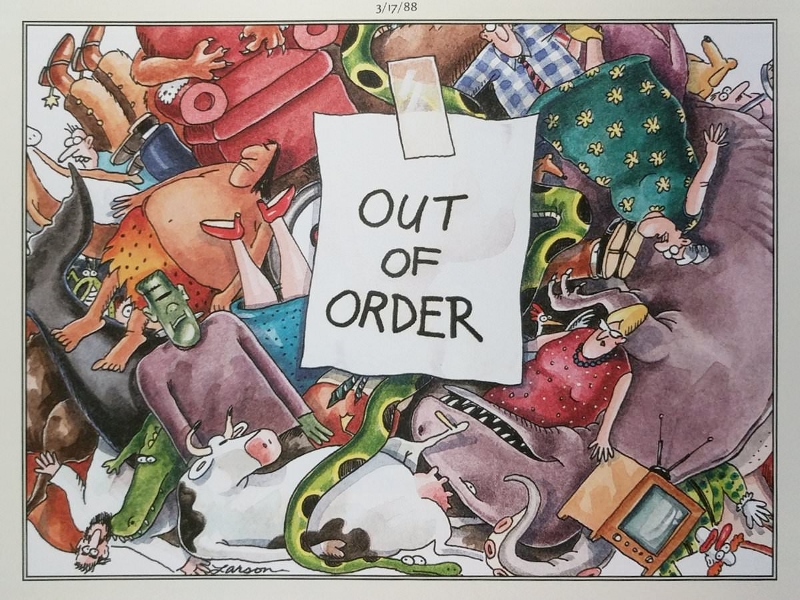
Image: Gary Larson, © 1988

Leave a comment

Filed under Essays

Slow Motion Debacle

Anyone who watched the debate last Thursday between President Joe Biden and former President Donald Trump surely has a variety of words to describe it.  Mine are sad, pathetic, hopeless and frightening.  And those are the highlight adjectives!

I didn’t see it.  I had to do some writing and other work on my personal computer.  Plus, my genitals needed some extra attention, and I just couldn’t ignore them to watch two cantankerous old men exchange pithy barbs.  One good feature about the debate is that the microphone for whichever of the two candidates not speaking was muted.  I know that was incorporated strictly after the fiasco of the first Trump-Biden debate in 2020 – the one where a frustrated Biden blurted to Trump, “Would you shut up, man!”

If only both men could be muted now, I think we’d all be better off.  Americans – and people across the globe – pretty much know where they stand on particular issues.  Or where they don’t stand.

I recall the questions surrounding the health of Ronald Reagan when he ran for president in 1980; he was 69 at the time, and the voting populace (along with the media) verbalized their concerns about his welfare.  For the most part, seniority is respected and appreciated in certain fields.  Politics isn’t necessarily one of them, but experience does hold a certain value.  Reagan made the most of his age, even joking about it on occasion.  He held the distinction of being the oldest president until Trump.  In November of 2022, Biden crossed a new threshold when he became the nation’s first octogenarian Chief Executive.  And here we are.

I’ve always said the Democratic Party’s biggest mistake in the 2020 election cycle was to let Biden and Bernie Sanders run for president.  After leaving the White House as vice-president in 2017, I feel that Biden should have retired into the realm of a senior statesman; giving speeches, writing books and propagating democracy every reasonable chance he had.  The Democrats began the 2020 campaign with the most diverse collection of candidates, including more women than had ever attempted to run for president at one time and an openly queer man in their ranks.  Then they ended up just like the Republican Party – with two old White men at the top, Biden and Sanders.  Of course, one of those Democratic candidates, Kamala Harris, has become the nation’s first female and non-White vice-president, and another, Pete Buttigieg, has become the first openly queer cabinet official.

Like many people, I’d often mock older individuals in my youth.  Now I’m 60 and I know how that feels.  I don’t consider myself “old” in the traditional sense; my body has definitely aged, but I won’t let my mind collapse into senility.  But even I know this nation is in trouble with the likes of Biden and Trump as the primary presidential candidates.  And yes, it is because of their age.

The U.S. is rapidly approaching the 250th anniversary of its official birth as a nation.  Right now the future just doesn’t look too bright for us.

1 Comment

Filed under Essays

Graying Wolf

“Damn!  You’re old as shit!”  That’s what Dan*, a friend and former colleague, texted to me last year after I’d informed him that I’d just turned 60.

“And you’re so ugly you almost hurt my feelings!” I replied with a laughing emoji.

Dan and I have always had that kind of friendship – if one of us didn’t insult the other, we might think we were mad.  It’s a man thing actually.

I’ve had those so-called “senior moments” where I walk into a room and wonder why.  I find myself occasionally losing my balance and stumbling or literally bumping into something.  A bruise just below my left knee hasn’t healed after several months.  It’s like a dark, small-scale version of Jupiter’s “Great Red Spot”.  A night light in my bedroom is one that I used to turn off at 10 p.m. because I generally have to sleep in total darkness.  Now I keep it on 24/7.

Albeit a former gymnast and taekwondo practitioner, I can no longer do deep knee bends.  My left knee in particular seems to get caught whenever I bend it.  In March of 2021, a close friend posted a picture on Facebook of himself squatting beside a vintage vehicle.  His wife and daughter had treated him to a vintage car show for his birthday.  I congratulated him and then added, ‘BTW, how long did it take u to stand back up from that squatting position? LOL!’

Earlier this year I wrote how I moved my Uncle Wes* and his cat, Leo, into my home.  Wes had just turned 84, and – after a hard life – his body is slowly giving out on him.  I don’t know how much longer he has, but I’m glad I can provide him a safe home in these final days.  And then I look in the mirror and think, ‘Damn!  With any luck (if you can call it that) I’ll be his age.’

My father was 83 when he died in 2016, and my mother was 87 when shed passed away four years later.  I have a few other relatives who have made it into their 80s.  My paternal grandmother died in 2001 at 97.  Aside from their longevity, all of them had one other thing in common: they had loved ones caring for them as they aged.

I did get some good news recently, though.  I had visited a local urologist, mainly for general male-specific healthcare, but also because I’d noticed a significant decline in energy and focus over the past couple of years.  I attributed the latter simply to age, but I wondered if I needed testosterone replacement therapy; a growing practice for older men.  I had some blood drawn at the urologist’s office and then visited the doctor again to discuss the results.

And the results were phenomenal.  I measured 534 ng/DL (nanograms per deciliter) of testosterone, which puts me in the 35-40 age range.  Most men my age fall into the 300 spectrum.  I won’t necessarily reclaim my lost title of “Stud Burger” (or maybe I will), but to say I’m as healthy as a 35-year-old feels pretty good.  The urologist doesn’t want to put me on any kind of hormone replacement therapy (HRT) as that could eventually hurt me more than help.

So the only possible cause of my fatigue is the result of another blood test by my regular doctor more than a month ago: low sodium levels.  I grew up in the 1970s and 80s, when high cholesterol and too much salt in one’s diet became alarm bells of concern.  I remember talk in the early 80s of actually trying to ban salt in processed foods.  It was met with the same response Ronald Reagan got when he tried to get the state of California to label ketchup as a vegetable.

A couple of months ago I was discussing age with a close friend who’s a few years younger than me.  I highlighted my concerns about my own aging; that I have no siblings (and therefore no nieces or nephews) and no children.  Going back to what I stated above: I’m getting older alone.

“I hear you, brother,” he responded.  He’s mostly in the same position, although he has a sister.

Regardless I have to say that I’d rather get to be this age – and experience the myriad agonies that come with it – than to die as a very young man.  I lost a close friend to AIDS in 1993; he was almost 32.  During my tenure working at a retail store in the 1980s, two of my teenage colleagues were killed in auto wrecks.  I look at photos of young military men and women who died in the Afghanistan and Iraq wars and recollect what I was doing at their age.

So I’m doing okay.  Gray hair or not – I’m at a good place in life.

*Named changed

3 Comments

Filed under Essays

No Good

Late last month a jury in New York City convicted former President Donald Trump of financial fraud.  It’s an ignominious verdict.  For the first time in U.S. history, a former president has been found guilty of a criminal offense.  Many liberals are happy, since they view it as vindication for Trump’s disastrous one term in the White House.  Conservatives are outraged, as they consider the entire affair nothing but political shenanigans at the hands of hateful Democrats.

And, just when everyone thought it couldn’t get any worse (or weirder), a jury in Delaware has found Hunter Biden, President Biden’s youngest son, guilty of purchasing a gun while hooked on illegal narcotics.  He apparently lied about it, when completing the form – a felony.  The younger Biden has long admitted his battle with drug addiction.  His ex-wife and former girlfriend testified about his drug use.  I’m not surprised that gun-rights advocates aren’t running to his defense.  They oppose any limits to gun rights, even remaining silent when people with a clear case of lunacy obtains firearms, and dismiss the severity of every mass shooting with their usual “thoughts and prayers” bullshit.  Regardless, it is the first time that a child of a sitting U.S. president has been convicted of a crime – another dubious moment in the annals of American politics.

Now that Trump and Hunter Biden have been successfully convicted, each awaits their respective sentencing.  They could face jail time, but I doubt either man will be incarcerated.  A former president and the son of a current president qualify as scions of the political elite – and they always seem to get away with even the most egregious of antics.  Remember, Richard Nixon didn’t go to jail.

I view this mess with absolute disdain and even sadness.  This is not a good thing for the United States – the self-appointed beacon of global democracy.  In many ways the Trump fiasco resembles the sham impeachment of Bill Clinton a quarter century ago.  Back then Republicans tried everything possible to undermine Clinton’s presidency – only to land on a rather minor issue: lying about a sexual tryst with a White House intern; in other words, sex!

With Trump, Democrats tried two impeachments, amid a bevy of other tactics; ultimately arriving at one thing: paying off a former adult film star to keep quiet about an alleged sexual tryst; in other words, sex!

I’m old enough to remember Watergate and Iran-Contra, as well as many contentious Supreme Court confirmation hearings.  But Clinton’s impeachment fiasco was a new low for the U.S.

Until now.

In the morass that is the American political diaspora, many things have changed.  But so much else has remained immobile.  Conservatives keep pushing the myth that more guns make society safe, and liberals keep pushing the myth that merely throwing wads of cash at a problem will solve it or just make it go away.  Both groups are wrong.

We have so many problems in the U.S., the wealthiest country in the world.  A recent study by the National Health and Nutrition Examination Survey showed something extremely disturbing: food and clean water security for American children has dropped significantly since the turn of the century.  I’d heard of food insecurity, but clean water insecurity is a new dilemma for me.  As with many other things, such as education and health care, racial disparities are particularly acute.

Throughout the previous century, food and water security had improved, as the nation’s overall health infrastructure advanced.  But in 2005, 4.6% of all children in the United States experienced both water and food insecurity.  By 2020, researchers found that the percentage of children nationwide who faced both problems rose to 10.3%.

That should make everyone with any sort of conscience understand the nation’s true priorities.  But in the halls of our elected representatives, the primary concern seems to be the next campaign and what they can do for themselves.  I don’t really care that Donald Trump fucked a porn star or that Hunter Biden bought a gun while high on crack.  Their problems aren’t mine and neither are their visions of reality.  Whether it’s food insecurity or jobs, Americans need to focus on the issues that affect them directly and personally.  So do politicians.  But I don’t hold out hope for the latter.

Leave a comment

Filed under Essays

No Tax Latex

It’s been nearly two years since the U.S. Supreme Court outlawed abortion and left it up to individual states to decide whether or not women should be able to decide what to do with their bodies.  The Dobbs decision sent proverbial shock waves throughout the American conscience.  For the first time in modern judicial history, a fundamental right was snatched away by a band of elitists who – like most extremists – feel they know what’s best for everyone else.

Now another abortion-related issue has come before the Court: whether mifepristone is legal or not.  Basically this medication induces abortion without an individual having to visit a clinic.  Recently the U.S. Food and Drug Administration expanded approval of the drug.  That incited the ire of Alliance for Hippocratic Medicine, a conservative anti-abortion group that forced the matter onto the plate of the High Court.  If the Dobbs decision is any precedent, things don’t look good for mifepristone.

I might have one solution to the overall problem of unwanted pregnancies: tax-free condoms.  Even before I entered my teens, my father put the fear of the Almighty into my brain – never trust a girl when she says she’s on birth control.  Of course, women should never trust a man when he says she can quit her job because he’ll make her his queen, but that’s a different dilemma.

To many men wearing condoms is comparative to showering while wearing a raincoat.  (Points to anyone who has actually heard that firsthand.)  But, as we saw with the AIDS epidemic, condoms are a safeguard.  Personally I’m tired of hearing men say that birth control is a woman’s responsibility.  A real man takes charge of his own birth control. 

Unexpected pregnancies present more than a few challenges to an individual female.  Children who come into the world unplanned and unwanted often end up being unloved; thus, they often become society’s problem.  Two decades ago economists Steve Levitt and John Donohue hypothesized that a reduction in crime in the 1990s was one effect of the 1973 Roe v. Wade decision that legalized abortion nationwide.  A strong economy and a greater presence of law enforcement, especially in major metropolitan areas, were also counted as dominating factors.  But it was the abortion connection that prompted the most controversy – and greatest outrage.  Liberals opined that abortion provided women with greater autonomy over their own health care, while conservatives pointed to a reversal of liberal social policies beginning in the 1980s as the primary reason for a reduction in criminal behavior.  Either of these theories bears some truth.

Another interesting result of the Dobbs decision is the sudden rise in vasectomies here in the U.S.  Perhaps some men are finally getting the hint that they also have reproductive choices.  Institutes from the Cleveland Clinic to Planned Parenthood are noting an increase in vasectomies.  It’s both logical and practical.

But I still think eliminating taxes on condoms will provoke younger and/or single men to buy and use them.  As of now, I don’t know of any state that maintains this practice, but I still feel it would be worth the trouble.  States will garner tax revenue on a slew of other products anyway.  I’m fully aware condoms are not a panacea to solve unwanted pregnancies; no form of birth control outside of abstinence is.  But, just as with the foolishness of “Just Say No”, abstinence only blanket ideology isn’t reasonable either.  Children cost money – as any parent can tell us.  They should be a blessing, not a burden.

5 Comments

Filed under Essays

What Fools We Are

This is a great essay by fellow blogger Valentine Logar who never holds back, yet does it with style and class.  Thanks, Val!

Leave a comment

Filed under Essays

Zero Credit

The image above represents something very important to me and I’m sure to most working people.  For the first time since about 2000 I have no credit card debt.  I paid off my last outstanding credit card in February and felt so ecstatic I almost had an orgasm!  Key word – “almost”.  But it’s still a great feeling.  Credit card debt has been one of my vices – along with alcohol and road rage.  Then again credit card debt has been the vice of many Americans.  Currently Americans hold approximately USD 1.13 trillion in credit card debt; an expense that worsened with the 2008 economic downturn and even more so with the COVID-19 pandemic.  (Ironically a Republican was president of the United States at the start of each fiasco, which may or may not factor into it – but that’s a different matter.)

I remember paying off a massive amount of credit card debt in 1998, along with the truck loan I had at the time.  And I was able to stay debt free until I lost my job at a bank in 2001.  Odd how those two things often coincide, isn’t it?

I always used to tell myself I just needed to earn more money.  I struggled constantly when I worked for that bank and I kept saying I should return to college and earn a degree.  I finally did that in 2007.  But after graduating in December 2008, the engineering company I was working for then couldn’t afford much in the way of salary increases because of – wait for it – the sudden economic downturn.  Damn!  Then I got laid off in the fall of 2010 and struggled somewhat as I tried to make my freelance technical writing career flourish.

But by then, I’d learned an even more important lesson: you don’t always solve money problems with money.  Indeed some people earn six and seven figure annual salaries and are always in debt.  It’s true, for the most part, that middle class incomes have shrunk considerably since the late 1970s; that is, in relation to the overall cost of living.  A few years ago economic statisticians finally confirmed what the rest of us lowly working class drones already knew – “trickle down” economics doesn’t work!  It never has and it never will.  Yet conservative politicians keep pushing that theory onto the masses, and many people keep falling for it.  That’s why I say my brain is too big to be conservative – with all due respect to my conservative friends and relatives.

In high school I was forced to take algebra and geometry and later wondered what purpose either discipline served.  Other than knowing the shortest distance between two objects is a straight line, I feel that the ability to balance a checkbook and figure out percentages (so you know how much to tip the bartender) are the only truly essential math.  Budgeting should be included.  It’s good to know how long a light year is, but it’s more important to realize that it’s not worth having a savings account if you have more in credit card debt.  Two plus two is so hard for some folks to figure out.

Regardless I’m glad I don’t have to wait for that zombie apocalypse to wipe out my credit card debt.  Reality is often better.

2 Comments

Filed under Essays

Having Wes and Leo

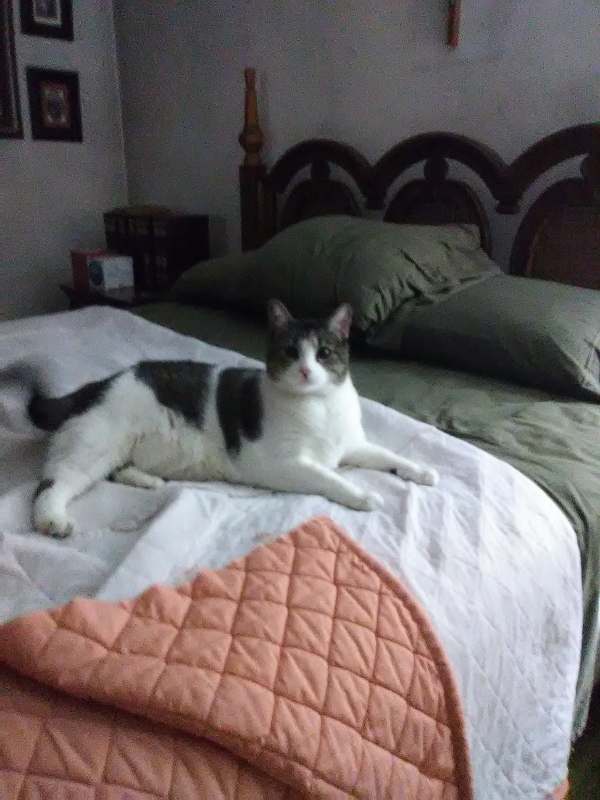
Leo – in typical feline fashion – trying to remain calm, while adapting to his new surroundings.

A couple of months ago I made a major decision.  I decided to move my Uncle Wes* and his cat, Leo, in with me.  Wes is my mother’s younger brother.  He served in the U.S. Army in the 1960s and has been married only once; no children.  A proverbial wild man, he’s led a rough life and is now paying the price for it.  Bringing him here was no lightweight decision for me.  No one else has lived here with me since my mother died in June of 2020.  And Leo has the unique distinction of being the very first feline to step foot into this house.  Outside of the occasional stray cat venturing into the back yard, no cat has ever been in here.  Twenty years ago I underwent a formal allergy test and learned – as I’d long suspected – that I’m allergic to ragweed, mountain cedar and cat dander – among other things.  Other things include stupid people, but that’s a different essay.

Despite not being a people person, I guess it’s my nature to want to help people who sometimes can’t fend for or take care of themselves.  As cynical as I’ve become in my seven decades on Earth, a smattering of humanity still lurks deep within my soul.  Besides, I prefer to care for those closest to me.  I couldn’t stand the thought of Wes spending his remaining years in a state of uncertainty.  Like anyone who’s lived into adulthood, he’s made his share of mistakes.

Wes had been living in a dumpy, one-bedroom, one-bath apartment with no washer and dryer in a neighboring Dallas suburb.  Fortunately the laundry facility stood next door, but in an increasingly cashless society, he was frequently searching for quarters.  He had three cats at one point, but Leo is the only surviving one left.  On at least two occasions in the past year he fell in his apartment and couldn’t get back up.

Shortly after my mother died in June of 2020, a close friend told me my parents probably forgave me for never getting married and having children of my own; considering how I cared for them in their final years.  Perhaps because I’ve often wondered how – being an only child – I would have handled their health problems if I’d had a spouse and kids.  My paternal grandmother was fortunate; with seven adult children in her senior years, someone could always look out for her.

Thus, I have to think of what might happen to me if I get to be that age.  My grandmother was 97 when she died, and both my parents lived into their 80s.  Wes just turned 84.

I’m lucky if I hear from one of my first cousins and I only know a few of my neighbors.  I’ve heard plenty of horror stories of elderly and/or disabled people dyeing alone in their homes and lay undiscovered for weeks or even months.

In early 1991 I recall reading one chilling report from a town in Massachusetts – police had discovered the remains of an elderly woman in her home.  The most shocking fact of the case to me was that officials believe she died in July of 1989 because that’s when her banking transactions ceased.  Another startling attribute was that she had two adult children.  Her son admitted, however, that they’d been estranged from their mother for years.  Neighbors also emphasized what a recluse the woman was.  But, I asked myself, how could someone lie dead in their home for nearly two years before being found?

I’m a recluse; always have been and always will be an introvert.  I used to loathe that, but now I cherish it.  It’s just who I am.  The aforementioned friend had also noted years earlier that he feared I was becoming a recluse because I rarely left the house.  My mother was still alive at the time, and I feared leaving her alone because her mind was already sinking into dementia.

Whatever happens in the future, I’m glad I could get Wes to move in here.  We get along great, and it’s actually nice having someone else in the house.  It’s also nice having an animal in the house.  I just have to keep Leo off my bed!

*Name changed

6 Comments

Filed under Essays